Trump Confronts His Political Reality
TL;DR
Donald Trump is entering the lame-duck phase of his presidency as his political influence wanes. Despite his past resilience, recent Republican defiance and policy failures signal his diminishing control over the GOP.
Key Takeaways
- •Trump's political power is declining as he faces Republican resistance, such as the Indiana Senate rejecting his redistricting plan.
- •His inability to control allies like Marjorie Taylor Greene and manage crises like the Epstein files shows cracks in his authority.
- •Low popularity and dysfunctional Congress reduce incentives for Republicans to align with Trump, risking election losses.
- •Trump's public behavior has turned darker, with offensive remarks and erratic posts, reflecting his frustration.
- •The article suggests Trump's career is finite, despite his history of comebacks, as lame-duck symptoms accumulate.
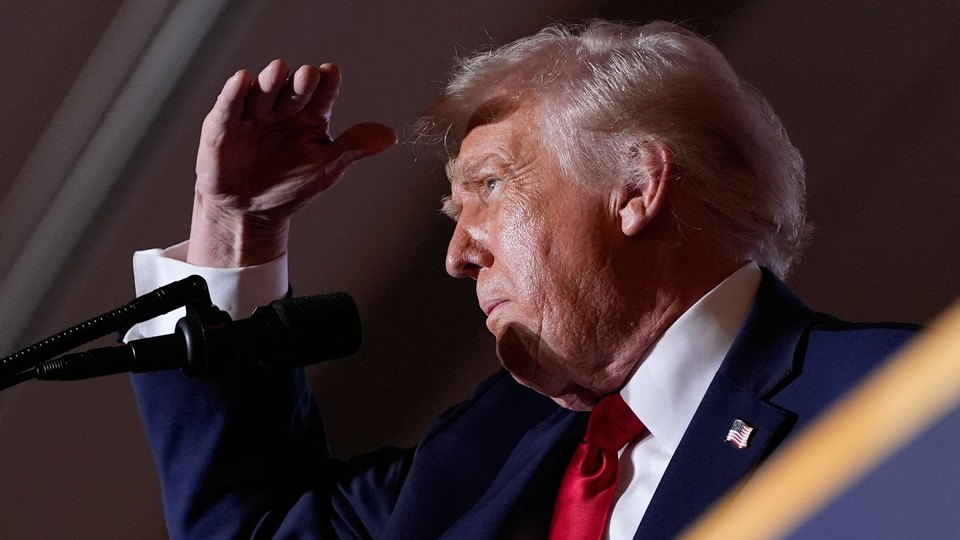
A force is pulling on Donald Trump that is even more inexorable than the march of time: political mortality.
Sometimes scandal or ineffectiveness is what fells a politician; if they survive those, term limits may get them anyway. But not even the most fearsome and durable leader escapes the eventual decay of their power. The towering Lyndon B. Johnson was forced to drop out of the 1968 presidential race, facing a tough Democratic primary; Margaret Thatcher’s powerful reign ended with a Conservative mutiny; Mitch McConnell, once the wily master of the Senate, now finds himself an ostracized backbencher.
Trump may have imagined he was immune. If so, he wasn’t alone. The rules of political gravity, journalists have often declared, sometimes seem not to apply to him. He defied the Republican Party establishment to win the 2016 nomination. He beat the odds to defeat Hillary Clinton that fall. And although he was written off as finished following the 2020 election and his attempt to steal it, Trump completed the greatest comeback in American political history in 2024, easily eclipsing Richard Nixon’s 1968 election.
One of the secrets to Trump’s success has been his control over other Republican figures, because of either their political and personal affinity or, failing that, the ability to bully them into submission with rhetorical attacks or threats of primary challenges. But as the end of Trump’s political career approaches, his grip over the GOP is showing some cracks.
This afternoon, the Republican-dominated Indiana Senate rejected a plan to redraw the state’s U.S. House districts to benefit the GOP, despite a weeks-long pressure campaign from the president and top allies including Vice President J. D. Vance and Speaker Mike Johnson. After an initial failure, Trump demanded a second attempt, but this one wasn’t even close: Senators voted it down 19–31.
This is the latest in a string of stumbles. The first was Trump’s inability to quash an effort to force the disclosure of files related to the late pedophile Jeffrey Epstein. Trump was unable to persuade even his protégées Lauren Boebert and Marjorie Taylor Greene not to sign a House discharge petition, and he eventually had to jump on the bandwagon himself. The experience permanently broke his relationship with Greene, who announced she would leave the House in January and has given a series of interviews criticizing the president. (The stories she’s told of death threats and harassment from Trump fans show one reason members are retiring at record rates.) On the other side of the Capitol, Trump’s demands that Republican senators kill the filibuster in order to end the government shutdown were met with a cold shoulder.
Now Trump is grappling with brewing unhappiness about his likely illegal military mission in the Caribbean Sea. Even Republicans have been troubled by reports that the U.S. killed survivors of one boat strike as they clung to wreckage, in what appears to be a textbook example of a war crime. (The administration says military leaders acted legally.) In response, Congress is withholding some of Secretary of Defense Pete Hegseth’s travel budget to demand he provide relevant videos. This arguably falls short of what the situation calls for—many experts have noted that Trump has no valid legal justification for any of the strikes—but it’s notable because of how hesitant Republicans have been to challenge the administration.
Members of one’s own party starting to draw away is a classic symptom of being a lame duck. Sometimes a president can stave lame-duck status off until after the midterm elections of his second term, but Trump has some particular weaknesses here. First, more than any time in recent history, Congress is dysfunctional—thanks in part to a slim majority and Trump’s efforts to bypass it—and incapable of approving any major legislation except must-pass bills, and even those are touch-and-go. Since the One Big Beautiful Bill Act passed this summer, lawmakers know that few other initiatives will move. That gives them less incentive to avoid breaking ranks.
That’s especially true because Trump’s popularity is historically low and falling. Members know that Trump can wreck them in a primary, but they may not be convinced that he can save them in a general election—in fact, he may be dragging them toward big losses next November. One ominous sign is that Democrats keep performing well in elections this year. On Tuesday, a Democrat flipped a Georgia state-House district that Trump won by 12 points; another captured the mayorship of Miami for the first time since 1997. This is likely to get worse if Trump continues to angrily dismiss voter concerns about inflation.
Some Trump allies have offered a solution to the lame-duck problem: Simply run for a third term, Constitution be damned. But Trump himself has said, with evident regret, that he does not believe that is possible. (He could still change his mind.) As the indications of political obsolescence accrue, Trump’s public mood has taken a dark turn. During a Cabinet meeting last week, which he appeared to doze through parts of, he called Somali immigrants “garbage.” He reprised that during a speech—ostensibly on affordability—Tuesday, in which he also confirmed that he called several places “shithole countries” in 2018, a statement he had long denied making. Later that night, Trump uncorked a furious, meandering post of nearly 500 words on Truth Social, in which he called for The New York Times to be shut down and said he’d been asked to take three cognitive tests this year, which may not be the positive sign he seems to believe it is.
Trump remains an exceptionally powerful president—in part because he has seized power for the White House and sidelined Congress. Previous lame-duck presidents have taken some consolation from the freedom to act as they want, knowing they never have to face voters again, and Trump has already begun pursuing policies that he can see are not popular. Still, for a man whose life has been a story of improbable resurrections, the dawning realization that his political career is finite must be bitter.
Related:
When Did the Job Market Get So Rude?
By Franklin Schneider
Recently, I’m ashamed to admit, I received an email that initially made me feel warm, human, even grateful: a rejection for a job I’d applied to. But my thankful feelings quickly curdled into self-loathing—the nausea one gets when looking back over pathetic, paragraphs-long texts to an ex, whose monosyllabic responses suggested they’d clearly moved on. The rejection was a form letter, not even a late-round, personalized “we gave you serious consideration but ultimately decided to hire a VP’s nephew” message. I was so accustomed to being treated with indifference, I realized, that the barest acknowledgment of my existence felt like a win.
Read the full article.More From The Atlantic
Read. Tamar Adler’s food writing doubles as a philosophy of kitchen scraps, Lily Meyer writes.
Explore. Rage bait is a brilliant word of the year, Amogh Dimri argues.
Play our daily crossword.
Rafaela Jinich contributed to this newsletter.
When you buy a book using a link in this newsletter, we receive a commission. Thank you for supporting The Atlantic.