Harness engineering: leveraging Codex in an agent-first world
TL;DR
A team built a software product with zero manually-written code using Codex agents, achieving 10x faster development. They focused on designing environments and feedback loops for agents, redefining engineering roles to maximize human time and attention.
Key Takeaways
- •Engineering teams can shift from writing code to designing systems and prompts that enable AI agents like Codex to generate all code, increasing velocity by orders of magnitude.
- •Agent effectiveness depends on creating legible environments where agents can access and reason about application UI, logs, metrics, and repository knowledge directly.
- •Structured, versioned documentation in the repository serves as the system of record, with progressive disclosure to avoid overwhelming agents with context.
- •Human engineers focus on breaking down tasks, specifying intent, and building feedback loops, while agents handle execution, review, and iteration autonomously.
- •Throughput and quality improve as agents gain capabilities to reproduce bugs, validate fixes, and manage complex tasks over extended periods without human intervention.
Tags
Over the past five months, our team has been running an experiment: building and shipping an internal beta of a software product with 0 lines of manually-written code.
The product has internal daily users and external alpha testers. It ships, deploys, breaks, and gets fixed. What’s different is that every line of code—application logic, tests, CI configuration, documentation, observability, and internal tooling—has been written by Codex. We estimate that we built this in about 1/10th the time it would have taken to write the code by hand.
Humans steer. Agents execute.
We intentionally chose this constraint so we would build what was necessary to increase engineering velocity by orders of magnitude. We had weeks to ship what ended up being a million lines of code. To do that, we needed to understand what changes when a software engineering team’s primary job is no longer to write code, but to design environments, specify intent, and build feedback loops that allow Codex agents to do reliable work.
This post is about what we learned by building a brand new product with a team of agents—what broke, what compounded, and how to maximize our one truly scarce resource: human time and attention.
We started with an empty git repository
The first commit to an empty repository landed in late August 2025.
The initial scaffold—repository structure, CI configuration, formatting rules, package manager setup, and application framework—was generated by Codex CLI using GPT‑5, guided by a small set of existing templates. Even the initial AGENTS.md file that directs agents how to work in the repository was itself written by Codex.
There was no pre-existing human-written code to anchor the system. From the beginning, the repository was shaped by the agent.
Five months later, the repository contains on the order of a million lines of code across application logic, infrastructure, tooling, documentation, and internal developer utilities. Over that period, roughly 1,500 pull requests have been opened and merged with a small team of just three engineers driving Codex. This translates to an average throughput of 3.5 PRs per engineer per day, and surprisingly the throughput has increased as the team has grown to now seven engineers. Importantly, this wasn’t output for output’s sake: the product has been used by hundreds of users internally, including daily internal power users.
Throughout the development process, humans never directly contributed any code. This became a core philosophy for the team: no manually-written code.
Redefining the role of the engineer
The lack of hands-on human coding introduced a different kind of engineering work, focused on systems, scaffolding, and leverage.
Early progress was slower than we expected, not because Codex was incapable, but because the environment was underspecified. The agent lacked the tools, abstractions, and internal structure required to make progress toward high-level goals. The primary job of our engineering team became enabling the agents to do useful work.
In practice, this meant working depth-first: breaking down larger goals into smaller building blocks (design, code, review, test, etc), prompting the agent to construct those blocks, and using them to unlock more complex tasks. When something failed, the fix was almost never “try harder.” Because the only way to make progress was to get Codex to do the work, human engineers always stepped into the task and asked: “what capability is missing, and how do we make it both legible and enforceable for the agent?”
Humans interact with the system almost entirely through prompts: an engineer describes a task, runs the agent, and allows it to open a pull request. To drive a PR to completion, we instruct Codex to review its own changes locally, request additional specific agent reviews both locally and in the cloud, respond to any human or agent given feedback, and iterate in a loop until all agent reviewers are satisfied (effectively this is a Ralph Wiggum Loop(opens in a new window)). Codex uses our standard development tools directly (gh, local scripts, and repository-embedded skills) to gather context without humans copying and pasting into the CLI.
Humans may review pull requests, but aren’t required to. Over time, we’ve pushed almost all review effort towards being handled agent-to-agent.
Increasing application legibility
As code throughput increased, our bottleneck became human QA capacity. Because the fixed constraint has been human time and attention, we’ve worked to add more capabilities to the agent by making things like the application UI, logs, and app metrics themselves directly legible to Codex.
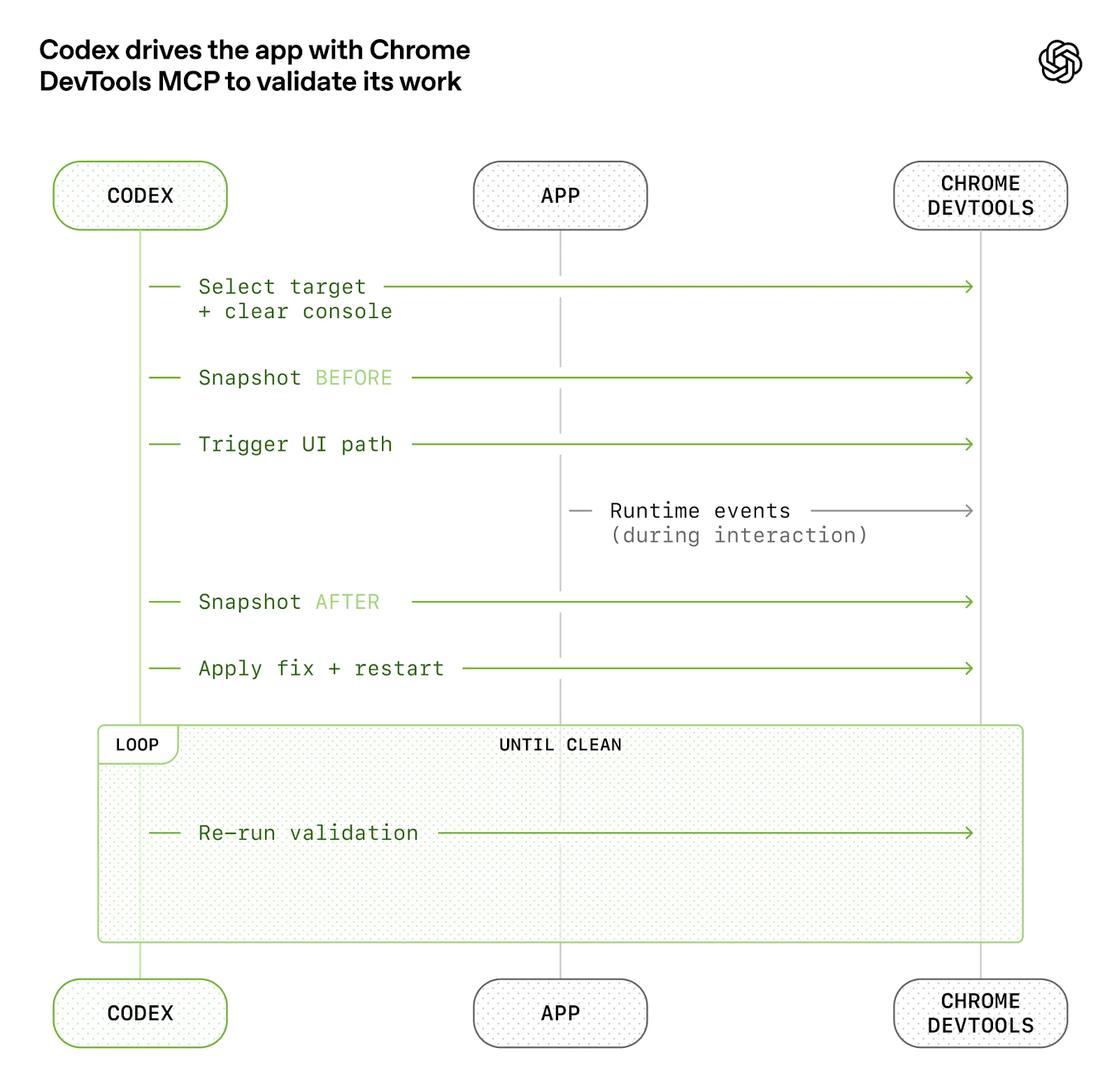
For example, we made the app bootable per git worktree, so Codex could launch and drive one instance per change. We also wired the Chrome DevTools Protocol into the agent runtime and created skills for working with DOM snapshots, screenshots, and navigation. This enabled Codex to reproduce bugs, validate fixes, and reason about UI behavior directly.
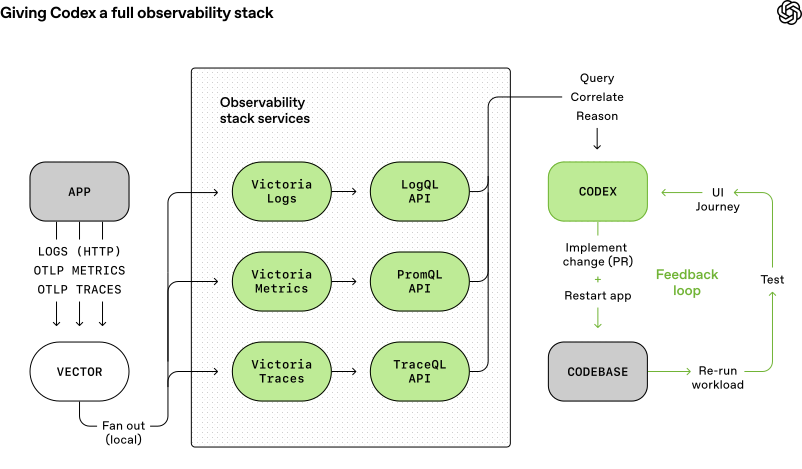
We did the same for observability tooling. Logs, metrics, and traces are exposed to Codex via a local observability stack that’s ephemeral for any given worktree. Codex works on a fully isolated version of that app—including its logs and metrics, which get torn down once that task is complete. Agents can query logs with LogQL and metrics with PromQL. With this context available, prompts like “ensure service startup completes in under 800ms” or “no span in these four critical user journeys exceeds two seconds” become tractable.
We regularly see single Codex runs work on a single task for upwards of six hours (often while the humans are sleeping).
We made repository knowledge the system of record
Context management is one of the biggest challenges in making agents effective at large and complex tasks. One of the earliest lessons we learned was simple: give Codex a map, not a 1,000-page instruction manual.
We tried the “one big AGENTS.md(opens in a new window)” approach. It failed in predictable ways:
- Context is a scarce resource. A giant instruction file crowds out the task, the code, and the relevant docs—so the agent either misses key constraints or starts optimizing for the wrong ones.
- Too much guidance becomes non-guidance. When everything is “important,” nothing is. Agents end up pattern-matching locally instead of navigating intentionally.
- It rots instantly. A monolithic manual turns into a graveyard of stale rules. Agents can’t tell what’s still true, humans stop maintaining it, and the file quietly becomes an attractive nuisance.
- It’s hard to verify. A single blob doesn’t lend itself to mechanical checks (coverage, freshness, ownership, cross-links), so drift is inevitable.
So instead of treating AGENTS.md as the encyclopedia, we treat it as the table of contents.
The repository’s knowledge base lives in a structured docs/ directory treated as the system of record. A short AGENTS.md (roughly 100 lines) is injected into context and serves primarily as a map, with pointers to deeper sources of truth elsewhere.
Plain Text
1AGENTS.md2ARCHITECTURE.md3docs/4├── design-docs/5│ ├── index.md6│ ├── core-beliefs.md7│ └── ...8├── exec-plans/9│ ├── active/10│ ├── completed/11│ └── tech-debt-tracker.md12├── generated/13│ └── db-schema.md14├── product-specs/15│ ├── index.md16│ ├── new-user-onboarding.md17│ └── ...18├── references/19│ ├── design-system-reference-llms.txt20│ ├── nixpacks-llms.txt21│ ├── uv-llms.txt22│ └── ...23├── DESIGN.md24├── FRONTEND.md25├── PLANS.md26├── PRODUCT_SENSE.md27├── QUALITY_SCORE.md28├── RELIABILITY.md29└── SECURITY.md
In-repository knowledge store layout.
Design documentation is catalogued and indexed, including verification status and a set of core beliefs that define agent-first operating principles. Architecture documentation(opens in a new window) provides a top-level map of domains and package layering. A quality document grades each product domain and architectural layer, tracking gaps over time.
Plans are treated as first-class artifacts. Ephemeral lightweight plans are used for small changes, while complex work is captured in execution plans(opens in a new window) with progress and decision logs that are checked into the repository. Active plans, completed plans, and known technical debt are all versioned and co-located, allowing agents to operate without relying on external context.
This enables progressive disclosure: agents start with a small, stable entry point and are taught where to look next, rather than being overwhelmed up front.
We enforce this mechanically. Dedicated linters and CI jobs validate that the knowledge base is up to date, cross-linked, and structured correctly. A recurring “doc-gardening” agent scans for stale or obsolete documentation that does not reflect the real code behavior and opens fix-up pull requests.
Agent legibility is the goal
As the codebase evolved, Codex’s framework for design decisions needed to evolve, too.
Because the repository is entirely agent-generated, it’s optimized first for Codex’s legibility. In the same way teams aim to improve navigability of their code for new engineering hires, our human engineers’ goal was making it possible for an agent to reason about the full business domain directly from the repository itself.
From the agent’s point of view, anything it can’t access in-context while running effectively doesn’t exist. Knowledge that lives in Google Docs, chat threads, or people’s heads are not accessible to the system. Repository-local, versioned artifacts (e.g., code, markdown, schemas, executable plans) are all it can see.