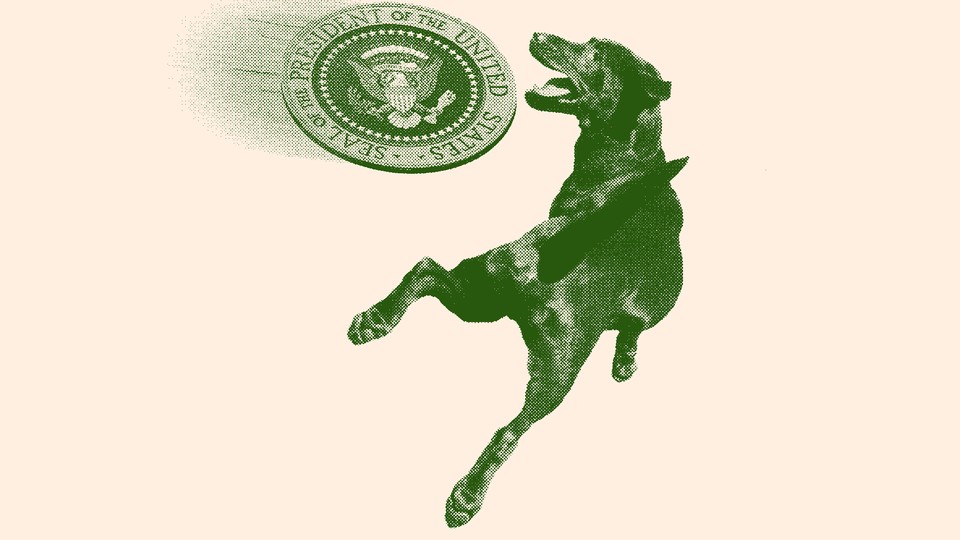
Presidential dogs have a long history of misbehavior in the White House, from biting incidents to political scandals, highlighting the tension between their unpredictable nature and their role in humanizing leaders.
Key Takeaways
•Presidential dogs, such as Joe Biden's German shepherds and historical pets like FDR's Major, have frequently caused incidents like biting and property damage.
•Dogs are often used as political tools to humanize presidents, with examples like Nixon's Checkers speech and Hoover's campaign photos.
•The stressful environment of the White House may contribute to dogs' misbehavior, raising ethical concerns about keeping pets for political gain.
•Despite their antics, dogs can teach loyalty and compassion, potentially offering a beneficial contrast to the controlled life of power.
Misbehaving dogs in the White House have plagued administration after administration. Illustration by Matteo Giuseppe Pani / The AtlanticThis is an edition of Time-Travel Thursdays, a journey through The Atlantic’s archives to contextualize the present. Sign up here.
Since the dawn of the Republic, one recurring scandal has plagued administration after administration: presidential dogs acting badly. Little historical record exists on how the first pets in the White House behaved, but one of their names provides some hints—John Adams’s family called their dog Satan.
Future animals did not behave much better. Franklin D. Roosevelt’s German shepherd, Major, allegedly bit the United Kingdom’s prime minister and tore his pants. (Major Roosevelt was sent away from the White House grounds shortly thereafter.) Theodore Roosevelt’s bull terrier, Pete, chased a French ambassador up a tree. (Pete was also removed from the White House.) And Calvin Coolidge’s fox terrier, Peter Pan, ripped the skirt off of a woman, and was eventually given away to Coolidge’s secretary.
More recently, Joe Biden’s German shepherds, Major and Commander, come to mind as the quintessential presidential pets that ran amok. Major, the first rescue dog to live at 1600 Pennsylvania Avenue, was sent away less than a year into Biden’s term after a biting incident, only to return and promptly bite someone else. Commander was sent away in 2023 for similar behavior—it was later revealed that he had attempted to chomp down on Secret Service members some two dozen times.
As my colleague Elaine Godfrey wrote after Commander’s banishment: “Dogs act like dogs, and sometimes like real jerks, even when they live in the White House.” That may be the real issue with presidential pets. “It is against his nature to be so repressed,” Henry Childs Merwin wrote in an article about dogs in The Atlantic in 1910. My 6-year-old cattle-dog mix can get whipped into a frenzy over the sight of a man wearing a hat; I can only imagine how she would act if left to live in a sprawling new house full of strangers (not to mention the helicopters that regularly land on the lawn).
Nevertheless, presidential dogs’ propensity for misbehaving prompted me to wonder why our leaders even have them at all. Conventional wisdom dictates that parading around a pup is a political ploy meant to humanize politicians. Donald Trump objected to a pet for that reason (he is the first president in recent history not to keep one). During his 2019 campaign, he told an audience that walking a dog on the White House lawn might look good, but “feels a little phony to me.”
Dogs have certainly played important roles in several presidential campaigns. In 1928, Herber Hoover’s team printed and distributed thousands of photos of the candidate and his Belgian shepherd, King Tut. (Tut was eventually sent away from the White House after becoming anxious and aggressive toward strangers.) Franklin D. Roosevelt, amid a faltering campaign for a fourth term, successfully turned a scandal involving his dog, Fala, into a rousing monologue that was broadcast nationally and helped reinvigorate his standing. (Republicans had accused him of spending millions of taxpayer dollars to get Fala back to the United States after he was left behind in the Aleutian Islands, which Roosevelt denied. “I don’t resent attacks, and my family don’t resent attacks, but Fala does,” he said in the speech.)
And perhaps most famously, then-Senator Richard Nixon defused a brewing scandal that he had maintained a secret campaign fund for his own personal gain by introducing Checkers, his family’s new dog, on national TV in 1952. After defending himself against the corruption accusations, he conceded that his family “did get something, a gift, after the election”: a little cocker spaniel. As Lee Huebner wrote in The Atlantic on the 60th anniversary of the “Checkers Speech,” the address “salvaged Nixon’s career, plucking a last-second success from the jaws of abject humiliation.”
As a dog lover myself, I find it hard to stomach that these animals are kept in stressful environments sometimes to win political points. It is difficult not to care about a dog, even if that dog rips the pants of a prime minister. And perhaps that is the point. As Merwin put it in 1910: Dogs “soften the hard hearts of men.” They teach their owners loyalty, compassion, and unconditional love, not in spite of their unpredictable nature but because of it. Living in the White House is usually made easy by all of the staff who work to deliver on any presidential whim—maybe a little mayhem is good for the people in power.