Trump should focus on weakening Iran's regime rather than changing it, by targeting its military capabilities and leadership to create internal pressure. This approach aims to undermine the regime's control and encourage internal opposition without direct regime change.
Key Takeaways
•The U.S. should prioritize weakening Iran's regime over regime change by targeting its military infrastructure and leadership.
•Effective strategies include disrupting Iran's command structures and creating uncertainty among its security forces to inspire defections.
•Supporting Iranian opposition requires careful consideration to avoid triggering national backlash and must include protection for protestors.
•Long-term weakening could lead to internal reforms or collapse, as seen in past conflicts where the elite questioned their strategies.
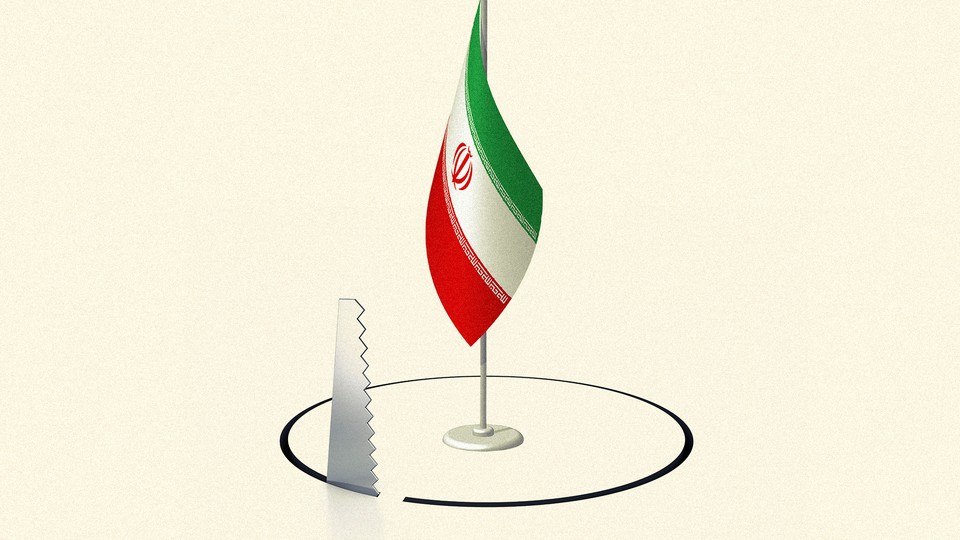
Instead of regime change, try regime weakening. Illustration by The AtlanticPresident Trump prides himself on being a rule breaker, but he is discovering a rule he can’t break: Good statecraft demands clear objectives. Trump has billed the war with Iran as a one-time opportunity for Iranians to take back their country. This implies regime change, yet the administration’s ambitions have in fact been vague and inconsistent. By offering a grab bag of justifications and intentions, the United States has been squandering an opportunity to declare a goal that is both necessary and achievable: Instead of changing Iran’s regime, the U.S. should fatally weaken it.
Tehran is counting on the cost of this war exceeding Trump’s willingness to fight it. If Iran’s regime survives, it will be even more determined to rebuild and wreak vengeance, at least in the short term. Some argue that the only way to stop Iran from menacing the region and its people is to crush this regime. But the regime’s tenacity cannot be underestimated. There are no limits to what Iran’s leaders will do to survive, as demonstrated by their massacre of up to 36,500 Iranian protesters in the streets in January.
Toppling the regime also demands breaking up the forces that suppress Iranians, including the Islamic Revolutionary Guard Corps and the notorious Basij militia. The Pentagon’s air campaign aims to weaken these groups by striking their headquarters, command posts, armories, and communication nodes, but it’s unclear whether this will be enough to undermine the forces that prop up the regime. Unless U.S. and Israeli air attacks can isolate and disorient these forces by cutting them off from their command and control, this air campaign will not be sufficient.
If the goal instead is regime weakening—enfeebling the Islamic Republic so the Iranian public could overwhelm it—there are two ways forward. One involves continuing to attack Iran’s weapons stockpiles and production facilities to render the Islamic Republic incapable of threatening its neighbors for a long time to come. Yes, that could take a while, but the U.S. and Israeli intelligence communities have the insight necessary for effective surgical strikes.
The other approach involves going after Iran’s leadership. Iran’s military and political operatives should feel that they must always be on the move if they hope to stay safe. Ali Larijani, a senior official who recently posted a threat to Trump’s life—“Be careful not to get eliminated yourself”—should not feel safe making speeches or holding meetings. Abbas Araghchi, Iran’s foreign minister, should not feel comfortable doing interviews.
The U.S. and Israel must do whatever they can to disrupt and scramble communication between Iran’s leadership and its security forces. Creating uncertainty in Iran’s military should help demoralize officers and inspire defections. Enough soldiers abandoning the cause may convince high-ranking mullahs and generals that Iran will devolve into chaos unless they make changes to how the country approaches its people and neighbors. This may sound unlikely, but after Iran’s 12-day war with Israel last June, members of the Iranian elite openly wondered whether investing in nuclear infrastructure and regional proxies continued to make sense. A long-standing fear of the late Ali Khamenei was that Iran would one day have its own Gorbachev—someone in power who believed that the only way to save the Islamic Republic was to carry out fundamental reform.
If the U.S. is hoping for a popular uprising against a weakened regime, the Trump administration has a moral obligation to better support the people whom the president is urging to rise up. Arming a few thousand members of Iran’s Kurdish minority, as some have floated, will not suffice. The Iranian people have both clear ethnic differences and a clear national identity. Arming Iranian Kurds in isolation could trigger a national backlash without protecting the broader Iranian public.
Defense Secretary Pete Hegseth and the president have yet to rule out deploying U.S. ground troops to secure and destroy nuclear assets and possibly to arm and protect opponents of the regime, but this seems an unlikely option. For Trump, who excoriates his predecessors for pursuing nation building in “forever wars,” U.S. ground operations are likely to recall America’s tragic invasions of Iraq and Afghanistan, both of which now serve as cautionary tales.
More pressing, if the U.S. and Israel hope to see a weakened regime fall to an Iranian opposition, Trump and Israeli Prime Minister Benjamin Netanyahu need to empower worthy Iranian rivals to Iran’s new supreme leader, Mojtaba Khamenei. Finding indigenous Iranians who can lead this charge will not be easy, given the regime’s decades of hollowing out the opposition by killing or arresting dissidents with leadership skills.
For Iranians who took to the streets in January, spurred by Trump’s ultimately empty promise that “help is on the way,” America’s bombing campaign now may not be the invitation for a “people’s coup” that the president seems to think it is. Even the Iranian Kurds do not seem to be showing any great readiness to launch an insurgency. Perhaps Iranians who feel moved to organize an uprising are waiting to see how the U.S. will support and protect them, particularly as Iranian security forces are still patrolling the streets. Can the U.S. strike those forces without killing civilians? The Israeli military has had some recent success using drones for strategic strikes against regime security forces, but the U.S. has yet to hit roaming members of the Basij and IRGC, either because it’s too hard or deemed too unimportant relative to striking the regime’s weapon arsenals and factories. But if the Trump administration hopes for Iranians to challenge this regime, the U.S. will need to show it is ready to do more to protect those who do.
These efforts may not spell the end of Iran’s odious, oppressive regime. But destroying much of Iran’s ability to project power and attacking the security forces that suppress the Iranian public will surely hasten the regime’s collapse. When the regime’s foot soldiers suffer the same relentless strikes, water and electricity shortages, and plummeting currency as the rest of the country, they may be less inclined to spill blood and risk their own lives to prop up a republic riven with cracks.