The Trump administration uses social media spectacle as governance, treating military actions like the Venezuela raid as content for online reactions. This creates a recursive loop where news and memes merge, prioritizing performance over policy in a postliterate political era.
Key Takeaways
•The Trump administration prioritizes online spectacle and content creation over traditional governance, using social media to troll enemies and engage supporters.
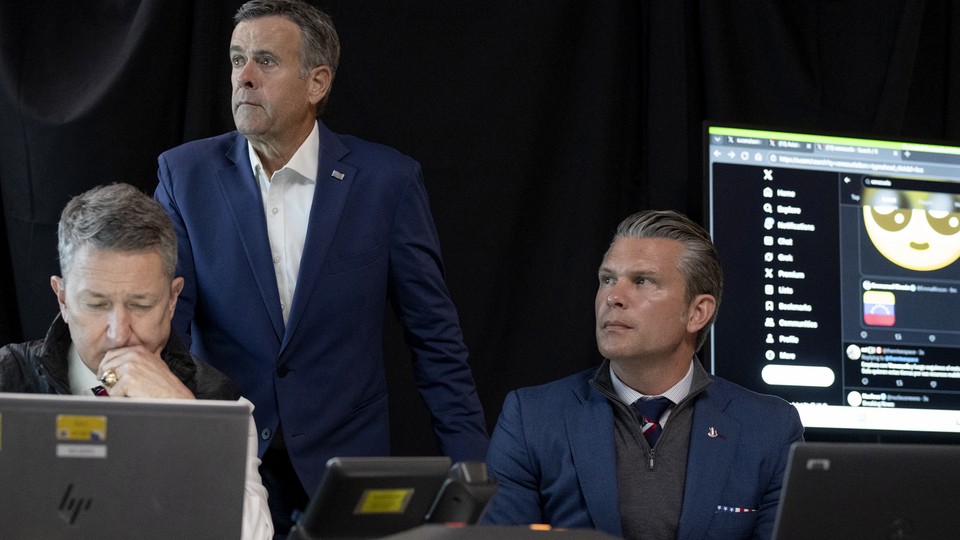
•Events like the Venezuela raid are treated as entertainment, with officials monitoring reactions on platforms like X and producing memes alongside military actions.
•Social media algorithms fuel a culture where news and reactions merge instantly, creating recursive loops of memes and commentary that dehumanize conflicts.
•This approach reflects a postliterate political era where performative speech substitutes for policy, using government resources to generate viral content.
Why the Trump administration is posting messages like “THIS IS OUR HEMISPHERE” after the attack on Venezuela Molly Riley / The White House / Getty This weekend’s attack on Venezuela produced plenty of indelible images. The one burned into my brain was shared by President Donald Trump on Truth Social. Defense Secretary Pete Hegseth is sitting in front of a laptop at a makeshift command center in Mar-a-Lago. He’s monitoring the raid with a grave expression on his face, eyes intently focused on something out of frame.
At first glance, the image has all the trappings of a Serious Tactical Raid Photo, à la Pete Souza’s famous Situation Room snapshot, which showed President Barack Obama and his national-security team tracking the raid on Osama bin Laden’s compound. But then you see what’s behind Hegseth: a large screen displaying an X feed. The photo is blurry, but it seems to show Hegseth and company using X’s search function to monitor tweets about the raid. On the screen, hovering over Hegseth’s left shoulder, is a giant face-holding-back-tears emoji (🥹).
The photo quickly spread around the internet on Saturday—mostly as a way to mock just how terminally online the Trump administration appears to be. “They monitor the situation just like how we do,” one person who works in crypto wrote on X. On Bluesky, I watched others make fun of Hegseth, Trump, and Secretary of State Marco Rubio as part of a “podcaster-occupied government.”
It is no secret that the Trump administration is social media–addled. Over the past year, most of the government’s major online accounts—especially on X—have become megaphones for cruel and racist shitposting, not unlike what one might see from a garden-variety troll on 4chan. These accounts have shared deportation ASMR; an AI-generated, Studio Ghiblified version of a real photo of a crying woman being arrested by ICE; a post comparing immigrants to the alien vermin in the Halo video-game series; and Nazi-coded “Defend the fatherland” memes. And who could forget the AI-slop video of Trump in a fighter jet dropping what appeared to be human feces on protesters in Times Square. These official government communications are a key part of how the Trump administration does its job. It is governance through content creation.
This is why the Trump administration is staffed with former reality-show stars, cable-news hosts, and popular podcasters. It is why the government allows friendly camera crews to accompany ICE raids, why former Congressman Matt Gaetz is given a Pentagon press credential along with Laura Loomer, and why Vice President J. D. Vance spends his days trolling people on X. It’s why Kristi Noem staged a photo op in front of a cage full of men at El Salvador’s Terrorism Confinement Center, and why the administration has allowed YouTubers to make videos there. It’s why an assistant attorney general at the U.S. Department of Justice is on X, grousing about her follower count stalling at a paltry 1.3 million and asking, “What kind of content do my folks want to see more of to like and share?” And it’s the reason that Katie Miller—who left the Trump administration to work for Elon Musk and then left Musk to start a podcast—posted a photo on X on Saturday showing a map of Greenland colored as an American flag with the caption “SOON.” The U.S. government is concerned first and foremost with spectacle, engaging in both fan service for its most extreme supporters and the constant trolling of its enemies. The goal, above all else, is to elicit a response.
The Hegseth photo from Saturday and others like it confirm this dynamic. Why would the men in charge of the most powerful military and intelligence services in the world be monitoring a popular X account called “OSINTdefender” if they weren’t performing for an online audience? (The White House did not respond to a request for comment on the matter.) Perhaps one could defend their scrolling as potentially useful data gathering on the grounds that, during the bin Laden raid, early tweets from local citizens began to break the news well before the mainstream media caught on. But such posts are low-level intelligence, a kind that is arguably far too trivial for a Cabinet secretary or president to pay attention to. The simplest explanation is that everyone in that room at Mar-a-Lago wanted to observe the spectacle created by their actions.
“I watched it literally like I was watching a television show,” Trump said in a phone interview Saturday with Fox News. “It was an amazing thing.” His description suggests military invasion as personal entertainment—a reality show with stark geopolitical consequences that the president can produce and direct via his whims.
Trump is obsessed with ratings, and social media provides ample opportunities to watch numbers go up at the same time as other politicians, media members, and onlookers respond. And so you get not only an invasion and a press conference but a slew of posts. In the first day after Nicolás Maduro was seized, Trump or official government accounts had shared:
High-resolution war-room photos
Footage of the invasion set—without any shred of irony—to the Vietnam protest song “Fortunate Son”
A meme stating, in bold red and white lettering, “Don’t Play Games With President Trump”
An angry photo of the president beneath block lettering of the acronym “FAFO”
A video mash-up of Trump, Rubio, and Maduro set to Biggie Smalls’s “Hypnotize”
The more I watched the fallout from the invasion play out online, the more futile any effort to make sense of it felt. I felt like I was trapped in a recursive loop of a very specific style of internet content: the reaction video.
Reaction videos began on YouTube in the mid-2000s, and they are now a hallmark of online content. As the name suggests, they show people responding to other media. In the early days, these were typically gross-out videos like the infamous “2 Girls, 1 Cup,” and as The New York Times’ Sam Anderson wrote back in 2011, their appeal was allowing “people to watch this taboo thing by proxy, to experience its dangerous thrill without having to encounter it directly.”
Over time, reaction videos became far more interesting and varied—a way to experience something vicariously for the first time or to share the joy of something you love with others. As Anderson noted, the videos are best at capturing surprise: “that moment when the world breaks, when it violates or exceeds its basic duties and forces someone to undergo some kind of dramatic shift.”
Today, the world feels like it’s breaking in any number of ways—so perhaps it makes sense that the logic and structure of the reaction video pervades media, culture, and politics. Some of this feeling has to do with the structure of social media, where timelines are no longer sorted chronologically but algorithmically, feeding users a steady stream of content that’s likely to elicit a strong reaction. The algorithmic internet has always been chaotic, but as the platforms have matured and evolved, the culture they produce and behaviors they provoke have become insular and inscrutable—at least to people who don’t spend huge chunks of time online. Especially on X, algorithmic culture is characterized by ceaseless iteration: Everything that’s happening is piled atop all the things that just happened.
When any given event occurs—a raid in Venezuela, say—the trolls, pundits, know-it-alls, and shitposters flood in immediately. Discourse is a gameable phenomenon now; people know how to play their roles by heart. These days, one doesn’t experience the news on these platforms before seeing the memes and reactions—the reaction and the news are, in essence, one thing now.
By the time I saw the news of the raid, a photo Trump had posted showing a blindfolded Maduro in a Nike sweatsuit had already become a meme. Just a few minutes later, that meme had mixed with a dozen others. In a few hours, I stumbled upon a split-screen generative-AI slop video of Maduro DJing in the sweatsuit in one frame while, in the other, Trump’s face was superimposed onto a clip of Jon Hamm blissed out and dancing in a club. An image of Maduro in handcuffs wearing a blue sweatshirt and giving a thumbs-up was followed immediately by a marketing meme posted by that sweatshirt’s manufacturer; scroll more and there’s the same photo, now with Maduro’s face replaced by Charlie Kirk’s.
The result is essentially insane and postliterate. But it is also pretty much legible for those steeped in online culture. It is coherent incoherence, everything reacting to everything else, all at once. The same thing happened after Kirk was shot. The memes, commentary, and speculation became a culture unto itself, a loop of ironic posting, information warring, and commentary on commentary—all before his shooter was identified or Kirk was even pronounced dead. This process is nihilistic, and it has a dehumanizing effect. Stories about people or countries in conflict become abstract, buried under a pile of memes and recursive references that exist for little more than scroll-by entertainment. Over the past decade, online performance for others has evolved out of popular culture and media and become a primary means of communication for everyone—mass shooters, meme makers, and POTUS all included.
Trump has been rightfully called the Twitter president in the past, and a crucial part of that legacy is the skilled exploitation of this information environment. His administration’s chief output is online shitposting. It’s not an actual form of governance, nor is it a kind of policy, but it is performative speech that’s supposed to signify action and, in the case of the Venezuela raid, strength. The resources of the most powerful military in the world are being marshaled in service of making memes declaring, “THIS IS OUR HEMISPHERE.” All because the country’s leaders think it’s good theater, and in a postliterate political era, the spectacle is propulsive. It gives so many of the entities of our media, political, and cultural ecosystems what they crave: something to react to.