Congress is failing to assert its constitutional authority, particularly in war-making powers, as the Trump administration acts unilaterally in Venezuela without congressional approval. Republican leaders show little resistance, weakening Congress as a co-equal branch of government.
Key Takeaways
•Congress is seen as the weakest in history, with Republican leaders allowing executive overreach on military actions like the Venezuela operation.
•The Trump administration bypassed Congress in the Venezuela mission, treating it as law-enforcement rather than seeking war authorization.
•Some bipartisan efforts, like the Epstein bill, show potential for congressional pushback, but foreign policy remains an area of abdication.
•Democrats' criticism of the Venezuela attack is often muted, and few Republicans break ranks to challenge presidential authority.
•Congress's role in war-making has eroded over decades, with little hope for change under current partisan dynamics.
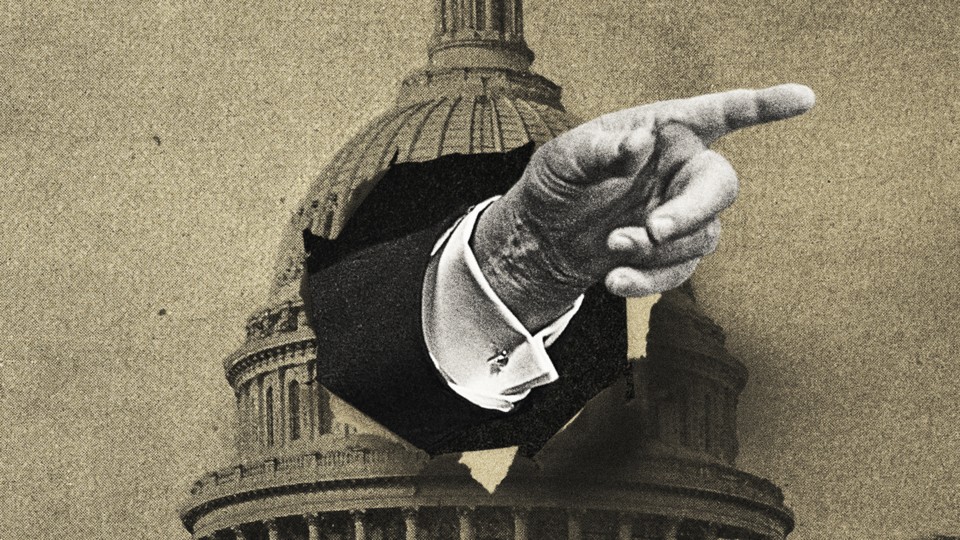
The fast fade of a co-equal branch of government Illustration by Ben Kothe / The Atlantic. Source: Jim Watson / AFP / Getty. Representative Seth Moulton is a senior member of the House Armed Services Committee, but he learned about the U.S. military’s middle-of-the-night capture of Venezuelan President Nicolás Maduro the same way many Americans did: A friend who saw the news on the internet texted him.
“That is not the way Congress is supposed to be notified of operations by the Department of Defense,” Moulton, a Democrat from Massachusetts, told us wryly. Still, Moulton was surprised neither by the Trump administration’s decision to attack Venezuela nor by the fact that it declined to give Congress a heads-up about the mission, much less seek its approval. A Marine who served four tours of duty in Iraq, Moulton had watched for months as the military stationed warships off Venezuela’s coast, and he gave little credence to the insistence of senior administration officials, in classified briefings to lawmakers, that they were not planning to take out Maduro. “I know what it means to be a Marine, sitting on a ship off the coast, and you’re not there to interdict boats or conduct a naval blockade,” he said. “Those are ground troops. And so it was no mystery to me why they were there.”
The president and his aides can lie to Congress with impunity, he argued, because the Republicans who run the House and Senate have shown they will do nothing about it. “This is the weakest Congress in American history,” Moulton said, accusing Republican leaders of making a co-equal branch of the federal government “essentially fade away.”
Moulton is running for a Senate seat, giving him even more reason than usual to criticize the GOP. But his views about Congress’s self-diminishment are widely shared inside and outside the Capitol, and the facts are hard to dispute. In the first weeks after Donald Trump returned to the White House, top Republicans offered no protest as his administration flouted their constitutional authority over spending, shutting down agencies that Congress had authorized and funded. Now the same leaders are handing over Congress’s power to authorize war-making without a fight. They’ve hardly made a peep over a military attack in which the administration cut out even the senior-most lawmakers, who are customarily informed about major operations.
Speaker Mike Johnson has praised the capture of Maduro and parroted the administration’s argument that the mission amounted to a law-enforcement action rather than an act of war to oust a foreign leader. “We are not in a war in Venezuela,” he told reporters today. “It is not a regime change. I want to emphasize that. It is a change of the actions of the regime.” With rare exceptions, rank-and-file Republicans have offered similar support for the Venezuela mission. Some have joined Trump in denigrating Congress, echoing his assertion that congressional leaders couldn’t be trusted with advance news about the operation. “Congress is a sieve,” Representative Tim Burchett of Tennessee told us. “I’m glad that the president would forgo that formality.”
Other Republicans compared the Maduro mission to President George H. W. Bush’s unilateral 1989 invasion of Panama to depose Manuel Noriega and President Barack Obama’s drone strikes on suspected terrorists in the Middle East. They also noted that the Biden administration put a $25 million bounty on Maduro’s head. But as in so many other areas, Trump has pushed the boundary of executive power further than his predecessors. Representative Randy Fine, a Florida Republican, acknowledged that if Obama had, say, “bombed Israel and not told us about it,” the GOP would want to hold him accountable. But he said Congress’s role in this case was simply to listen to the administration’s briefings about Venezuela. “I don’t think any accountability is warranted here,” Fine told us. “I think the president did the right thing.”
For a moment last fall, Congress showed some life. A group of Republicans joined Democrats to force the passage of legislation requiring the Justice Department to release its files on the convicted sex predator Jeffrey Epstein, defying an aggressive push by both Trump and Johnson to kill the proposal. Similar bottom-up efforts have gained steam, including a bill that would extend health-insurance subsidies that expired last year. Democratic Representative Ro Khanna of California, an author of the Epstein bill, told us the legislation “changed the entire game. It’s opened up a floodgate of Republicans willing to stand up to the president.”
Still, the administration isn’t exactly demonstrating renewed deference to Congress. In addition to ignoring (and, according to Democrats, deliberately misleading) lawmakers on the Maduro operation, the administration has released only a small fraction of the required Epstein files, and those have come with heavy redactions. And the floodgates of Trump criticism end, apparently, at foreign and military policy—an area where, Khanna acknowledged, Congress has been abdicating its responsibility for decades: “I’ve unfortunately not seen enough of a reaction against these strikes.”
Khanna’s Republican partner on the Epstein bill, Representative Thomas Massie of Kentucky, has sharply criticized the Venezuela attack. But other Republicans have returned to the president’s side. “He’s doing the right thing to keep America safe,” Representative Nancy Mace of South Carolina, a Republican backer of forcing a vote on the Epstein legislation, told us. She didn’t fault Trump for the lack of a congressional heads-up, saying it would have been “a recipe for disaster because members of Congress just can’t be trusted.”
Beyond the GOP’s acquiescence, Khanna and Moulton have also been frustrated by the lack of a unified and unequivocal Democratic condemnation of the Venezuela attack. The House and Senate Democratic leaders, Hakeem Jeffries and Chuck Schumer, began their initial statements by noting how detestable Maduro is before shifting to criticism of the Trump administration for acting unilaterally to take him out. That kind of throat clearing, Moulton said, took some of the sting out of their response. Democrats, he told us, need to stick to “the blunt truth, which is that this is insane, utterly insane.”
In the Senate, Democrats are hoping that at least four Republicans will join them in passing a War Powers Resolution to bar the president from taking further military action in Venezuela without congressional approval. Its author, Senator Tim Kaine of Virginia, told reporters that it was time for Congress to “get its ass off the couch” and reassert its war-making powers. At least one Trump ally, Judiciary Committee Chair Chuck Grassley of Iowa, took issue with the administration’s claim that the Maduro mission was a law-enforcement operation. He released a statement with the panel’s top Democrat, Senator Dick Durbin of Illinois, saying that if that was the case, it was “unacceptable” for the administration to exclude the committee that oversees the Justice Department from its classified briefings.
Over the weekend, it looked like another Trump ally, Senator Mike Lee of Utah, might break ranks over the Maduro operation. “I look forward to learning what, if anything, might constitutionally justify this action in the absence of a declaration of war or authorization for the use of military force,” Lee posted on X before dawn on Saturday, briefly returning to his pre-Trump roots as a separation-of-powers hawk. Within two hours, however, Secretary of State Marco Rubio had brought his former Senate colleague back into the fold. By Saturday evening, Lee was repostingmemes of Rubio dressed as a saint and a Latin American warlord.
A few Republicans have sought something of a middle ground, backing the Venezuela attack while arguing that Congress should have a say in what happens next. “From here on out, Congress needs to play a central role,” Representative Kevin Kiley of California told us.
Moulton sees little chance of that happening—at least as long as the Republicans in charge remain subservient to Trump. “At this point,” he lamented, “Trump could kill these Republicans’ kids, and they’d tell him it was a great job.”