The 2016 meme '[gestures broadly at everything]' captured the overwhelming confusion of its time. A decade later, it still resonates because 'interesting times' have become our status quo, highlighting how overwhelm can lead to political helplessness.
Key Takeaways
•The '[gestures broadly at everything]' meme originated in 2016 as a way to express collective overwhelm about events like mass shootings, Brexit, and political shifts.
•The meme's enduring relevance into 2026 shows how 'shockingly unusual times' have become normalized, making overwhelm a persistent condition.
•Overwhelm can lead to helplessness, despair, and apathy—robbing people of the political power to understand and articulate what's happening around them.
•While the meme acknowledges speechlessness, it also serves as a warning about the dangers of empty gestures in a democracy that relies on clear communication.
•The meme's elasticity allows it to evolve from expressing exceptional circumstances to questioning what happens when 'interesting times' never end.
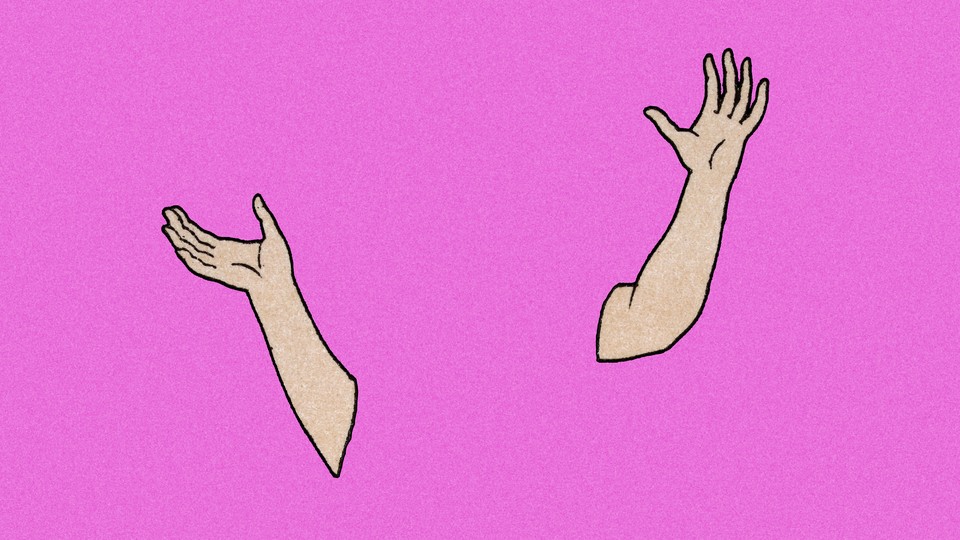
The more turbulent the times, the more tempting it is to [gesture around at everything]. Illustration by Ben Kothe / The Atlantic All times are interesting times, but the summer of 2016 was especially interesting. That July, as a Twitter user named Katie Loewy tried to make sense of mass shootings and Brexit and the rising political power of the host of The Celebrity Apprentice, she proposed a theory. “I’m not saying that David Bowie”—who had died earlier that year—“was holding the fabric of the universe together,” she wrote, “but *gestures broadly at everything*.”
The tweet promptly went viral, partly for what it said—the idea of Bowie as cosmic load bearer was, as explanations go, absurd and amusing and plausible—but mostly for what it didn’t. *Gestures broadly at everything* was a punch line to a joke that was all too familiar. It turned overwhelm into a knowing melodrama. Soon, people across the English-speaking internet were posting, emailing, and texting their own versions of Loewy’s stage-whispered aside: [gestures wildly at everything]; <gestures vaguely at everything>; [gestures around]. The meme’s brackets and asterisks—never has punctuation been so eloquent—seemed to step in where words failed.
Recent years have been boom times for language that is inarticulate on purpose. Vibe has become a diagnosis; chaos has become an all-purpose condition. Dictionaries have highlighted, as their words of the year, brain rot and post-truth and an emoji caught between laughter and tears. But [gestures around] might be the term of the decade. It is a vestige of 2016 that, precisely because it is self-consciously speechless, captures the tensions of life in 2026. You can tell a lot about an age by its propensity for empty [gestures]. You can tell a lot about ours by the fact that bracketed addlement is, at this point, a cliché.
“I think it goes without saying that we are in shockingly unusual times,” a federal judge declared last month. She was referring, most directly, to mass protests—and state violence—in Minneapolis, while hearing a case on the matter. She might also have been referring, though, to crises in Venezuela or Greenland or the thousands of other happenings, both obviously historic and subtly so, making shock such a reliable feature of everyday life.
“May you live in interesting times,” as the old line goes, is never quite the blessing it seems. Interesting times can be incoherent. They can be maddening. This is one reason [gestures around] first caught on. When Loewy tweeted about the fraying fabric of the universe, she later told Slate, she had particular ruptures in mind; her theory of a Bowie-to-Brexit pipeline was connected to both her personal politics and the fact that she lived in London at the time. But her tweet’s wording absolved her of the need to specify. It did the same for the many people who turned her dashed-off gesture, over the years, into a piece of common language. *Gestures broadly at everything* commiserates—Everything, ugh—but maintains plausible deniability. It assumes, correctly, that overwhelm is a nonpartisan proposition.
As they said in 2016: How relatable. In a media environment that delivers news through feeds and flows and fire hoses—in a time that has given us what critics have called the “end of endings”—overwhelm is, to some degree, inevitable. But it is also a profound concession. It can become, at the scale of a population, dangerous. Overwhelm can beget helplessness. Helplessness can beget despair. Despair can beget apathy. And each sensation can make us vulnerable because each can rob us of an elemental form of political power: the ability to understand what is happening around us—and, then, to talk about it.
[Gestures around] acknowledges the theft by, effectively, embodying it. To use it is to perform an extremely condensed piece of theater: Here you are, trying to say something meaningful about the world at large; and here you are—mutely, melodramatically—failing. [Gestures around] resonated in 2016 because it acknowledged what a lot of people thought: Their explosive era was, as times go, exceptional. Today it resonates for the opposite reason: Shockingly unusual times are, for the most part, our status quo. The past decade has found many people striving to stay balanced while things they took for granted—rights, systems, democracy itself—have withered and fallen away. It has given people new ways to wonder about the practical difference between action and apathy, activism and slacktivism, complacency and complicity. [Gestures around], ever elastic, still speaks, silently, to a sense of overwhelm. But it has also become a way to wonder: What do we do if the interesting times never end?
The meme, of course, offers no answers. But it can offer clarity about the character and stakes of people’s uncertainty. Overwhelm is a personal experience that, when it affects the populace at large, becomes a political one; unchecked, it can unsteady people’s sense of themselves as actors and agents. It can replace words with empty gestures. [Gestures around], though, serves as a signal, and potentially as a rebuke—to the comforting and misguided assumption that politics is something that happens to other people.
Democracy, in its American form, takes words for granted. It relies on speech. It assumes people’s ability to identify crises—to distinguish between the everyday dramas and the scene-shifting ones—and then to react appropriately to them. Everything that makes [gestures around] so perpetually useful as a piece of language makes it even more valuable as a warning, and then as an opportunity: It reminds those who keep finding themselves at a loss for words that they always have the chance to find new ones.