Charli XCX champions mood-board aesthetics over traditional music-making, arguing modern artists should create immersive 'worlds'. While her album 'Brat' successfully blended style with substance, her recent film 'The Moment' and soundtrack for 'Wuthering Heights' reveal the limitations of prioritizing vibes over craft.
Key Takeaways
•Charli XCX represents 'mood-boardism' in pop culture, where aesthetic curation often supersedes traditional artistic goals like storytelling or emotional depth.
•Her album 'Brat' succeeded by combining trendy aesthetics with genuine musical craft and introspective lyrics, proving mood-board approaches can drive innovation.
•Her recent projects—the film 'The Moment' and 'Wuthering Heights' soundtrack—show the pitfalls of prioritizing style over substance, resulting in underdeveloped execution.
•Charli's view that 'music is not important' reflects an accelerationist stance in the attention economy, where branding and cross-media presence often overshadow artistic integrity.
•True artistic excellence requires time, revision, and depth—elements often sacrificed in the rush to maintain cultural relevance through constant reinvention.
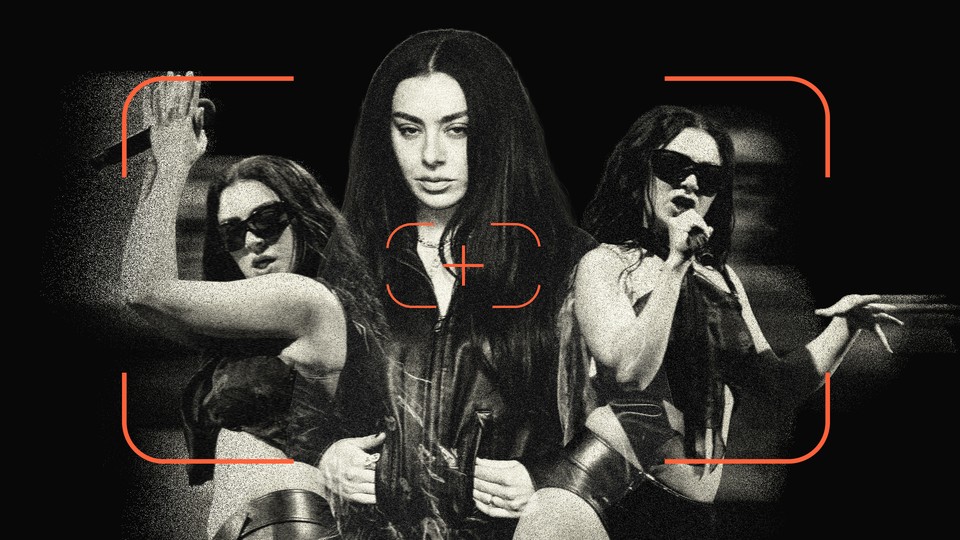
The singer believes that music isn’t the point of pop stardom. Is she right? Illustration by Alisa Gao / The Atlantic. Sources: Harry Durrant / Getty; Joseph Okpako / WireImage / Getty; Matt Crossick / Variety / Getty. The most influential media format of the 21st century probably isn’t the podcast, or the TikTok video, or the video game. It’s the mood board. Long used by graphic designers and ad execs, mood boards are collages of images and words—magazine clippings, movie stills, headlines—that guide how a project is supposed to feel. Over the course of the internet era, platforms such as Instagram and Pinterest have encouraged everyday people to mood-board their life, and creative-director jargon—curate, worlds—has gone mainstream. Trendspotters now hunt for the next “rare aesthetic,” which is Gen Z slang for any combination of images and sounds that makes the brain sizzle in a cool (usually nostalgic) way.
Mood-boardism carries a certain set of assumptions about creativity. It suggests that powerful effects can arise from decontextualized parts, as if casting a spell from snips and snails and puppy-dog tails. Various higher objectives of art and media—discover new ideas, crystallize difficult truth, tell meaningful stories—tend to come second to vibes. Some creative professionals have started dissing mood boards as feeding our supposed crisis of cultural stagnation. But the technique is now automated by AI, which ingests prompts and recombines preexisting media to spit out content.
For now, the leader of mood-board chic is a human being, and a quite likable one: the 33-year-old British dance-pop singer Charli XCX, though to call her a dance-pop singer is to focus on just part of her persona. For as many people who know her for songs such as “Boys” and “Von Dutch,” equally as many others recognize her aesthetic traits: fried black hair, chalky nocturnal complexion, cigarettes, auto-tune, and the piercing green hue of her 2024 album, Brat. She’s the kind of person who is praised with the term je ne sais quoi, even though fans can list exactly what makes Charli Charli. And over the years, she’s made the case that mood-boardism can, in fact, drive innovation—though her latest projects, the film The Moment and the soundtrack for Wuthering Heights, show why it usually doesn’t.
Charli earned cult acclaim throughout the 2010s by blending archetypes cunningly: She was part Britney Spears, part Siouxsie Sioux, part guerilla-marketing exec. She sang stuttering hooks in a worldly rasp over beats by idiosyncratic producers; she did fascinating things online, such as livestreaming the creation of a new album during the early pandemic. Brat was conceived title-first, before a note of music was written. When the album pushed her, at last, into mainstream recognition, she could brag that she was already an icon to the tastemaker class. “I’m your favorite reference, baby,” she rapped on the opening track, “360.”
But what fans really loved about Brat, and have always loved about Charli, is the way her taste is backed by craft. Her production spiced up 2000s rave-pop with hints of chipper children’s music in an oh-so-brain-sizzling way. She wrote Brat’s lyrics in the style of text messages to her friends, and although some of the results were a bit crude, the overall effect was to x-ray her self-doubting, irrepressibly romantic psyche. When she invited a cast of contemporary musicians to remix the album, it pushed the Brat era—if not the original album per se—into transcendence. She projected herself as queen of a coked-up dance party, but the point wasn’t just hedonism. Listening felt like being pulled into side chats with lots of different characters who were at precisely the right level of intoxication to reveal something interesting to you—crushes, anxieties, rivalries. This was fresh, extroverted pop that managed to capture something true and complex about social life.
To hear Charli tell it, the point of Brat was to make a shade of green hot. In a viral interview clip from shortly before the album’s release, she opined that “music is not important” and that the task of the modern artist is to create a “world”—to project a vision across a variety of media, basically. This was hardly a radical statement in an era of cinematic universes, nor did it necessarily break with the approach of, say, David Bowie or Beyoncé. But the statement had an air of accelerationism, positing an upside to the systematic sidelining of music in the modern attention wars. After all, if we redefine marketing as art, then we’re definitely not in an artistic doldrum. Still, hearing “Music is not important” from one of music’s most promising voices was … concerning. I hoped she was being a bit cheeky.
Alas. Following Brat, she’s working to extend the Charli XCX experience into a new medium for her: film. She is an actor in at least seven different movies that have recently come out or will soon. The flagship of that crop is The Moment, a self-produced mockumentary about the Brat era. She has also recorded the soundtrack for Emerald Fennell’s eye-popping, ticket-selling take on Wuthering Heights. These efforts extend her brand by combining influences in savvy ways. They also show what a hollow goal that is.
In The Moment, Charli plays a version of herself from recent history: late summer 2024, when Brat was blasting out at parties, inspiring TikTok dance trends, and becoming appropriated by a presidential campaign. Keenly aware of the short shelf life for trends in the digital age, and that the big break she has spent her career seeking has finally arrived, movie-Charli works to keep Bratmentum going for as long as possible. “The second people are getting sick of you,” the influencer Kylie Jenner counsels her in one scene, “that’s when you have to go even harder.”
Going harder, in this case, means cutting deals. The real-world Charli has endorsed an array of products including eyeshadow and prebiotic sodas; the film version pushes that tendency just over the line of parody by having her endorse a Brat-colored credit card aimed at young LGBTQ consumers. She also devises a concert documentary that will be released by Amazon. Although she initially wants to make that film with her longtime creative director, Celeste (played by Hailey Gates), her label insists on a hack director named Johannes (Alexander Skarsgård, a doofy highlight of the film).
What ensues is a clash of mood boards. Celeste’s version of the tour is harshly minimalistic, all black-and-white strobe lights and profane on-screen text. (This is the version that Charli actually staged; I recall questioning my own eyes when I saw her perform last spring, because she’d managed to make herself look like a hologram.) Johannes warns that such a vision will alienate families who want to stream the concert at home. He pushes a colorful girl-power pep rally complete with corny props and inspirational speeches. He tries, in other words, to make Charli XCX more like Taylor Swift.
Plenty of listeners already think of Charli and Swift as the yin and yang of contemporary pop, representing different ideals: chaos versus order, subculture versus stadium, Dionysus versus Apollo. And the two women have fed that comparison with their music. A Brat song was widely interpreted as expressing self-loathing inadequacy in the shadow of Swift’s success. A song on Swift’s 2025 album, The Life of a Showgirl, was, in turn, widely interpreted as a Charli smackdown: “I heard you call me ‘Boring Barbie’ when the coke’s got you brave,” Swift sang. Maybe what she’d really heard were rumblings that The Moment was going to hold up Swift’s aesthetics—which, to be fair, are also a lot like Katy Perry’s or Disneyland’s—as the height of tacky.
All of which is to say that The Moment has rich material to mine. It suggests that the arch commercialism practiced by the real-life Charli is not the same as trading integrity for success. And it makes a fascinating point about what really sets Charli apart from her more earnest contemporaries. Charli and Celeste want the Brat tour to feel like a nightclub, but Johannes says, “A nightclub is not a story. A nightclub is a nightclub, and at some point, the night has to end.” Charli’s true artistry, the movie implies, isn’t bound by the prescribed, linear structures of narrative. It’s all about sensation.
What, then, is Charli doing making a narrative film? The Moment dutifully attempts to meet the needs of the form, moving from one plot beat to another, including by using pointedly garish title cards. But the filmmakers seem much more passionate about its look and feel than its screenplay or structure. Aidan Zamiri, a music-video director overseeing his first feature film, assembles a twitchy bricolage of techniques: part vérité slapstick (like This Is Spinal Tap) and part gonzo art flick (think Harmony Korine). As I watched, I thought about how clever the creators must have felt as they mixed Hollywood tropes to portray the psychological horror of selling out.
Mostly, though, I wondered when the movie would end. The Moment is a comedy with almost no effective jokes, a listless sense of pacing, and cinematography that is stylized but really not that stylish. It feels rushed and underdeveloped—the product of too many deadlines, too little patience, or simply the view that vibes are more important than execution.
That view is certainly what has propelled Emerald Fennell into being Hollywood’s most gleefully incoherent filmmaker. As reviewers have noted, the engine of her Wuthering Heights is not emotion or plot but rather the whiplash created by audiovisual juxtapositions—most of which project the dubious theory that Victorian social rules were equivalent to BDSM. I enjoyed my time in the theater but left feeling dazed and manipulated, like I’d been in a loud casino for more than two and a half hours.
Charli’s soundtrack is a full-fledged album—her putative follow-up to Brat, though she’s downplayed the idea that it really counts as that. It also diverges from the tone of Fennell’s movie quite a bit. Whereas the film is madcap and edgy—even bratty—the Wuthering Heights album is sullen and stately, built upon strings and droning electronics. Explaining why the project appealed to her, Charli wrote (on Substack) that she wanted to dive “into a world that felt undeniably raw, wild, sexual, gothic, British, tortured and full of actual real sentences, punctuation and grammar.” She has also repeated the keywords “elegant and brutal” in interviews.
These ideas are—as with The Moment—extremely promising. Answering the question of where she should go after the ebullience of Brat with a stoic seance of an album is smart. Choosing to flip from a memoiristic lyrical style to one inspired by classic literature is smart. And some of these songs are not just smart—they’re sensational. The lead single, “House,” opens with the Velvet Underground’s John Cale delivering a spoken-word poem portraying himself as a vampire of sorts, before distorted guitar kicks in for a jump-scare effect. The satisfyingly noisy sense of liftoff that ensues undoubtedly took a painstaking, iterative process of writing, recording, and mixing to achieve. Then there’s “Chains of Love”: Charli in full Oscar-bait mode, twisting a plaintive chorus into windswept, ballooning shapes with the help of her trusty auto-tune. I can’t stop playing it.
The rest of the album is just fine. Charli is a natural at writing melodies that woodpeck their way into the skull, so the songs work on the level of catchiness. But they don’t develop and complicate themselves in interesting ways. The lyrics string together repetitive and mostly generic metaphors comparing love to death and commitment to confinement. She sings of dying in fires and having her face smashed into stone, but the music drizzles grayly upon the passion she describes. This is a first-draft take on “elegant and brutal,” for sure.
Charli might just be in a low-stakes, post-breakthrough interregnum, exploring whims without putting too much pressure on herself. But from the way she talks about creativity, I have my fears that she thinks first drafts are all she needs. Charli’s praise of world-building echoes the way that marketers and influencers talk. And in the present oversaturated media environment, a common playbook for success is to pursue constant visibility: posting and provoking every day, touting micro-reinventions, to keep the attention of the audience. The mood-board mentality facilitates this need for speed. Assemble reference points, add in your personality, and voilà: a new moment.
Great music transcends moments. And although referential borrowing, high-concept brainstorming, and first-thought-best-thought immediacy drove the work of many classic artists, their greatest works required revision, editing, collaboration, second-guessing, dark nights of the soul, and time. Charli may feel that culture is moving too quickly for her to take the months or years needed to convert ideas into excellence. She may fear that we have no time for masterpieces. But the truth, she may find, is that masterpieces are all we have patience for. And she has the rare ability to give us what we need.