I Trained as a Dancer. Then I Saw the Robots Move.
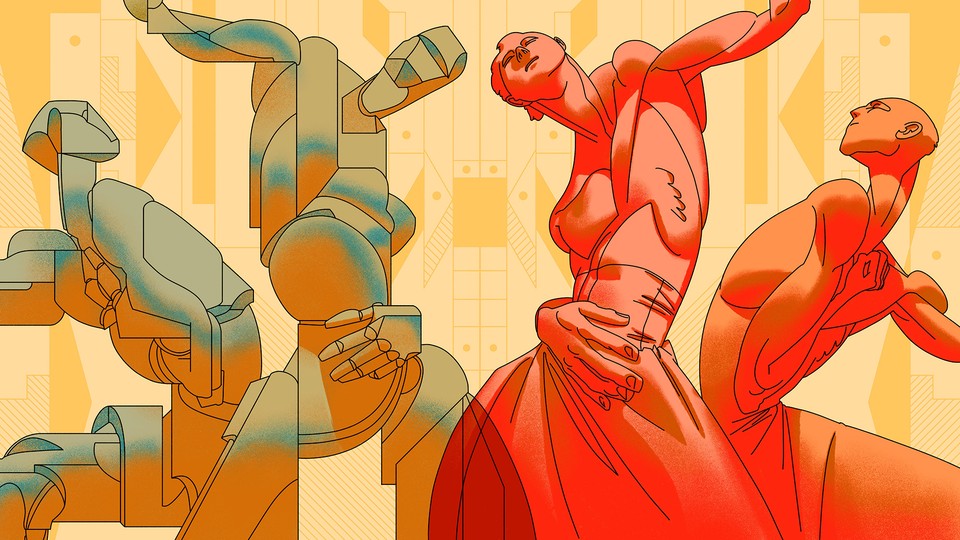
They were impressive, but could they ever feel human? Illustration by Avalon Nuovo Earlier this year, I watched a video that caught me entirely by surprise: A clip from the CCTV Spring Festival in China, in which more than a dozen humanoid robots performed an intricate martial-arts routine. They backflipped. They high-kicked. They wielded swords and dropped into potentially pant-splitting lunges. A side-by-side comparison with their movements just the year before was astounding: The robots, made by the company Unitree Robotics, could now move with a fluidity that looked less like the archetypical “robot dance” and more like ballet, albeit a dead-eyed version.
I was impressed, but—I must admit—a part of me felt threatened. And jealous. Despite my more than two decades of dance training, those robots could perform moves that I never could. (Like backflips! I cannot backflip.) The video plopped me back into a time of complicated emotions, when I was enchanted by dance but constantly saw it as a catalog of tricks I had largely failed to master.
My early days at a preprofessional ballet school were joyful. I craved the weightlessness of a jump. I wanted to stretch my body to touch as much of the world as it could. But with time, this joy curdled into a sense of ineptitude and dread. Afternoons of practice resulted not in perfection but in painful pointe-shoe blisters. Twice a year, I nervously awaited a report card that graded me on categories such as “body type” and “musicality” and that often made me feel that I’d come up short. One night, I dreamed that I completed a triple pirouette—a spin that eluded me most days—which turned into a quadruple turn, then a quintuple, and on and on until I was the ballerina in a music box. A robot. I awoke the next day feeling betrayed: Why could my mind dream this up, yet my body seemed incapable of making it happen? Soon after, I quit ballet.
“China’s dancing robots,” as coverage of the Unitree humanoids called them, stirred up those old feelings of incompetence. But they also piqued my curiosity—and skepticism. It was incredible to me that machines could be trained to move so intricately. I was less sure, though, whether what they were doing—all show-offy mechanics—could really be called dance.
Companies have been trying for years to get robots dancing. Tesla managed to make its humanoids perform a (rather ungraceful) arabesque. Boston Dynamics got its robots doing the mashed potato, the grapevine, and the twist. And a whole academic field, “choreobotics,” has emerged to study the intersection of robotics and dance.
Various ideas seem to be motivating this push to make robots shimmy. Some researchers envision robots as dance partners. Others adopt a more utilitarian view: A robot that can dance might move better in health care, factory, or domestic settings. Then there’s what I’ll call the How to Win Friends and Influence People argument—the idea that, as one UC San Diego robotics professor put it, having robots dance could “reshape public perceptions of robots as friendly and collaborative rather than terrifying like The Terminator.” In a 2024 TED Talk, the robot choreographer Catie Cuan described a hypothetical future in which a robo-waiter might deliver you a glass of water at a restaurant and then charm you with “a small celebratory dance.”
But getting robots to move in any human way, let alone to backflip, is exceedingly difficult. Although the exact details of how companies program their robots are largely proprietary, several firms seem to train their humanoids through motion-capture data (basically, taking movement information from a human in a onesie), tele-operation (a person remote-operating the robot from a distance, like a drone), and the huge library of videos available online. All of those data can then be fed into an AI model; companies and researchers hope that, eventually, these tactics will help robots to achieve “embodied intelligence,” or an ability to move around in and respond to the physical world.
But it’s much harder to get robots to move smoothly than it is to get ChatGPT or Suno to spit out text or song. That’s in part because although languages have alphabets and songs have sheet music, when it comes to broader human movement, no widely adopted notation system really exists, Amy LaViers, the director of the Robotics, Automation, and Dance Lab, in Philadelphia, told me. The notations of movement that have been created over time, such as Labonotation, are incomplete for what many roboticists need, LaViers argues. That’s why she and other choreobotics researchers are trying to reduce the complex language of human movement to a periodic table of the smallest units possible—called “movemes,” similar to the idea of “phonemes” in linguistics—so that they can teach robots how to better perform humanlike, expressive motions.
Making this comprehensive periodic table is complicated, however, because of how intricate the human body is. Speech is formed primarily in the mouth, but the body as a whole has so many more “degrees of freedom,” LaViers said—spines can twist, rib cages can expand, fingers can create peace signs and devil horns. Over Zoom, she showed me flash cards of some actions she’s including in her periodic table: Float, Left Back High, Slide, Glide. Still, dance notation is in its early days, she said: “We’re scribbling on cuneiform clay tablets.”
A periodic table of movement may not be complete, but technology moves quickly. Initially, watching the Unitree robot video, I immediately imagined a world in which robots would one day be not just backflipping but also completing, say, 100 perfect pirouettes in a row. But LaViers urged me to rethink how I was defining dance. “A single preprogrammed performance that works well,” such as that Unitree one, she said, “is a different thing than having robots that can dance.”
Human dancing is something else entirely, full of nuances that can’t be totally translated into atomized steps. As any dancer can attest, great dancing typically comes from experimentation—bodies playing against one another and the music, people adding their own bits of pizzazz, choreographers communicating in impromptu dancespeak that can sound totally wacky out of context: Think “5-6-7-8, ratata-PAH!”
Dancers also reach for all sorts of creative communication—metaphors, allusions, images, intonations—to describe movements and infuse them with a desired energy. Over the years, dance teachers have told me to extend a leg as if I’m “moving through honey,” to lift my spine as if I’m “kissing the ceiling” with my head, to pivot like I’m “being kind to the space” around me. At a recent jazz-dance class, the teacher asked us to explore the “yumminess” of an arm motif. Before, I’d just been placing my arm into a half-T shape. But, guided by this texture, I started to move my arm with more weight, and every muscle in it suddenly woke up.
Metaphorical language changes a dance, because when humans move, it’s not just about the step, Kimerer LaMothe, a philosopher and the author of Why We Dance, told me. “We are putting into motion all of the ways in which we’ve reached in our lives, all of the ways we’ve hugged in our life,” she said. “Everything we’ve felt: our anger, our blame, our shame, our rage, our grief—it’s all in this arm.” I can picture an arm pose as “yummy,” in other words, only because I’ve eaten food. To dance, then, is to step into a field of subjectivity in which we summon everything our body has ever felt.
In LaMothe’s view, dance is also a part of how humans evolved. Even more, she argued, people are movement, not static objects. Our hearts beat, our muscles change—we’re dancing all the time. A robot might be trained to learn from different motions, but unlike us, it has no muscles or hormones that can be reshaped or rearranged by the act of dancing. Even the most complicated periodic table of movement could never fully encapsulate this.
In writing this article, I was reminded of the day my urge to dance became apparent to my family. The lore goes that when I was about 3 years old, my brother tattled on me: “Valerie was dancing today. At school.” My grandmother, a Seventh-Day Adventist Dominican diva who at the time abhorred the unholy movements of the flesh, put me on her kitchen table. She told me to dance, if I dared. It felt like Judgment Day—I’d be grounded, or perhaps sent to Mars—but I had to obey, so I shook my hips with abandon. My grandma had been ready to tell me off, but the sight made her laugh. She allowed me to dance on.
Recently, wondering whether I could recapture that sense of freedom, I put on my headphones and played a song—“Lonely Fight,” by Mk.gee—whose fuzzy atmosphere and sleepy harmonies tend to pull me into a woozy, tender state. I paid attention to my impulses to move and followed them: a curled squat, an elbow escaping and extending. And I remembered something that LaMothe once said in an interview: “I am the movement that is making me.” No matter whether I have loved dance or hated it, experienced it as a joy or a chore, I—unlike a robot—feel it in every molecule.
When you buy a book using a link on this page, we receive a commission. Thank you for supporting The Atlantic.