A summer evening in 1962: The fireworks were over, the crowds dwindled, and the store emptied. I counted out the registers, turned out the lights, and locked the hand-carved sorcerers’ doors behind me.
My usual route out was through Sleeping Beauty’s castle, over the moat via a working drawbridge. But tonight, a security guard stopped me. “Can’t go that way, gotta go out the side exit.” “Why?” I asked. He said, “There’s a photographer taking a picture.”
I obediently took the adjacent side route (in those days, film was expensive, so no one stepped in front of even the most casual snapshot). I passed the photographer, a woman. I want to say I remember the camera, whether it was on a tripod or whether she held it, and what she was wearing. But I can’t. I want to say I was there when the camera clicked as I strolled by, but I can’t. I want to say I stopped and chatted. I didn’t, but I wish I had. Because the photographer was Diane Arbus.
Arbus, among the most renowned photographers of the 20th century, is known for her photographs of the outliers next door—carnies, identical twins, exotic dancers, and weight lifters, among others. (It’s sloppy to call her subjects “freaks,” as some observers did, a term that slanders the subjects as well as the photographer.) She found people to photograph who were visually captivating and dignified, and who pulled us into fringe worlds that most of us know nothing about.
Her photos without people as subjects are rare and more rarely shown. There exist only a dozen or so depopulated images, including a puddle on a sidewalk, a wax-museum axe murderer (I’m calling a waxen axe murderer a nonperson), a facade of a Hollywood movie set with scaffolding propping up its skeletal shell, and the creepy interior of a dark ride at Coney Island.
After a bus trip from Manhattan to Southern California, she decided to photograph what she called “pseudo places,” an apt description of Disneyland’s high, rampant whimsy. Her notebook from the period: “I have found the most wonderful pseudo places at dawn in Disneyland, ruins of Cambodian temples which never existed, false deserts littered with bones of animals who never died, mountain like a shrine for unbelievers. And black swans swim in the moat of a castle which looks like the advertisement for a dream.”
The presence of Disneyland’s “guests” in the photos, I suppose, would have given the photos a souvenir context that would have rendered them flat, so Arbus arranged access in the off-hours, when the park would be empty. (The park’s rules were more easygoing then. Remember, I started when I was 10 years old and was paid my day’s earnings—about $1.50—in cash.)
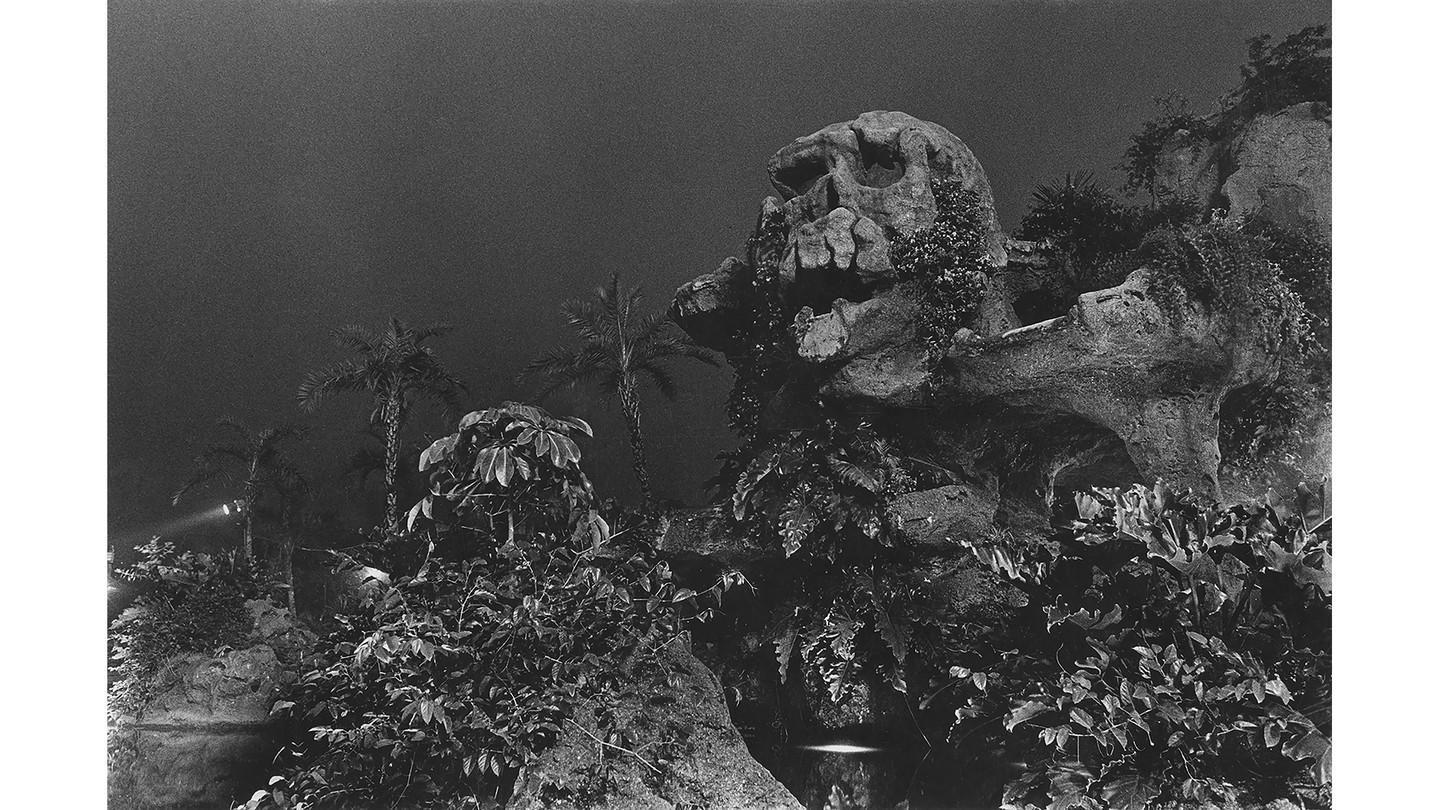
She turned her camera on “Skull Rock,” a self-explanatory name describing an outcropping of plaster, where a Yo-Ho-Ho dead man’s skull emerges out of the volcanic upheaval (around the corner from Mr. Toad and just behind the Chicken of the Sea pirate ship). Arbus’s photo transforms a fake scary place into an actual scary place: The photograph is nightmare material for both children and adults.
She also shot a sunset scene of ersatz boulders, looking like a carapace army resting on transports, waiting to be moved into place. The image is officially titled Rocks on wheels, Disneyland, Cal.1962. But it is undoubtedly misnamed: The setting is a mountainous terrain, probably the Anaheim Hills, whereas Disneyland’s domain is as flat as Kansas. The rocks were traveling to, and had not yet arrived at, Disneyland.
The photo delivers a Daliesque strain of surrealism—as well as a dash of humor, but only if you want it. In Arbus’s Disneyland series, humor was the last thing on her mind. The inevitable irony inherent in pointing out phony places—motels that look like tepees and giant roadside dinosaurs—is absent from these honestly delivered photos.
Her final Disneyland image is of Sleeping Beauty’s castle, the perfect “pseudo place” and my home away from home—where I heard Tchaikovsky’s “Sleeping Beauty Waltz” on a loop. The castle’s authority makes you believe it’s real, despite being smaller than it should be, prettier than it should be. (If you turned your head to the right, you could see a TWA rocket ship ready for launch to the moon.) Arbus photographed the castle as though it were a delectable sweet—more akin to what it was to us Disneyland romantics than to a Manhattan ironist. There is no evidence of mockery in the photo, and if there is, certainly the glowing white swan gliding on the moat’s black water doesn’t know it.
As the decades passed, I became more conversant with Arbus’s work. But I remained unaware of the castle image until much, much later.
When I finally saw the castle photo, it was like being surprised by a snapshot of your toy box from when you were 5. A sudden yank back in time, pulled not just by familiarity, but by a tangible recall of time and place, with the mood exactly right. For the first time in years, I remembered the incident with the mysterious photographer. Research showed that the dates lined up, the hours lined up, the location lined up: The after-hours lone photographer I passed was undoubtedly Diane Arbus.
My nostalgia—more like melancholy—for Disneyland has waned but is not absent. It has been replaced by a bundle of more recent memories, of family and parenthood. But seeing the image now, nearly 65 years later, I am taken back to the castle undimmed, starlit, swan-lit. In Arbus’s mind, I’m sure the photo was slightly bent, but to me it is accurate, straightforward, and ever so real, even if it is pseudo.
This article appears in the July 2026 print edition with the headline “Disneyland With No People.”