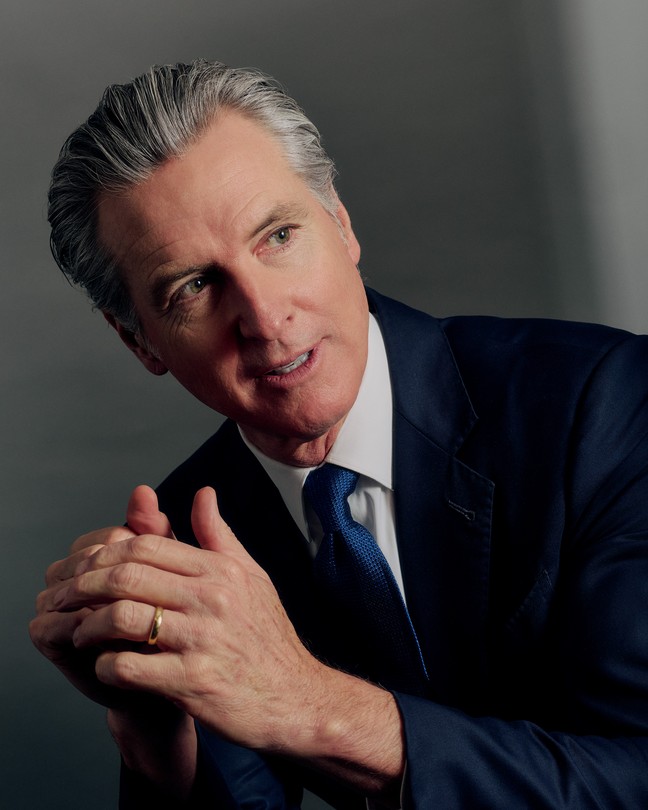
California Governor Gavin Newsom, a leading Democratic contender for 2028, emphasizes strength over weakness in politics, using aggressive tactics against Trump and navigating his party's divisions. His career, marked by risks like early support for gay marriage and controversial social media posts, reflects a blend of charisma, privilege, and policy pragmatism.
Key Takeaways
•Newsom believes Democrats must project strength, even if it means being 'wrong but strong,' to win elections, contrasting with perceptions of weakness.
•He employs combative social media strategies and engages with conservative figures to broaden his appeal, while facing criticism for being too aligned with California's liberal policies.
•His political journey includes bold moves like issuing same-sex marriage licenses in 2004, which initially drew backlash but later validated his stance.
•Newsom's background involves privilege from Getty family connections, but he emphasizes hard work and struggles with dyslexia, shaping his communication style.
•He navigates Democratic factions by offering something to each, but his core beliefs and policy consistency are questioned, with challenges in housing and cannabis reform.
California’s Gavin Newsom would rather be wrong than weak. Ryan Young for The Atlantic Gavin Newsom has a 30-page file of reasons the Democrats lost the 2024 presidential election. Bounding across his Sacramento office, he starts listing them: incumbency, inflation, interest rates, Israel—and that’s just the letter I. “Yes, too woke,” he adds. “Yes, 107 days,” referring to the short campaign after Joe Biden’s forced withdrawal. But the California governor distills his party’s problem down to one word. Weak.
Newsom slaps his hand on a marked-up hardback of Bill Clinton’s memoir, brought down from the shelf a minute earlier. “Given the choice,” he tells me, summing up a crucial Clinton insight—one many Democrats still can’t quite seem to grasp—“the American people always support strong and wrong versus weak and right.”
According to prediction markets and early polling, Newsom is the Democrats’ current front-runner for 2028. He is also one of the most visible anti-Trump forces in America. His idea of strength includes a willingness to fight dirty, going lower than Barack Obama could ever imagine, and so his social-media accounts bristle with memes about Donald Trump’s bruised hand and advancing age. “Donald has fallen asleep in his own Cabinet meeting,” he recently asserted on X. Some posts are downright cruel, such as the one about Elon Musk’s estrangement from his transgender child: “We’re sorry your daughter hates you, Elon,” it said.
He also has a high tolerance for risk. Proposition 50, a ballot measure that has redrawn California’s congressional map in favor of the Democrats, was seen as a toss-up when he first backed it last year. The new map was a blatant partisan gerrymander, a departure from the time when the Democrats used to talk up the fairness of independent commissions. Morally wrong, maybe—but do you want to win back the House or not? Prop 50 passed by a two-to-one margin.
Newsom, who is 58, has a memoir coming out next month. This is a traditional rite of passage for people running for president, which he is, even though we are supposed to pretend that he hasn’t decided yet. He has some obvious advantages over the likely competition. As a heterosexual white man from a Catholic background, nothing about his identity is electorally risky. He is tall—6 foot 3—and good-looking in a faintly sinister way: You can imagine him being played by Matthew McConaughey or the vampire dad from Twilight. In a political arena now dominated by podcasts, he can talk until he’s hoarse; as San Francisco mayor, he once uploaded a multipart “State of the City” address to YouTube that lasted more than seven hours.
As for his liabilities, well, the word smarm comes up a lot: The teeth are too white, the hair perfectly gelled. As if to compensate for his overuse of buzzwords—he told me he was “concerned about the significant expansion in the health-care space from a sustainability perspective”—man and brother are strategically deployed to seem folksy. In person, he is enormously charismatic, and is obviously performing. “He is a good communicator,” the Bay Area political strategist Alex Clemens told me. “He tries very hard to be a good communicator, and some people latch on to the trying-hard, instead of the end result.”
Newsom’s core views are also hard to ascertain. Right now, Democrats are divided into multiple camps: the can-do Abundance crew; centrists, who warn about the overreach of “The Groups,” such as the ACLU; Resistance libs, often dismissively referred to as the “wine mom” tendency; and left-wing populists, who think the party should not yield an inch on social issues, but instead focus on bashing billionaires. Newsom is trying to offer something to all four factions. His mentor, former San Francisco Mayor Willie Brown, said last year that his protégé is a “movie star” capable of being elected president—but also that he has never asked Newsom what he believes, “for fear he doesn’t know!”
Newsom’s campaign tactics are similarly fluid. At the start of Trump’s second term, the governor offered him an “open hand, not a closed fist,” before casting himself as the leader of the Resistance. He attributes this change to the deployment of the National Guard to his state. “I was shaped by a different consciousness and understanding of our politics,” he told me.
And there’s another problem: California. Newsom was born and bred in a state widely associated with moonbeams, metrosexuality, and macrobiotics. He has never faced a serious challenge from the right, and has instead spent a career among left-wing interest groups whose stances on immigration, drugs, gender, and climate change seem far-out to Middle America. “If you want to see the socialist Biden/Harris future for our country, just take a look at California,” one speaker at the 2020 Republican National Convention said, with the cadences of a carnival barker warning about the apocalypse. “It is a place of immense wealth, immeasurable innovation, and immaculate environment, and the Democrats turned it into a land of discarded heroin needles in parks, riots in streets, and blackouts in homes.”
Who was that speaker? Kimberly Guilfoyle, otherwise known as Gavin Newsom’s ex-wife. Many California Democrats—and even some of Newsom’s friends—still cannot understand why he ever married Guilfoyle, who went on to have an open-casket MAGA makeover and was engaged for a time to Donald Trump Jr.
All of this brings us to the defining question: Who is Gavin Newsom, really, underneath the charm—and the smarm?
Authors write a memoir when there’s something about themselves that they want other people to understand. So what don’t outsiders get about Gavin Newsom?
“The memoir opens up with that question,” Newsom tells me—the question of whether “I’ve become a caricature of myself and contributed to it, as it relates to this perception of privilege and wealth that has dogged me—and at times infuriated, not just frustrated, me.” I run the caricature as I understand it past him: His father was a friend of the Gettys, one of San Francisco’s wealthiest and most well-connected families, and Newsom started his first business with Getty money. “Yeah, you got it, sums it up,” he says. So how is it wrong? “Well, you gotta read the book,” he deadpans.
Newsom’s version is that he grew up between two worlds. His parents divorced when he was still a young child. His late father, Bill, was close to the oil heirs Gordon Getty and John Paul Getty Jr.—so close, in fact, that Bill became an administrator of the Getty family trust and helped deliver the ransom for the kidnapped John Paul Getty III. With the Gettys, Gavin went on safari and watched polar bears in Canada. But at home with his mother, Tessa, life was Wonder bread and mac and cheese.
At his high school in Marin County, north of San Francisco, Newsom was not a great student, but he was a talented first baseman, and he has attributed his acceptance at Santa Clara University to the fact he was “left-handed and could throw a baseball a little bit.” At times, an exaggerated version of his college record has spread, giving the incorrect impression that he played for Santa Clara and was drafted by the Texas Rangers. (A spokesperson has previously said, “He is doing his job, and he cannot spend his entire day correcting people when they make errors about him.”)
Playing baseball “helped me build confidence, got me out of my shell, and so I have deep reverence—I value sports and athletics, and also competition,” Newsom tells me. One of his two podcasts, Politickin’, is co-hosted by the former NFL star Marshawn Lynch—the legendary “Beast Mode”—and the sports agent Doug Hendrickson. The show is raucous, fratty, and frequently profane; in one episode, Lynch told their guest, Jimmy Kimmel, that “you gotta let your nuts hang.” As Kimmel observed: “This has to be the weirdest podcast ever, right?” (Newsom paused Politickin’ during the Palisades Fire crisis, but plans to revive it later this year.)
After college, the young Gavin and his childhood friend Billy Getty founded a wine store called PlumpJack, which has since grown into a restaurant-and-vineyard empire. (The word is a nickname for Shakespeare’s Falstaff, and the title of an opera by Gordon Getty.) “I grew a business with a relatively modest investment from a few members of the Getty family,” Newsom says now. “There were 13 investors.” Then he adds: “I’m not naive as well; I don’t run away from a recognition of the advantages and the privileges that I did enjoy.”
These connections have led to many of Newsom’s unflattering nicknames over the years, such as “Prince Gavin.” “Everybody thinks of Gavin and a silver spoon,” Nancy Pelosi told me. “But that isn’t right.” The former House speaker is a strong supporter of Newsom and recently helped him fundraise for Prop 50. There is even a persistent MAGA folk myth that she is his aunt: In fact, Newsom’s aunt Barbara was once married to Pelosi’s brother-in-law Ron. Pelosi, who has known Newsom since birth, added, “He was a very hard worker in everything that he did, whether it was personally, professionally, and then civically.”
One source of lifelong struggle is his dyslexia. He is an obsessive note taker, a habit born of the condition. He reads a book or a briefing agonizingly slowly, then copies out the best points onto a notepad, before transferring them to yellow index cards. Because of this, he prefers to rely on interrogating nearby people or memorizing information. In the 2000s, this tendency led his staff to nickname him Rain Man. “If you notice, when he speaks, he’s never reading from notes,” Senator Alex Padilla of California, who ran Newsom’s first campaign for lieutenant governor, told me. “So he, in some ways, overcompensates through preparation.”
As a result, Newsom can rattle off talking points with disorienting velocity. When I challenged him on his record as California governor, he machine-gunned me with a list of achievements: “$11 billion to reform the Medicaid system, the most significant reforms to Medicaid in the country; taking our whole-person care pilots and bringing them statewide; getting an 1115 waiver, getting a 1332 waiver from the Feds, all hard work; CalRx, not subsidizing costs, lowering costs—$11 insulin as a proof point of that. You can look down a list: $25 minimum wage for health-care workers, $20 for fast-food workers, no other state in the country, hard-fought battles; 800,000 gig workers now can organize, that was a six-year effort . . .”
I checked these numbers afterward, and although some of the claimed policy triumphs were either arguable or still pending, he was word-perfect on the figures. No wonder he’s desperate to appear on Joe Rogan’s podcast, I thought. He would beast-mode Rogan with a swarm of facts.
Newsom has always, always wanted to be president. In the late ’90s, his Balboa Cafe, in San Francisco’s Cow Hollow neighborhood, was a place where old and new money mixed. “Though barely out of his 20s, he already has a repertoire of politician’s gestures—placing his arm conspiratorily on a listener’s shoulder, punching the air to make a point,” The New York Times reported in 1998.
His childhood friend Lori Puccinelli Stern once organized a charity auction at Planet Hollywood with future Governor Arnold Schwarzenegger. They sold off a cigar-smoking-and-chess session with the Terminator star and a date with Newsom, then one of the most eligible bachelors in town. The winners of the latter prize were an older couple in real estate, which surprised the hosts. “We were thinking maybe a young girl who had eyes for Gavin would want this,” Puccinelli Stern told me. “The couple said, ‘We want to have dinner with him and our children, because we want them to get to know someone who we think is probably going to be the president of the United States someday.’” Stern said she wanted to talk to me because too many people saw Newsom as a “cyborg politician” when he was funny and loyal, the kind of guy who, “if you’re stuck in a Turkish prison, mistakenly, he’s your phone call.”
Another close friend, the event impresario Stanlee Gatti, remembers talking with Newsom in the 1990s, when Willie Brown had just appointed his friend to the San Francisco parking commission. Newsom stopped by Gatti’s studio and saw him casting the I Ching, a traditional Chinese method of divination that uses coins or yarrow stalks. Newsom wanted to try it. “The I Ching said, If you’re thinking about running for political, public office—don’t,” Gatti told me. “It said, You are an artist and you are a creator, and you should be doing something that uses that part.”
In Gatti’s telling, Newsom didn’t demur. “I can see it so clearly, right now, him standing up there, and he goes: Okay, that’s it. I guess I’m not running for office.” But Gatti didn’t believe his friend. (I asked Gatti if he would cast the I Ching again, to predict his friend’s future once more. “I need him to throw it,” he said, mulling the idea. If Newsom was willing, Gatti said, “we can do it over the phone.” As I waited, he texted the governor. An answer pinged back in less than a minute: “Too risky.”)
Family connections quickly propelled him upward in local government. Bill Newsom once told San Francisco Weekly that a friend of his helped engineer his son’s appointment to the city’s Board of Supervisors. “Besides,” Newsom’s father said, “they needed a straight white male on the board.”
When he ran for San Francisco mayor, Newsom’s platform was moderate and pro-business, in the model of Senator Dianne Feinstein. His signature policy was “care not cash,” a program to divert welfare spending to housing for the homeless, which he touted as a compassionate answer to Rudy Giuliani’s broken-windows toughness. In the runoff, Newsom narrowly beat the Green candidate, Matt Gonzalez, who became a public defender. “I think it was a closer race than he would have hoped for,” said Padilla, who first met Newsom around this time.
But within two months of taking office, he made a huge gamble: He started issuing marriage licenses to same-sex couples—effectively daring the state to strike them down. In hindsight, it’s easy to forget how provocative this was. Democrats believed that gay marriage was a losing issue, and that Newsom’s actions risked a conservative backlash for little practical gain.
Kate Kendell, then the executive director of the National Center for Lesbian Rights, remembers getting a phone call from the mayor’s office on a Friday afternoon saying it planned to start issuing licenses the following Monday. She was wary. “Things felt very perilous and tenuous, and it felt like a firecracker moment,” she told me. When Newsom’s office said it would go ahead anyway, Kendell called the lesbian activists Phyllis Lyon and Del Martin, partners of more than 50 years. She asked if the couple, who were then 79 and 83, wanted to be the first to get a license.
Newsom decided at the last minute not to conduct the ceremony himself—“He felt like it would be too much about him,” Kendell said—and so County Assessor Mabel Teng married the couple, who had arrived in matching pantsuits, turquoise and purple. Newsom gave them a copy of the California constitution as a wedding gift. “It was pretty extraordinary,” Kendell said, “but he paid holy hell for it. He got angry calls from Dianne Feinstein. He got angry calls from Barney Frank”—an openly gay congressman—“that the Democratic establishment was not happy with him.”
Newsom believes that he was not invited to speak at the 2004 Democratic National Convention because of the backlash. When John Kerry lost the White House that year, some Democrats blamed Newsom. “I believe it did energize a very conservative vote,” Feinstein said at the time. It was “too much, too fast, too soon.”
The young politician didn’t fold, but he did brood. “I mean, come on, maybe Democrats shouldn’t have supported civil rights in the ’60s,” he told a public-radio station immediately after the election. The party, and the country, has since validated his gamble. In 2008, the California Supreme Court voted to allow gay marriages—for a brief window, before a ballot measure overturned the ruling. The second time round, Newsom personally married Phyllis and Del at city hall. “Del was much more frail now, but they wore the same pantsuits . . . It was a huge celebratory spectacle,” Kendell told me, adding: “I think public opinion had really started to shift.”
In 2015, the U.S. Supreme Court legalized gay marriage across the country. “I know change for many of our LGBT brothers and sisters must have seemed so slow for so long,” said President Obama, welcoming the ruling. “But compared to so many other issues, America’s shift has been so quick.”
For Newsom, the fallout from the gay weddings was nothing compared with the implosion of his first marriage. Newsom had married Guilfoyle, an assistant district attorney turned television host, in 2001. Her “something borrowed” was one of Ann Getty’s tiaras, and the reception for their 600 guests was held at the Getty mansion.
The marriage was short and tempestuous. Guilfoyle’s television career in New York pulled her away from the West Coast, and Newsom would spend Sunday evenings with Puccinelli Stern, her husband, and their new baby, watching Extreme Makeover: Home Edition and eating pizza. She told me he would turn up wearing a baseball cap, and when the lucky families saw their new home, he “would put his hat down so we didn’t see him getting emotional.”
Guilfoyle took a somewhat unorthodox approach to life as a political consort. Filling in for Newsom at a gay awards dinner, she told the crowd: “I know that many of you wanted to see my husband, and some of you had questions out there. Is he hot? Yeah. Is he hung? Yeah.” The couple infamously posed together, sprawled on a rug, for the September 2004 issue of Harper’s Bazaar, in a story headlined “The New Kennedys.” The rug, and surrounding house, belonged to Ann Getty, and the magazine’s fashion editor at the time was Jacqui Getty, who was then Ann’s daughter-in-law. Asked about Newsom’s ambitions, Guilfoyle replied: “Do I think he could be president of the United States? Absolutely. I’d gladly vote for him.”
Within months of the story’s publication, however, the couple announced their split. What followed was a dark time for Newsom: He was frequently seen with a glass in his hand at local restaurants, although a spokesperson maintained that he had no alcohol problems. The newly single 38-year-old “Mayor McHottie” had relationships with a Scientologist, a 19-year-old model, and—most damagingly—his former appointments secretary Ruby Rippey Gibney, who was married to one of his closest aides.
Days after coming clean about the last of these relationships, he announced that he would seek treatment because “I will be a better person without alcohol in my life.” For a decade, the media reported that he had been to rehab, but in 2018, The Sacramento Bee corrected this assumption. Newsom told the paper he had sought only counseling with a local therapist and later resumed drinking socially. More than one person I spoke with wondered whether Newsom had pleaded alcohol abuse at the time to avoid the charge of moral degeneracy. When the #MeToo movement brought the scandal back into the news, Rippey Gibney wrote on Facebook that she had not felt coerced into the relationship, as a “free-thinking, 33-yr old adult married woman & mother.” Around the same time, Newsom revisited the affair. “I acknowledged it. I apologized for it. I learned an enormous amount from it,’’ he said.
By the late 2010s, Newsom had a personal reason for supporting the #MeToo movement; his second wife is Jennifer Siebel Newsom, an outspoken feminist and a sexual-assault survivor. She was involved with two films about gender roles in America: Miss Representation, about girls, in 2011, and The Mask You Live In, which tackled men’s issues, in 2015. She testified that she’d been raped by Harvey Weinstein in 2005. (The jury could not reach a verdict in her case.) In keeping with her feminist principles, Siebel Newsom is not California’s first lady, but its “first partner.”
Their relationship started with a blind date at a fundraising gala at the Yerba Buena Center in 2006, and within 18 months, Newsom had proposed with a Tiffany diamond ring. They married that summer in a field in Montana, and Stanlee Gatti did the decor. The bride rode to the aisle sidesaddle on a black stallion; the groom wore a tan suit; the theme was “Out of Africa.” The ceremony was conducted by Carol Simone, a “modern day mystic” whose website describes her as a medium, an astrologer, and a tarot practitioner. Bill Newsom arrived in Gordon Getty’s plane.
The Newsoms now have four children, ages 9 to 16: Montana, Brooklynn, Hunter, and Dutch. Gatti told me that marriage and kids had settled Newsom; he had run into his friend and his son at a museum one morning during the pandemic, and noticed how relaxed he looked. “He had his hair floppy. Some people didn’t even recognize him.” (Newsom’s hair, usually slicked back, has been a source of admiration and horror for two decades. His secret, he once toldAmerican Idol’s Ryan Seacrest, was L’Oréal Total Control Clean Gel.)
Amid all of his personal upheaval, Newsom ran for—and easily won—reelection as mayor. He was such an obvious shoo-in that the race became a kind of circus: His opponents included a performance artist, a nudist activist, and the owner of a sex club. Tellingly, both the artist, “Chicken John” Rinaldi, and the sex-club owner, Michael Powers, told me they no longer live in San Francisco. Rinaldi was priced out and lives in Isleton, an hour east of the Bay. Powers moved right politically and didn’t feel welcome in California anymore. He now lives in Nevada. “I’m definitely a tried-and-true libertarian,” Powers said. “I believe that gay guys ought to be able to protect their weed fields with assault rifles.”
After Newsom won his second term, in 2007, Gatti designed an inauguration ceremony with 2,000 yellow roses spread across two giant urns, to fill the grand scale of city hall. The very same day, Newsom attended the swearing-in of the city’s newly reelected district attorney, Kamala Harris. The two have known each other for decades, but they are not close, sharing neither friends nor a political philosophy. In her book 107 Days, Harris recounts that Newsom did not pick up when she called him to discuss Joe Biden dropping out of the race in the summer of 2024—and, by implication, her need for a running mate. Newsom has said that he did not recognize her number.
The looming end of his second term as mayor presented Newsom with a problem. The obvious next step was to run for California governor in 2010, but his candidacy faltered once the old warhorse Jerry Brown—who had already served in the position in the ’70s and ’80s—made it clear he was entering the race. Newsom settled for lieutenant governor, a largely ceremonial position that he won easily. He chafed at his lack of responsibilities, and took advantage of Brown’s absences to pull stunts such as naming the avocado the official state fruit.
Newsom essentially spent eight years treading water—or, as I put it to him in Sacramento, just vibing. “I appreciate that perspective,” he replied, a politician’s phrase meaning screw you. He has now recast these years of avocado-bothering as a “gestation period of sorts,” where he spent time “working with the Brookings Institute, working with McKinsey, working on best-practices policy, urban policy, ultimately writing the first economic plan for the state.” An unhappy Jerry Brown “tried to torpedo me on that,” Newsom told me, and refused to appoint a committee to take the plan forward. (Brown declined my interview request.) “I was literally neutered,” he added. “It was quite brilliant, looking back as a gubernatorial play. I despised it at the time. Now I appreciate it.”
To fill the time, he hosted The Gavin Newsom Show on Current TV, interviewing a pre-bonkers Elon Musk about Tesla, listening to Oliver Stone praise California’s weed, and trying on Sergey Brin’s Google Glass. He also wrote a none-more-2010s book called Citizenville—a title inspired by the game Farmville—which discussed how digital innovation could transform government.
In 2018, after Brown retired, Newsom won the governor’s race with 62 percent of the vote. He has taken up a number of fashionable liberal causes, although some of these have fared badly on contact with electoral reality. For example, he declared that the state “could finally beat Big Oil” in 2013, and signed legislation that banned fracking and restricted oil drilling near sensitive sites—then approved a law allowing 2,000 new drilling licenses in Kern County this past September, citing high gas prices.
The Stanford professor Keith Humphreys worked on a blue-ribbon commission to reform cannabis laws with Newsom in the 2010s. Their original vision, he told me, was one that prioritized public health and put social justice over profit. “Gavin articulated this beautifully in the press,” Humphreys said. But the legislation that ended up being drafted and approved by voters “weakened the public-good aspirations of our commission and created a more profit-driven model, and Gavin didn’t utter a word of protest. Is this because he didn’t know the details were different, or is it because he didn’t mind, because he gets a lot of campaign donations from the cannabis industry? I genuinely don’t know the answer to that even now.” Legalization meant that big producers, operating on tiny margins, moved in and actively looked for new customers.
In September, Newsom signed a bill to roll back taxes on the legal-cannabis industry, because the regulatory burden has left it struggling to compete with the black market. Doing something that is sold as socially progressive, but ends up benefiting big-money donors, and then wrapping it up in so much regulation and taxation that the policy collapses under its own weight—how dysfunctionally California is that?
But the state’s biggest challenge is the cost of living—specifically, housing. Newsom has recently started name-checking the Abundance movement, which aims to convince Democrats that overregulation and NIMBYism are holding back the growth of blue states. He has signed a series of bills meant to make housing construction easier. But these efforts have yet to bear much fruit, and the candidates to succeed him as governor—he is term-limited—are making housing affordability a centerpiece of their campaigns, too. Mid-tier home prices in California are around double the national average.
“He’s much given to—like Trump, in a way—making these grand pronouncements about how something’s the greatest ever, how this is going to be the most wonderful thing,” the veteran California journalist Jerry Roberts told me, “and then his record is littered with failures.” Still, you try to get anything passed in California, a state with strong labor unions, a cadre of well-funded lobbyists, and a masochistic addiction to requiring approval via ballot measure.
The minutiae of policy may matter less in a national election, however, than the overall sense that California is too far left—and so its governor must be, too. Newsom twice supported ballot measures to repeal the death penalty in California, boasts about providing health care to undocumented immigrants, and in 2014 was the only statewide elected official to back Proposition 47, which reclassified some nonviolent offenses as misdemeanors rather than felonies. At the time, he said that there was “a growing, rational thinking around moving in a new direction” on crime and rehabilitation that other politicians were scared to embrace. Opponents drew a direct line between those reforms and the locked plastic cases around the goods in many San Francisco stores. I brought up Prop 47 as Exhibit A in the Republican argument that Newsom is too liberal for Middle America. “California is one of the toughest felony thresholds for shoplifting in America, period,” he said, adding that the felony limit is $950, whereas in supposedly tough Texas, it is $2,500. To Newsom’s mind, the charge that he is soft on crime is “complete mythology, and makes you question the press.”
On social issues, Newsom has already acted to mitigate the weakness of being associated with Californian wokery. Two of the first guests on his interview podcast, This Is Gavin Newsom, were Charlie Kirk and Steve Bannon, ensuring that people actually listened to the show. Kirk advised him to “run to the middle” and say “no men in female sports.” Newsom conceded the broader point—“I think it’s an issue of fairness” —before retreating to the standard Democratic talking points: Not many athletes are involved. This is a marginalized community with high suicide rates. The Republicans had been able to “weaponize the issue.” But even those tentative words were enough, Newsom told me, to cause a huge backlash within his own tent. Two members of the California legislature’s LGBTQ caucus declared that they were “profoundly sickened and frustrated” by his words.
“What’s so interesting is how painful that position is to many members of my party,” he says now. “And I’ve lost relationships and friendships because of that position.” He argues that his record of pro-LGBTQ bills gives him the ability to look for compromises; he also has a trans godson, 33-year-old Nats Getty. “I have someone I love dearly who went through a transition,” he says.
Hasn’t America been waiting for a politician who can hold this middle ground, I ask, someone who can say that we should treat everyone with respect and dignity, but also acknowledge that in some circumstances—sports, prisons—biological sex matters? “I agree,” Newsom says, before becoming uncharacteristically ineloquent. “Yeah. It’s … I … I’ve just—it’s been—it’s been really, it’s been an interesting—” He is “hesitating,” he tells me, because he has just recorded a podcast reflecting on the year, including his conversation with Kirk, who was assassinated in September.
Another reason for hesitation might be that California has other laws that must have the makers of Republican attack ads salivating with anticipation. In 2020, the state passed S.B. 132, allowing male criminals to self-identify into women’s prisons. One of those transferred, Tremaine Carroll, is awaiting trial on charges of raping two female inmates. (Carroll denies the charges.) A.B. 1955, passed in July 2024, prevents schools from having to inform parents if their children have adopted new names and pronouns. I bring up the latter example with Newsom. He reframes it, saying that the law was aimed to stop “commanding that teachers become snitches and say, You’ll be fired if you don’t snitch on a child. And it wasn’t about trans issues. It wasn’t just transitioning. It was around sexual orientation generally.” Under the Republicans’ preferred laws, he says, “if Bobby was going to dress up as a woman, you were compelled to then turn that child in.”
Heading into a general election, Newsom has a choice on how to treat his policy record: full-throated defense or brutal disownment. He could also try to reject the premise, rehabilitating the image of California as a place of innovation and dynamism, rather than the socialist dystopia conjured up by his ex-wife. Newsom is already thinking about this strategy, arguing that some people suffer from what he jokingly calls “California Derangement Syndrome.” His staff recently gave him a 1977 Time article about how the California “dream fizzled”—to add to the 1994Time article decrying “clogged freeways, eye-stinging smog, despoiled landscapes, polluted beaches, water shortages, unaffordable housing, overcrowded schools and beleaguered industries.” His point is that people love to declare the end of the Golden State.
Pelosi too pushed back on the idea that the rest of the country hates California. “I don’t know that we attract hatred,” the former speaker told me. “We have jealousy.” Padilla also disputes the popular characterization of the state. “There’s 58 counties in California, the majority of which are Republican,” the senator told me, adding, “It’s a lot more diverse than people think.”
That might well be, but unlike Bill Clinton—who succeeded as a Democrat in conservative Arkansas—Newsom has not yet shown he can outperform his party. He won his second governor’s race, in 2022, with 59 percent of the vote. Two years later, Harris won California’s electoral college with 58 percent. Newsom’s policies on capital punishment and gun control “are very popular among the Democratic base,” Jerry Roberts told me, “but I don’t know how that’s going to sell in western Pennsylvania, or South Carolina for that matter.”
All right, let’s talk about the tweets. The redistricting fight showed one version of Newsom’s strength, as he ran an expensive anti-Trump campaign focused on the threat to democracy and civil rights. His online presence, however, demonstrates that he can also mock Trump like a mean ninth grader. This is the work of a team of young staffers, whose Sacramento-office door carries an AI-generated image of Newsom being prayed over by Kid Rock, Tucker Carlson, and Hulk Hogan (RIP). Newsom is not Michelle Obama: When they go low, Newsom’s team goes even lower. (Despite this freewheeling approach, Newsom is not an informal boss; his staff calls him Governor, not Gavin.)
On X, the governor’s account pumps out all-caps posts in a pitch-perfect imitation of the president’s style. When Fox News attacked Newsom, he released a statement that read: “FOX HATES THAT I AM AMERICA’S MOST FAVORITE GOVERNOR (‘RATINGS KING’) SAVING AMERICA – WHILE TRUMP CAN’T EVEN CONQUER THE ‘BIG’ STAIRS ON AIR FORCE ONE ANY MORE!!!” Last month, he released a fake physical from the “California Department of Peak Excellence,” claiming that he remains “the healthiest person alive and ever to live.”
These Trump parodies are aimed at journalists and activists and have already garnered headlines such as “How Gavin Newsom Trolled His Way to the Top of Social Media.” On TikTok, he pursues a more populist strategy, pumping out caustic videos steeped in meme culture. He has 2.9 million followers there, the same as conservative commentator Ben Shapiro. In October, he joined a Fortnite game with the popular streamer ConnorEatsPants, as an overture to young men. (“Fifty-one percent of 18- to 24-year-olds have never asked a girl on a date,” he told me at one point, shaking his head. “Fifty-one percent. That’s just scary.”) For their dads, meanwhile, there’s the podcast with Marshawn Lynch.
Newsom has also taken his happy-if-bitchy-warrior act into hostile territory by appearing on MAGA podcasts. In July, he spent four hours talking with Shawn Ryan, a former Navy SEAL and Blackwater contractor who shares Joe Rogan’s suspicion of the “deep state” and America’s “forever” wars. Newsom accepted the gift of a pistol, a Sig Sauer P365-Xmacro, saying, “I’m not anti-gun at all.” (The NRA was unimpressed, noting that Newsom wants a Twenty-Eighth Amendment to raise the age of gun ownership, institute waiting periods, and ban assault weapons.) He burnished his common-man credentials by owning up to a 960 score on the SAT—below average—and claiming not to be able to pronounce “bona fides.” He recounted a conversation where he used the word Latinx. “And then my chief of staff, who happens to be Hispanic, goes, ‘Would you shut up?’”
Newsom can handle these breezy, expletive-filled conversations because he has none of Harris’s paralyzing caution. “He can be very cautious and calculating, as any politician with a 30-year track record would probably have to be,” Alex Clemens, the political strategist, told me. “But he also, on multiple occasions, including in this moment now, has shown a remarkable boldness in being able to say: I’m going off script.” (Trump’s military operation in Venezuela was not one of those times, however. Instead of posting a spicy tweet, Newsom released an official statement about the need for “democracy, human rights, and stability” that could have come from any Democrat.)
In the Ryan interview, Newsom said he was a fan of The Joe Rogan Experience—but “he won’t have me on the show, by the way.” Rogan left California during COVID, and is still energized by annoyance at its masking and school-closure rules. The governor has turned Rogan’s snub into another running feud, in posts baiting the “snack-sized podcaster.” Newsom is apparently betting that the next presidential election will be fought based on good vibes and naked aggression. “You would have never heard Gavin do these things—like troll Trump in the way he’s doing now,” Stanlee Gatti told me. But Newsom is “smart enough to know that’s the only way you can fight an idiot like Trump.”
The instant I mention this combative social-media strategy, Newsom knows where I’m going. “We didn’t like the Marie Antoinette?” he says, joshing me. He is referring to the haunting AI-generated image that he’d circulated of Trump decked out in pearls and a towering gray wig. Appealing to his press aide Bob Salladay, sitting quietly in the corner of the room, he adds: “Did we offend her?” The Trump image, Newsom suggests, has upset my “European mindset.”
I make a face to indicate that my problem is not, in fact, that I am a French monarchist. What bothered me, I say, was a post on X addressed to the right-wing influencer Chaya Raichik, better known as Libs of TikTok. Repeating a comment that Trump had recently made to a female reporter, the post from Newsom’s official account read: “Quiet, piggy.” Is it right to bring back misogyny to public life? “That’s good feedback, Bob,” concedes Newsom, looking precisely zero percent abashed. The piggy post was, he argues, just a “play” on Trump’s own words. Newsom insists that his posts are simply holding up a “reflective mirror” to the president, trying to show America what has become normalized.
Plus, Newsom adds with a mischievous look, it’s funny to watch “the propaganda networks, the Pravda networks, Fox and others, that seemed so taken aback by it, so deeply offended by such childish behavior on my part. Wash his poor mouth with soap!” Even those who think his posts are wrong can’t deny that they demonstrate aggression and ambition. If nothing else, this iteration of Newsom is not a snowflake.
In person, Newsom showed more depth than I expected from his hey-man-wassup podcast appearances and his sassy online clapbacks. He is self-aware, and he can be self-deprecating, too. “I know you’re saying, your lying eyes,” he told me, when I looked skeptical about his claim to have reduced homelessness in the state. He has even found a way to deal with his single biggest screwup—his COVID-era decision to attend a birthday party at the French Laundry, the three-Michelin-starred restaurant in Yountville where the prix fixe menu starts at $425 a person. (The gathering was for his friend, the lobbyist Jason Kinney, who’d led the campaign to legalize marijuana.)
That meal might be the single worst entertainment choice in American political history since Lincoln decided to see Our American Cousin. The French Laundry incident drove support for a recall election in 2021, although Newsom won by a margin of almost two to one.
The governor has come up with an unusual approach to the scandal: unconditional apology. When Ryan told Newsom that, before their conversation, he despised many of his actions, his guest concurred. “I’d despise me for the shit I read too—I despise me for the French Laundry,” he said, pointing emphatically at Ryan. “I beat the shit out of myself for that. And everyone who criticized me is goddamn right.” The abject contrition left Ryan with nowhere to go.
The most pleasant surprise of meeting Newsom was discovering that he has thought deeply about the history and future of the Democratic Party. He has referred to himself as a “Sargent Shriver Democrat,” after the architect of the War on Poverty and the founding director of the Peace Corps. (Shriver also benefited from connections with an extremely powerful family.) The hallway outside Newsom’s office is lined with photographs taken from the train that brought Robert F. Kennedy’s body from his funeral in New York City to his grave in Arlington National Cemetery. These offer an extraordinary portrait of the United States at a particularly unsettled moment: a cool ’60s couple on a motorbike; a row of kids in height order, lined up in their underwear to pay tribute; men with their hats doffed, held against their chest.
The photographs are a reminder of the decency of ordinary Americans, and a memento mori, a warning of the risks to which Newsom is exposing himself. He reveres Kennedy and frequently refers to his speeches; he used to be friendly with his son RFK Jr. until the latter went full MAGA. Even now, there’s a touch of wistfulness in how he talks about the younger Kennedy. When I bring up Newsom’s morning routine—lemon water, sit-ups, cold plunge, a regimen that reminds me of Christian Bale in American Psycho—I concede that it is healthier than my recent diet of hotel-breakfast bacon shot through with chemical preservatives. “See, this is where RFK and I agree—on ultra-processed foods,” he says.
On the day we met, Newsom had so far supplemented his lemon water with a smoothie and chicken salad. Looking at the lean figure in front of me, in a finely tailored tweed jacket, sneakers, and incongruous Millennial ankle socks, I resist the urge to ask if he tracks his mac