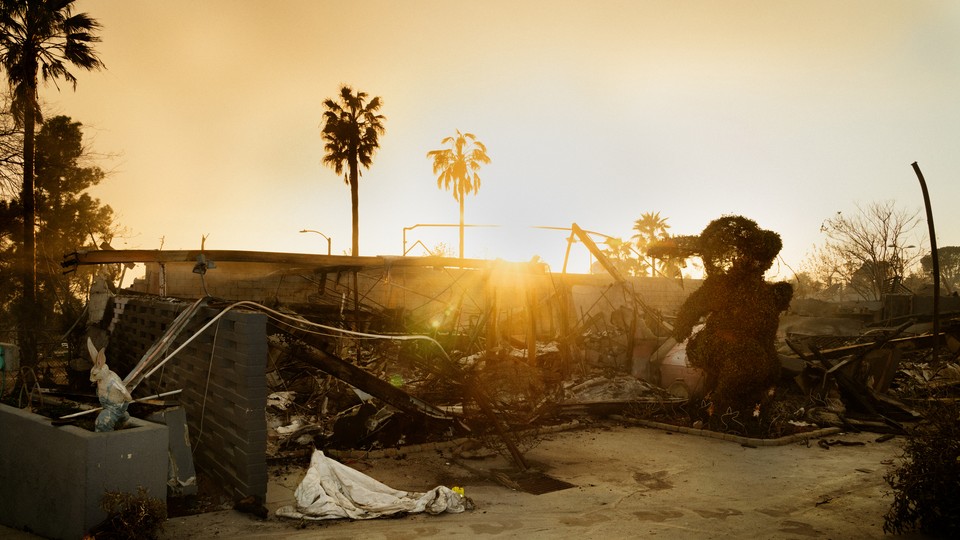
A year after the Palisades Fire, recovery remains slow with only 14% of destroyed homes approved for rebuilding. The community displays resilience through hopeful signs while facing ongoing challenges like evacuation alerts and complex rebuilding processes. Experts note each disaster's recovery timeline differs, and Southern California's unique wildfire dynamics require tailored prevention strategies.
Key Takeaways
•Recovery from the Palisades Fire is progressing slowly, with only about 14% of destroyed homes approved for rebuilding so far.
•Community resilience is evident through hopeful messages like 'This home will rise again' alongside frustration expressed in signs like 'THEY LET US BURN'.
•Rebuilding faces numerous challenges including updated building codes, flood-elevation requirements, and the tedious permitting process.
•Wildfire prevention strategies in Southern California need to be tailored to the region's unique conditions, where winds rather than forest fuel are the primary driver of destructive fires.
•Recovery extends beyond physical rebuilding to include emotional healing, community restoration, and adapting to permanent changes in the landscape and social fabric.
A year is only the beginning of recovery from disaster. Ethan Noah Roy This weekend, I stood on a bluff in the Palisades where houses used to be. Los Angeles rose to my left, and the sky had the dramatic clouds we get in the winter when it rains, as it has for a few weeks. The hillsides have turned to Irish green, but the burn scar, below, is still black. Twice, when my family drove past during the holidays, our phones blared with evacuation alerts for possible mudslides and flooding. Since last January, whenever the rain has been heavy, people living near the burn areas have had to sandbag their homes and field evacuation warnings.
Where the Pacific Coast Highway runs through the burn area, the speed limit slows to 25 miles an hour, and building equipment is scattered along the shoulder. What used to be the Malibu Feed Bin—a red barn where one could find both horse feed and a gigantic metal sculpture of a giraffe—is now a collection of temporary offices for the Los Angeles Department of Water and Power’s utilities-rebuilding projects. Inside the Palisades, most of the old landmarks are gone. The Building Block—a 1920s Spanish Colonial building known for being light pink, like the inside of a conch shell—has a piece of its facade still standing.
In the year since the fire, the Army Corps of Engineers has hauled away millions of tons of debris, in what the governor’s office has called the fastest major-disaster cleanup in American history. Most lots are empty now; the city of L.A., which oversees most of the Palisades, has approved rebuilding plans for about 14 percent of the homes destroyed, according to the Los Angeles Times. Paradise moved more slowly toward rebuilding after the 2018 Camp Fire, and Santa Rosa, after the 2017 Tubbs Fire, went much more quickly. Almost 80 percent of the homes lost in the Tubbs have been rebuilt; in Paradise, about a quarter of homes have come back.
Each disaster is different, Kathryn McConnell, who studies wildfire rebuilding at the University of British Columbia, told me: Population size, socioeconomics, and land value all can influence the rate at which a community recovers. But no matter what, a year—even though it can feel like many more when you’re waiting to return home—is not very long in the timeline of disaster recovery.
I saw very few people in the Palisades this past weekend, but the community had left messages on the houses and businesses. A banner on a garden gate: Thank you to all our wonderful neighbors! We can rebuild this beautiful town together. On an elementary school: Returning in January 2028. The CVS, which was spared by the fire, still had signs up from its grand reopening in August. (Across the street, a notice from the L.A. Department of Water and Power read DO NOT DRINK THE TAP WATER.) One of the more frequent lawn signs I saw on empty lots was THEY LET US BURN, a call to come to a protest against city and state agencies that’s happening this morning. There were many FOR SALE signs, and then, over and over again, ones that read instead, This home will rise again.
Paul Horvitz, a lifelong friend of my father whose ranch home of 45 years burned in the fire, was among the first homeowners in the Palisades to get a rebuilding permit. It helped that he’s a mortgage lender and knows more about the real-estate system than many people: Once the rain ends, he will be ready to start construction on his house, which will no longer be surrounded by bougainvillea but will be made entirely of fire-resistant materials. Other Palisades Fire survivors are entering the permitting tedium that survivors of the 2018 Woolsey Fire, in Malibu, have been navigating for years—finding out, for instance, that the plans they used in the ’70s are no longer up to code, or that they’ll need to raise their coastal home higher off the sand to comply with upgraded flood-elevation guidelines. Even a wealthy place like Malibu might rebuild slowly, in part because its geography is so complicated. About 600 homes burned there last year, and about one-third of the owners have put in permit applications. As of New Year’s Eve, only 22 homes have been approved to rebuild.
But rebuilding is only one way to measure recovery. In Malibu, my childhood friends and I realized that all of the restaurants where we’d normally gather at the holidays had burned. In Altadena, a chef whose restaurant survived the Eaton Fire, told CBS that when he goes to work, he thinks, This was a neighborhood restaurant. It always has been. And now there’s no neighborhood. Jennifer Champion and her family lost their house but have moved into a condo in one of the Palisades’ more intact neighborhoods; still, she says not a day goes by that she doesn’t think about how much the fire took. Families of the 12 people killed in the Palisades Fire will gather for a ceremony today.
Everyone wants to make the next fire less brutal. Michael Rohde, an emergency-management consultant and a retired battalion chief with the Orange County Fire Authority, grew up just south of L.A., where he could see a fuel break the width of eight bulldozers on Mount Wilson. These types of clearings are meant to slow fires down by limiting the material they have to burn, but a large, indiscriminately placed fuel break like that probably won’t do much good when winds can carry embers for miles, Rohde told me. In Southern California in particular, clearing away strips of flammable brush could actually make the problem worse by inviting invasive grasses, Max Moritz, a wildfire specialist with the University of California Cooperative Extension, told me. He and other researchers have been beating this drum for decades. Already, the too-frequent fires in L.A. create an opening for these species to grow back instead of the native chaparral, Alexandra Syphard, an ecologist for the Conservation Biology Institute, told me. These are the grasses making the hills green right now, but by the summer, they dry into brown fuels that ignite more easily than the native plants.
Fuel breaks can still help during a fire, researchers and firefighters both told me, when placed along roadways and directly around housing developments where firefighters can access them. But the breaks need to be used more sparingly than they might be in forested land, and placed more deliberately. As part of the area’s recent fire-resiliency projects, public-land organizations have now been working on smaller, strategically placed breaks. Michael O’Connell, the president of Irvine Ranch Conservancy, told me that the IRC and its partners are developing some fuel breaks that replace nonnative grass with heavier, less flammable shrubs and cacti. Still, only recently has the state begun to manage Southern California fires as their own distinct problem. What works in the forests of Northern California, where fires are fueled by the forest itself, might not do as much in Southern California, where the most destructive fires are propelled by strong winds.
Those winds will return here; some of the people, homes, businesses, and routines will too. But many will not. Horvitz told me that some of his neighbors are still deciding whether they’ll come back. One who already moved away worried the place would just burn again; another had lived there for decades and took the fire as a sign it was time to go. Along one stretch of the Pacific Coast Highway, the Reel Inn (a restaurant with surfboards in its rafters, and good fish tacos), Wylie’s Bait and Tackle (a shack opened by Bill Wylie in the ’40s, now owned by his granddaughter), and the Topanga Ranch Motel (bungalows from 1929, where Malibu kids would wait for the school bus) all burned and are now behind a chain-link fence. California State Parks, which owns the land, told at least the Reel Inn that it would not be renewing the business’s lease; then, after a local uproar, it told the restaurant it wanted to figure out a path forward. For the moment, when I drive on PCH at night, silhouettes of bare bluffs and hills, just barely darker than the sky behind them, line one side of the road. On the other side used to be homes. Now I can see the ocean.