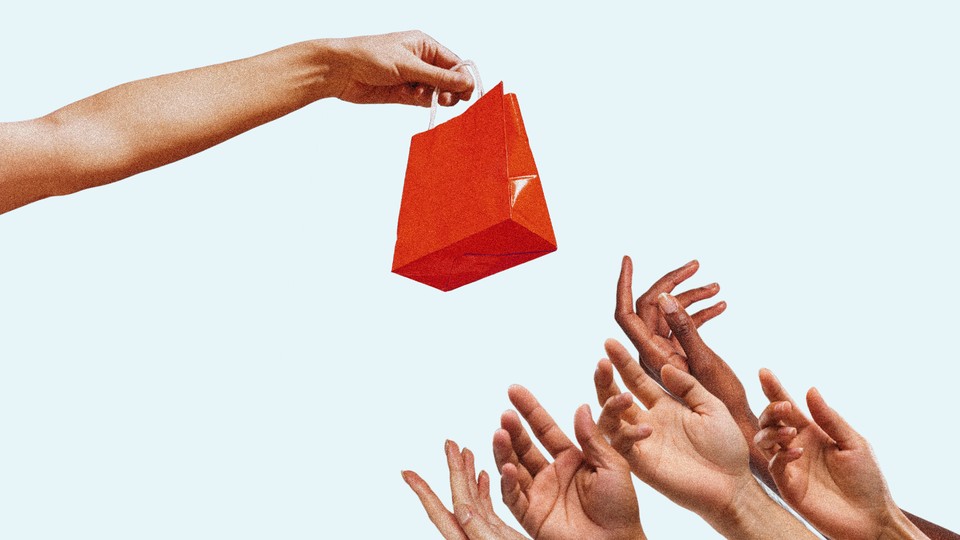
Drops create artificial scarcity to turn shopping into a game, making ordinary products feel exclusive. This tactic, once used by niche brands, now drives mass-market hype for mediocre items.
Key Takeaways
•Drops leverage human psychology by creating artificial scarcity, making products feel more valuable and exclusive.
•Originally from small streetwear brands, drops have spread to mainstream companies, turning inventory management into cultural events.
•The practice fosters a sense of belonging and excitement, but often results in hype over mediocre or easily replicated products.
•Drops have spawned secondary industries like resale markets and professional queuing services, highlighting their commercial impact.
When everything’s a drop, what’s the point of a drop? Illustration by The Atlantic Scarcity is humanity’s great motivator. This has been true forever, since back when we were basically apes: The most important resources—food, shelter, mates—were the ones that were most in demand. Shortage meant value, and being attuned to value meant staying alive. We learned to focus on the rare thing at the expense of what was around it—psychologists call this “tunneling”—and to prioritize avoiding loss over gaining rewards. It was typically smarter to fight for something everyone else wanted than to waste time looking for something else. That animal wisdom is a reason our species survived.
It is also a reason that, in late 2025, you could find a grown adult—a person who lives in the kind of material plenitude our distant ancestors could never dream of—in a Starbucks parking lot before dawn, desperately seeking a coffee cup shaped like a teddy bear. You see, this coffee cup was available only as a drop.
Generally speaking, a drop is just a slightly different way of releasing products. Instead of making goods at the rate of expected demand and releasing them without fanfare, companies are producing in intentionally low quantities and releasing in discrete, highly hyped events. When Starbucks’s cup—the “Bearista”—dropped in the United States in November, many customers reported that their store had only a handful, which people lined up overnight to buy. Warby Parker releases new frames via drop. Figs periodically drops limited-edition colors of its scrubs. Snack-food conglomerates have, in recent years, begun unleashing Marvel-themed Oreos or southwestern-ranch-flavored mayo the same way. Skims, Kim Kardashian’s lingerie brand, got huge operating primarily on a drop model—a never-ending carousel of novel products, available first come, first served.
At this point, the drop is so popular that it has nurtured its own cottage industries and developed its own technology. An entire YouTube genre is devoted to helping viewers game out Labubu drops. In New York, the professional standers of Same Ole Line Dudes will wait outside sample sales or clothing stores for $25 an hour, with additional premiums for overnight waits and inclement weather. Websites such as StockX capitalize on the booming market for resold limited-edition products. The cloud-computing company Queue-it builds software that helps ensure that online retailers’ sites don’t crash during concert-ticket releases and new drops; on a call with me, Malou Toft, the company’s chief revenue officer, compared the product to the Hoover Dam, in that it funnels a torrent of would-be customers into a manageable drip.
Sometimes the drops beget more drops. Last month, the granola brand Purely Elizabeth dropped a limited-edition granola and partnered with the chain Cha Cha Matcha on a menu inspired by that granola; naturally, the menu was also available for only a limited time. Sometimes, the products being dropped aren’t all that different from a brand’s regular offerings. Often, they sell out so quickly that the substance doesn’t matter. What everyone remembers isn’t the exquisite detailing on the Wicked limited-edition Stanley cup—it’s that people went nuts trying to buy them.
This is, of course, the point. Drops create artificial scarcity and manufacture novelty. They make underwear feel like a new iPhone, a coffee cup feel like a collector’s item. They turn inventory management into a cultural event and shopping into a game, even if it is one in which the prize is the right to spend $80 on a pair of Crocs that look like the Windows XP wallpaper.
When the drop was first adopted, it was by scrappy, small-production streetwear companies that had been forced by necessity to create limited inventory and to mete it out over time—if they made too much, they risked having leftover T-shirts, but if they made fewer products, everything could get bought up immediately, and shelves would sit empty for weeks or months. But if the practice was meant to keep supply and demand in harmony, it really, really didn’t work. Soon enough, “drop days” were convening hundreds of people outside tiny stores. Anything that, say, the cultish brand Supreme stamped its blocky logo on—a brick, a voodoo doll, a functional fire extinguisher—and issued as a drop became an overnight fetish object. In 2019, the company MSCHF was founded to specialize not in any one product but in drops, the more absurd and attention-grabbing, the better: a malware-infected laptop that sold in 2019 for $1.3 million; Nike Air Max 97s injected with holy water. MSCHF claims to be an artistic project skewering consumer culture, but I’m not so sure what the people buying its stuff think is happening.
In essence, all of these companies were adapting a practice that the jewelry and high-fashion industries have long relied on. Diamonds aren’t rare; for decades, De Beers has carefully controlled their supply to drive up demand. Designers such as Burberry have been known, in the past, to burn unsold goods in order to prevent them from being put on sale, which would dilute the brand.
But as the artificial-scarcity tactic spreads, it becomes less coherent. In my conversation with Toft, talking about drops led to an unlikely place: Abercrombie & Fitch, which in the early 2000s carried limited sizes and cultivated a clubby atmosphere, down to the beefy 18-year-olds standing sentry outside. “People felt as if they were part of an exclusive club,” Toft told me. “I think that’s what all of our companies online are trying to create: that feeling of belonging to a secret club that has early access or has special access to a certain product.”
It sounded to me like a pretty apt comparison to late-stage drop culture. Abercrombie & Fitch is, at the end of the day, a mall store, not particularly selective about whose money it is willing to take. Drops were once reserved for hypebeasts and collectors buying items so meticulously handcrafted that they could be made only in ultra-limited qualities. Now they are for normal people buying factory-produced suitcases or cookware or snack foods. Companies post extensively about upcoming drops, all the better to whip up excitement. Men’s magazines publish lists of “The Biggest and Boldest Fashion Drops of Fall.” And the stuff isn’t special, because it’s the same stuff as all the other stuff—it’s just made slightly less ordinary by virtue of the way you buy it. Within days of selling out at Starbucks, the Bearista cup was available knocked off on Amazon.