Trump Can’t Decide Whether the Iran War Is Still Going On
TL;DR
President Trump's conflicting statements on the Iran war's status, including declaring it 'very complete' while the Pentagon signals ongoing conflict, highlight administration confusion and economic concerns.
Key Takeaways
- •Trump's contradictory remarks on the Iran war's completion versus ongoing military actions create uncertainty and market instability.
- •The administration lacks clear goals and rationale for the war, with Trump offering multiple justifications and displaying ignorance on key facts.
- •Economic impacts, such as rising gas prices and stock market volatility, are exacerbated by the war and Trump's inconsistent messaging.
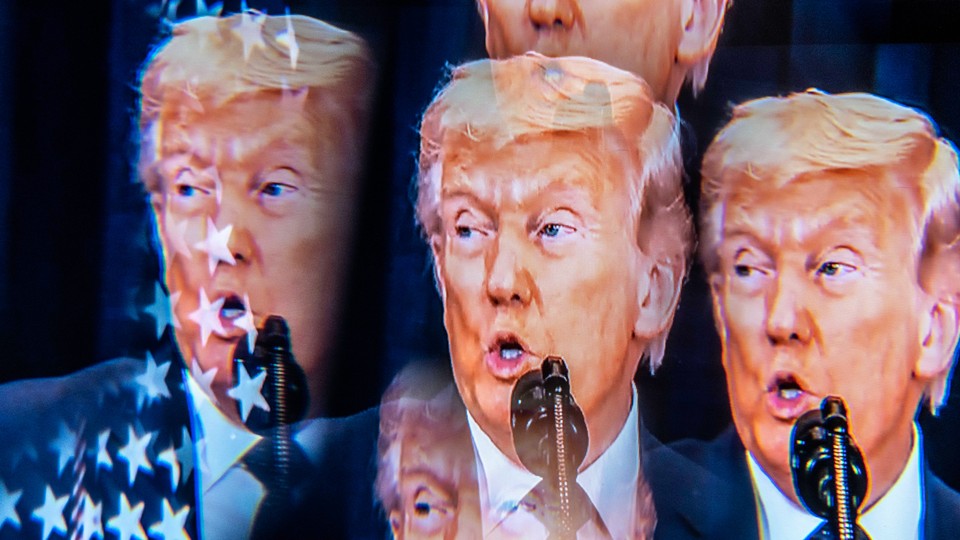
The Trump administration can’t say why the United States went to war with Iran, and it can’t say what the goal of the war is. Now it can’t even decide whether the war is still going on.
During an interview with CBS News yesterday afternoon, President Trump all but declared victory. “I think the war is very complete, pretty much,” he said.
This statement is so self-contradictory and confusing that one might be tempted to write it off as just riffing, except that he reiterated it at a press conference later in the day. “We’re achieving major strides toward completing our military objective, and some people could say they’re pretty well complete,” he said, apparently referring to himself. All that was missing to complete the parallel to the Iraq War was a flight suit, an aircraft carrier, and a Mission Accomplished banner.
Yet the same afternoon, the Department of Defense posted on X, “We have Only Just Begun to Fight,” mangling a famous quotation from John Paul Jones, the father of the U.S. Navy. Reporters at the press conference, perplexed, asked Trump about the gap. “You said the war is ‘very complete,’ but your defense secretary says this is just the beginning, so which is it?”
“Well, I think you could say both,” Trump replied.
You could—if you were a pundit making an argument about the future of the war. But people might hope for a bit more clarity from the man who launched the war without congressional authorization, popular support, or even much buy-in from his own advisers.
Trump’s equivocation yesterday may be his attempt to steady an economy shaken by the war. The president’s approval has been battered recently by the high cost of living. Although inflation was a major factor in his victory over Kamala Harris in 2024, Trump has seldom focused on it since entering office and has insisted that affordability is somehow both a Democratic “hoax” and a problem that he has already solved.
The war in Iran has exacerbated existing stressors: It has driven up gas prices, rocked stock markets, and suggested that Trump’s attention is not on the economy. The president appears rattled by this and even called on oil-tanker captains to “show some guts” and sail through the contested Strait of Hormuz, according to Fox News’s Brian Kilmeade, though he hasn’t volunteered to personally dodge Iranian missiles aboard a floating makeshift bomb.
Trump’s comments yesterday seemed to work, at least in the immediate term: Oil futures dropped, and markets rebounded a bit. Over time, however, whatever succor Trump provides to the economy by saying that the war is nearly over is likely to be canceled out by his administration’s vacillation. Markets seek stability, and Trump can’t seem to decide on a talking point, much less a strategy or aim for the war itself. As my colleagues Marie-Rose Sheinerman and Isabel Ruehl reported last week, Trump offered 10 different rationales for the war in its first six days alone. Traders may be primed to look for examples of Trump chickening out, but yesterday’s remarks seem more like a feint at ending the war: Defense Secretary Pete Hegseth declared that today would “be yet again our most intense day of strikes.”
Trump appears confused not only about the future of the war but also about some of its basic facts. The U.S. has faced international criticism over a missile strike on a girls’ school in Iran, which was next to a naval base that was also struck. Iranian authorities say that about 175 people were killed at the school, mostly children. Over the weekend, Trump said that the attack was friendly fire. “In my opinion, and based on what I’ve seen, that was done by Iran,” he said. “They have no accuracy whatsoever. It was done by Iran.”
Since then, evidence has emerged that the missile that struck the base was a Tomahawk, an American-made weapon. Yesterday, Trump claimed that Iran possesses Tomahawks. “Whether it’s Iran or somebody else, the fact that a Tomahawk—a Tomahawk is very generic,” he said. “It’s sold to other countries.” This is nonsense: Only a few U.S. allies, including the United Kingdom and Australia, are known to have them. When a New York Times reporter confronted Trump, asking why no one else in the government was backing up his claims, the president folded. “Because I just don’t know enough about it,” he replied. “Whatever the report shows, I’m willing to live with that report.”
This claim of ignorance is surprising, because Trump usually claims to know better than everyone around him. When asked a question to which he doesn’t know the answer, his default is to say that he’s considering it. But on occasion, when really backed into a corner, Trump will throw up his hands and claim that he doesn’t know anything about a topic.
No president can or should be expected to know everything. This is why he’s provided with a Cabinet and a team of other advisers, an executive branch full of subject-matter experts, and a Congress and judiciary to serve as checks on him. The problem is that Trump wants to operate with complete freedom from any restrictions and without waiting for advisers’ input. Asked when the war would completely end, Trump told CBS, “Wrapping up is all in my mind, nobody else’s.” That’s not very reassuring, for stock markets or anyone else.
Related:
Evening Read
The Highly Exclusive Way That Everybody Shops Now
By Ellen Cushing
Scarcity is humanity’s great motivator. This has been true forever, since back when we were basically apes: The most important resources—food, shelter, mates—were the ones that were most in demand. Shortage meant value, and being attuned to value meant staying alive. We learned to focus on the rare thing at the expense of what was around it—psychologists call this “tunneling”—and to prioritize avoiding loss over gaining rewards. It was typically smarter to fight for something everyone else wanted than to waste time looking for something else. That animal wisdom is a reason our species survived.
It is also a reason that, in late 2025, you could find a grown adult—a person who lives in the kind of material plenitude our distant ancestors could never dream of—in a Starbucks parking lot before dawn, desperately seeking a coffee cup shaped like a teddy bear. You see, this coffee cup was available only as a drop.
Read the full article.More From The Atlantic
Explore. Hollywood’s star power is shifting, David Sims writes. Auteur filmmakers have become as much of a selling point as the actors they work with.
Reflect. Are we all material—tissues and veins—or is there some nonmaterial substance, some essence, that transcends the corporeal form? The scientist Alan Lightman explores the “profound disconnect” between the mind and body.
Play our daily crossword.
Rafaela Jinich contributed to this newsletter.
When you buy a book using a link in this newsletter, we receive a commission. Thank you for supporting The Atlantic.