The article critiques the modern obsession with analyzing romantic relationships through various 'gaps' like age, swag, or woke differences. It argues that while some gaps reflect real power imbalances, overanalyzing them can be counterproductive and distract from genuine connection.
Key Takeaways
•Modern dating culture increasingly focuses on analyzing relationships through various 'gaps' (age, swag, woke, etc.), which can create unnecessary anxiety and oversimplify complex dynamics.
•While some gaps like age differences can reflect genuine power imbalances, many perceived gaps are subjective and may not predict relationship success or compatibility.
•Dating apps paradoxically expose people to more diversity while also enabling them to filter out differences, creating tension between encountering and avoiding gaps.
•The article suggests that focusing too much on gaps is narcissistic and counterproductive—true connection comes from seeing partners as individuals, not just in relation to oneself.
•Similarity and complementarity are poor predictors of relationship success; relationships thrive on mutual understanding, not perfect alignment of traits.
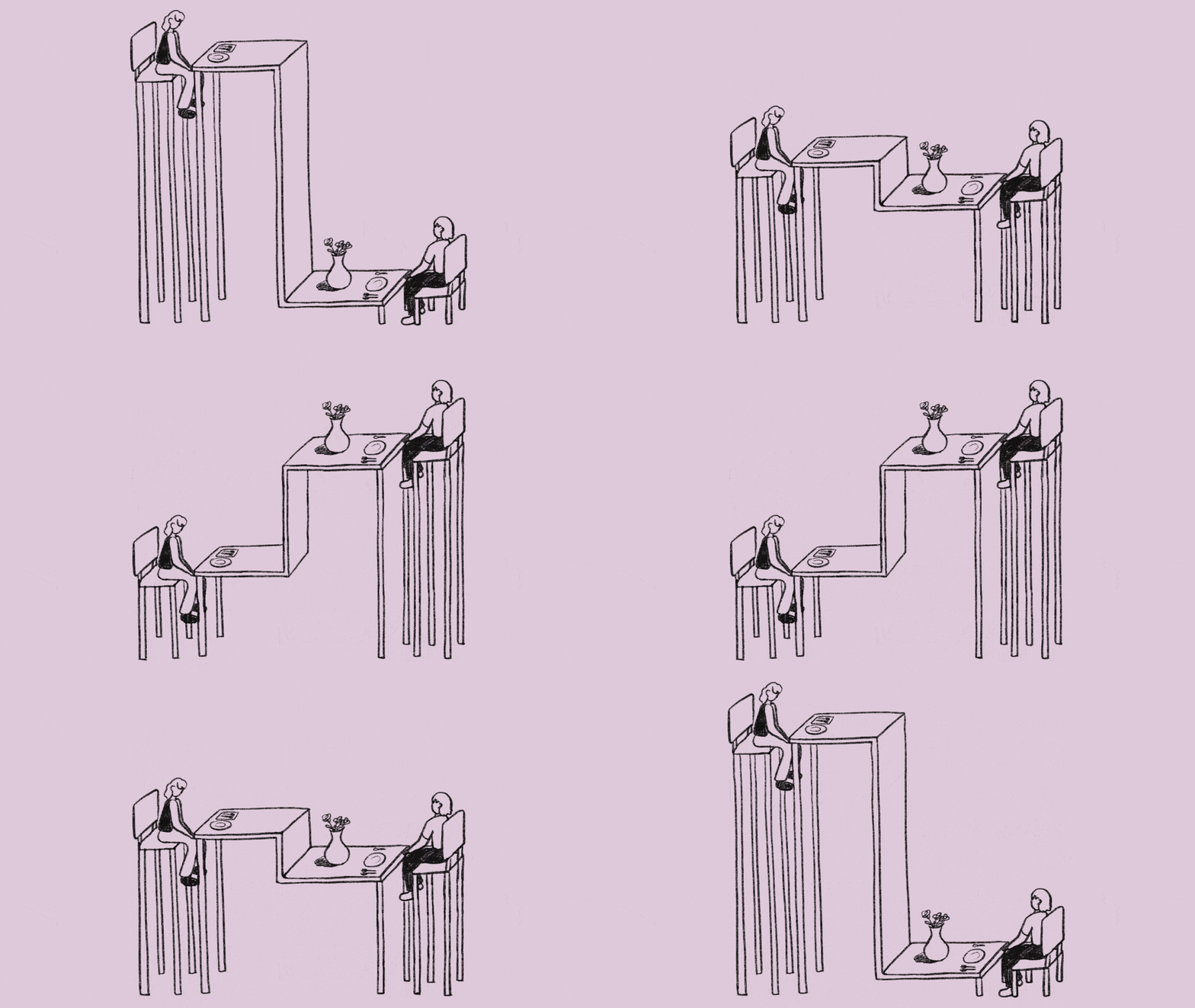
Age gaps, swag gaps, woke gaps—where does it end? Illustration by Alisa Gao / The Atlantic Every so often, I hear a time-honored dinner-party question that always leads to lively debate: Would you sleep with your clone?
It’s hard to say where the conversation starter came from. Perhaps it originated with a 2015 BuzzFeed article titled “Can We Ask You a Really Weird Question?,” which inquired—well, you know. Or maybe it can be traced much further back, to works of science fiction that explored similar puzzles. Is a clone conscious? Does it have rights? But today’s clone query, in my experience, tends to prompt chatter about something a little less heady: whether engaging sexually or romantically with someone just like yourself sounds like a creepy nightmare—or whether it sounds like a dream of convenience, of perfectly aligned interests and interactions as frictionless as silk.
I’ve been thinking about this because lately, I keep hearing about the differences between lovers. You’ve probably heard of age-gap relationships. But what about the “job importance gap,” the “woke gap,” the “growth gap,” the “AI gap”? The “being able to breathe through your nose properly gap”? (That one hits for me.) Within a period of four months last year, the culture magazine Dazed published articles on “swag gaps,” “intelligence gaps,” and “party gaps.” You can pop “gap” on the end of just about any attribute—and when you get in the habit, analyzing your own relationship dynamics in these terms becomes easy. Come to think of it, I’ve experienced anxiety gaps (I was the more nervous one), cooking gaps (call me chef; I don’t order in every meal), and sleep gaps (I need my eight hours).
In the wilds of the internet, some “gap” references are played solely for laughs; others appear completely serious. Many fall somewhere in between: They go for cheeky and knowing while making a sincere point—usually about approaching the gap in question with caution, or avoiding it entirely. And this category is the kind that can get in your head; any perceived distance, if you squint, might turn from a sliver into a canyon. Take the swag gap. On its face, it means a mere discordance in stylishness. Perhaps you throw the phrase around at brunch while unpacking a recent flirtation. But then TheWall Street Journalsuggests that it may be “less about aesthetic misalignment than imbalance of self-worth.” The article is full of quotes from people apparently regarding the swag gap with solemn earnestness. Suddenly the bagginess of your pants, in stark contrast to a crush’s skinny jeans, may seem to reveal a deeper truth about the soul.
I’m not surprised that people are wrestling with what it means to desire someone different from them. Since the rise of dating apps, singles—instead of coupling up with people in their social bubble, who are likely to be similar to them—have become more likely to date across race, education, and religious lines. This is a big societal shift, but within individual relationships, the change tends to be felt in idiosyncratic little ways. A museum-appreciation gap could be a class gap in disguise. A camping gap could indicate disparate upbringings: Maybe one partner grew up riding city subways and naming the rats, whereas the other was tromping through woods, singing with the birds.
The irony is that although online dating has allowed people to mingle with a greater diversity of romantic prospects, it also gives the illusion of control over any perceived incompatibilities. On apps, you can filter out anyone with an age or faith or ethnicity unlike yours. You can drop hints about your background—by sharing your Ivy League alma mater and an obscure literary reference, or including a photo of yourself beaming with a caught fish—and swipe past profiles without similar signals. You can decide that traveling a few neighborhoods away would be too much of a pain. It’s never been this easy to encounter difference in a dating pool—or to evade it.
Not all reservations about gaps are unwarranted. Asymmetries can, for instance, result in lopsided power dynamics. Just think of the granddaddy of today’s hyperspecific divisions: the age gap, which is far more likely to involve an older man and a younger woman, and can truly be troubling when the younger party is very young. Some would be glad that the average age difference between partners, according to the Pew Research Center, has been declining since 1880.
Indeed, gaps of many kinds have been presented as obstacles to equality—perhaps especially for women. The swag gap became notorious when a certain tabloid photo of Justin and Hailey Bieber dropped: Hailey strutting ahead in a bright-red minidress, her hair pinned into a bun, the shimmer in her eye shadow and necklace catching the light; Justin slouching behind in a heather-gray sweat suit, the zipper halfway down and no shirt underneath, his face enclosed by a drawn hood. The image seemed to capture something a lot of women had already felt: that they were expected to doll themselves up, make the plans, do the chores, work the charisma, all for what Olivia Rodrigo has called a “second string loser”—a man who doesn’t do his own laundry or schedule in advance, because he has no need to. “I’ve watched the smartest, hottest, kindest, most talented women of our generation fall for the guy who didn’t utter a word at happy hour,” one writer, considering men’s role in the swag gap, grieved on the lifestyle website InsideHook.
This kind of resentment has been simmering in the culture for a while now. Back in 2016, Vulture published an article—a portent of the true gap era to come—about the “attractiveness gap” trope on screen. (Think Everybody Loves Raymond, The King of Queens, nearly anything in the oeuvres of Judd Apatow and Rob Schneider.) Some filmmakers, the article pointed out, have been criticized for selling viewers “the male fantasy that you, too, can be a lazy zhlub with barely any redeeming qualities and still get a super-hot wife willing to put up with it.” But it’s not a fantasy at all, the article argued; it’s just an observation of life.
If gaps reflect societal inequities, then closing them could be seen as a just and necessary corrective. To what end, though? Should partners be like clones of each other, neither one hotter or funnier or more able to breathe through their nose? That may be difficult to actualize. And when power differentials do exist, they’re rarely clean-cut. That is a major insight of Sally Rooney’s Normal People: When a hunky and popular young man from a loving, working-class home gets involved with a lonely and “plain-looking” young woman from a wealthy, emotionally frigid family, they each wield their specific types of privilege and envy the types they don’t have. They wound each other in a million different ways. And they fascinate each other in just as many.
People might be doing themselves a real disservice, in other words, by paying gaps too much mind. Sure, a woman deserves a partner who matches her level of emotional commitment. But does she need one with identical career ambition? Why not go for someone with a chiller schedule who can give her snacks and foot massages while she’s on the grind? Even age-gap critiques can go too far. In a recent HuffPostarticle investigating why “Gen Z Is Particularly Weird About Relationship Age Gaps,” Justin Lehmiller, a research fellow at the Kinsey Institute, told the author that more and more young people seem to view age differences as “inherently exploitative.” But he and other experts were concerned that nuance was getting lost. Lehmiller has been studying age-gap relationships for years, and said he believes that in many of them, “nothing untoward is happening.”
Psychologists generally agree that similarity isn’t a good predictor of romantic compatibility. Nor is “complementarity”; opposites don’t necessarily attract. Gaps, then, aren’t a hugely helpful frame with which to consider relationships at all. And besides, isn’t it a bit navel-gazey to think so much about yourself in comparison to others? Freud called that impulse the “narcissism of small differences”: the frivolous ways we strive to neatly differentiate ourselves. In truth, we all exist on messy spectrums of an endless number of qualities, and we act differently at different times. You might cook more than your current partner but less than plenty of other people. Your job may be important to you—but who knows, maybe you’ll lose it. If 10 years from now you look back on this day, will you really think you had that much swag?
Better to try seeing someone in their own right: for who they are, not just who they are in relation to you. “Love,” the novelist Iris Murdoch wrote, “is the extremely difficult realization that something other than oneself is real.” If I could invite her to a dinner party, I might ask a certain question—and I think I know how she would answer.