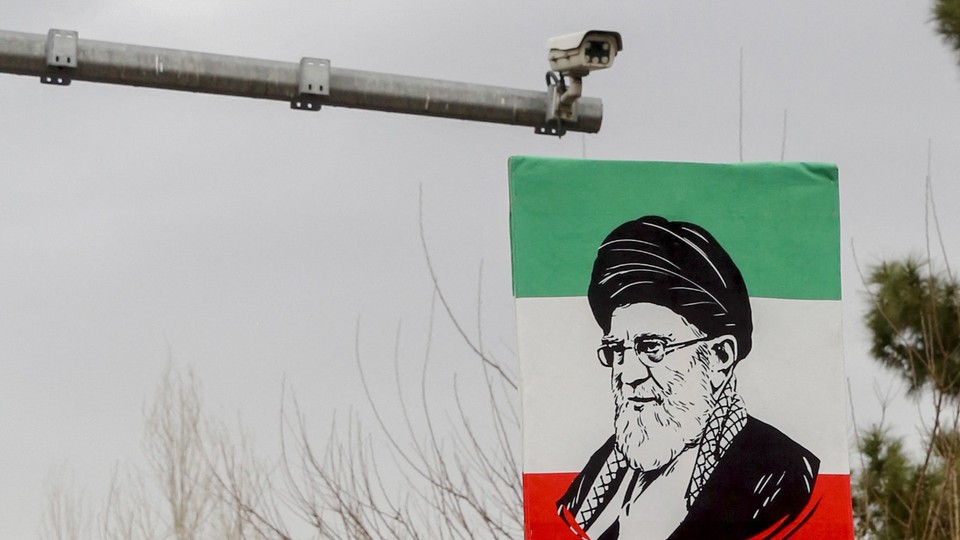
A dark joke about an Iranian offering to pay to help overthrow the regime illustrates how oppressed citizens use humor as resistance and actively aid foreign powers against their government.
Key Takeaways
•Iranians use grim humor as a form of psychological resistance against their oppressive regime.
•Citizens are reportedly providing intelligence to help Israel and the U.S. target Iranian leadership.
•Historical parallels from Fascist Italy, Nazi Germany, and Soviet Russia show how jokes sustain hope under tyranny.
•The article suggests Iranians are moving beyond jokes to actively participate in undermining the regime.
Dark humor is sometimes the most reliable weapon. Babak / Middle East Images / AFP / GettyThe agent asks an Iranian: “Are you willing to work for Israel and the United States to overthrow the Khamenei theocratic regime?”
The Iranian replies: “I am willing!”
The agent says: “That’s awesome! A hundred thousand dollars!”
The Iranian looks troubled, hesitates for a moment, grits his teeth and says: “A hundred thousand it is! But I can’t come up with that much all at once—can I pay in installments?”
That joke, which I happened to come across today, sheds light on what’s happening in Iran.
On Saturday—the first day of the present air war against Iran—the United States and Israel reportedly killed 48 regime leaders, including the supreme leader, Ayatollah Ali Khamenei. Today an Israeli strike flattened the site in Qom where the regime’s most senior clerics gathered to elect a new supreme leader—though it’s unclear just how many were in the building at the time.
This targeting success surely owes much to advanced electronic surveillance and deep cyber penetration of Iran’s weapons systems and infrastructure. But in this war, as in the 12-day war last year, Israel and the United States are obviously benefiting from intelligence from some Iranians themselves, who are willing to risk their lives to help bring down the Islamic Republic.
The Iranian regime has oppressed, humiliated, and murdered its people. In anger and pain, those people make a joke out of their readiness to accept rescue from any source—and to aid and welcome that rescuer in any way they can.
Rescue does not always arrive as yearned for. But one weapon that’s always available to the oppressed is the subversive joke. Dark humor expresses an inner refusal to acquiesce in one’s own oppression. When other forms of truth are suppressed, the joke must serve instead.
A mother heads to the market to buy food for her children. It’s harvest season, yet there is nothing to buy. She cannot restrain herself from speaking aloud: “He has ruined everything! He has destroyed this country!”
She feels a tap on her shoulder. She wheels around to see a policeman. He asks in a menacing voice, “Of whom are you speaking, signora?”
Thinking quickly, the mother replies: “Of my husband! I was speaking of my husband.”
The policeman snaps to respectful attention. “I beg your pardon, Signora Mussolini!”
A good joke could exact a heavy price from those who told it.
A Soviet judge exits his courtroom, laughing enthusiastically. A fellow judge approaches him.
“What’s so funny?”
“It’s a joke, but I can’t tell you,” answers the laughing judge. “I just sentenced the man who told it to me to five years in a labor battalion!”
Laughter is one way to sustain hope until the day of liberation. Or as a Nazi-era German joke puts it:
Every day, a shabbily dressed man pauses at the same newsstand to scan the front pages. He then moves on without buying anything. At last the news seller confronts him.
“I know times are tough, but you must be able to afford at least one single newspaper.”
“I don’t need to buy the whole paper. I only care about the obituaries.”
“You do need to buy the paper, because the obituaries are in the back pages.”
“Not the one I’m looking for. That one will be right up front.”
It appears that Iranian citizens are not merely telling grim jokes or waiting for the obituaries they hope to read. They’re doing their part to speed those obituaries into reality. Until then, one more Soviet-era joke expresses the nightmare the tyrannical Islamic regime has made of Iranian lives:
A man is walking down a Moscow street, weeping uncontrollably. A policeman stops him.
“Why are you crying?”
“I’m not allowed to say.”
The policeman grabs him: “Tell me or I’ll arrest you.”
The man wipes his eyes and says: “Fine. I’m crying because it’s the only thing they haven’t banned yet.”