The article critiques the excessive media coverage of moon events like supermoons, arguing it stems from traffic-chasing journalism. It explores how the moon became a reliable source of viral content due to its universal appeal and predictable awe factor.
Key Takeaways
•Media outlets excessively cover moon events (e.g., supermoons) primarily to generate clicks and traffic, especially during the digital-media boom.
•The moon serves as a 'platonic ideal' of shareable content because it's universally loved, predictable, and evokes awe without controversy.
•This trend reflects broader issues in journalism, such as reliance on metrics and the chase for viral stories, but is considered relatively harmless compared to other traffic-chasing tactics.
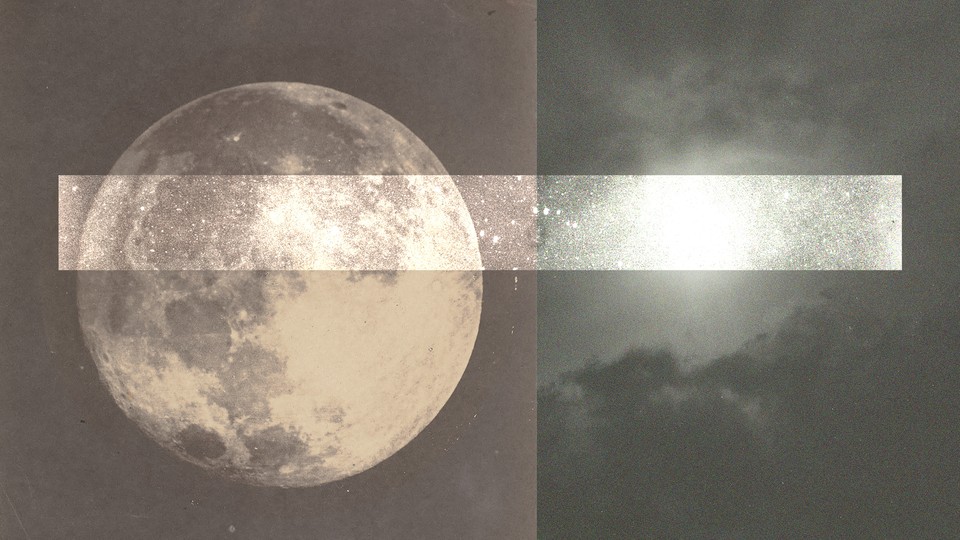
Not every lunar event requires a media frenzy. Illustration by Anna Ruch / The Atlantic* For the past several years, I’ve been experiencing a tension in my relationship with the moon. I love the moon as much as anyone, but the problem, bluntly, is that the moon is too famous. Maybe you’ve noticed this. The moon is constantly in the news. It is doing something “rare” or “unique” seemingly every week. Local-news outlets will inform their readers that a supermoon is about to “take to the skies” or rise “over Milwaukee,” in stories that are not technically inaccurate, though they do fail to acknowledge that the moon is always taking to the skies and that it rises over everyone. (They will often also give advice on how best to view the moon, as though most of us don’t know generally where it is.)
National outlets do the same thing. The main difference is that Newsweek will claim that a supermoon is rising not over Milwaukee but over the United States. A partial list of outlets that covered the supermoon last month includes Time, Mashable, LiveScience, PBS, ABC News,Wired, CNN, Vogue, CNET, USA Today, the Associated Press, and The Washington Post. Forbes chose to innovate by referring to it as a Christmas supermoon, even though it was visible only for a short period in the first week of December. Elle also had a creative take, which was that “supermoon season” would have some kind of profound effect on our minds and bodies (as is generally the idea when moon coverage intersects with astrology).
Admittedly, this has become a bit of a fixation for me. I’ve tried to get my colleagues worked up about it too, a few times, by sharing links and writing “STOP TALKING ABOUT THE MOON!!!” in a Slack channel. The December supermoon coverage led me to notice—though only with a huh, look at that—the December supermoon, which was pretty bright and reminded me again of this interest. So, as the year drew to a close, I thought I might as well ask and answer the question “Why is everyone talking about the moon all the time?”
On some level, it’s obvious. The moon is great. Many moon events have tantalizing names. A Blood Moon, for instance, is another name for a total lunar eclipse, which happens every few years. A supermoon is another name for a full moon that occurs when the moon is at the point in its orbit that brings it closest to the Earth, providing the illusion of a bigger, brighter moon, which usually happens three or four times a year. Depending on when the supermoon occurs, it has a different name—a March supermoon is a Worm Moon; a May supermoon is a Flower Moon. In December we had a Cold Moon, which doesn’t look very different from other supermoons, but has a different name because it happens when it is cold. These names tie us to our forebears, in this case by reminding us of older ways of keeping time.
The names can sometimes be confusing. A Blue Moon—familiar from “once in a blue moon,” a phrase indicating extreme infrequency—is the term for when a second full moon appears in one calendar month, which happens every two or three years. It’s possible for a moon to be super and blue. It’s also possible for a moon to be super andblood, as was the case with the Super Blood Moon in September 2015, when all of this, apparently, started.
The Newspapers.com archive shows essentially zero interest in supermoons before 2010, then a small spike in coverage in 2011 around a March supermoon that was somewhat spooky looking, and then an enormous spike in the fall of 2015, which happens to have been right in the middle of the digital-media boom, when newer journalism companies were obsessed with pageviews, shares, and time spent on site. At The Verge, where I worked at the time, we ran this headline: “Tonight, a Supermoon Will Shine Red With the Blood of the Innocent.” That same moon was, as one of BuzzFeed’s several stories on the event put it, “Big and Red AF.”
Jeff Jarvis is a writer and emeritus journalism professor who has been critical of the traffic-chasing business model. When I asked him what he made of moon news, he said he’d wondered about it himself recently. He assumed it was part of a tradition going back to the days of “scissors editors” in newsrooms—folks whose whole jobs consisted of cutting stories out of competing newspapers so that they could be copied. The internet only makes this copying process go more quickly, Jarvis told me. This reminded me that in 2015, many newsrooms would look at a now-defunct online tool called CrowdTangle to see what kinds of stories were performing the best for other outlets. Primarily, what you could see was what was being shared the most on Facebook and other social platforms, including Reddit, which was in itself a good place to source viral stories because of the “Hot” list on its homepage.
Jarvis compared the moon to the famous Dress. In 2015, a BuzzFeed staffer saw a photo of a dress on Tumblr, which she copied into an article under the headline “What Colors Are This Dress?” There was some kind of optical illusion happening: Many people saw it as blue and black; others as white and gold. The post, which included a poll that users could vote in, was a huge hit for BuzzFeed, and for other websites that aggregated it. The moon is also a naturally occurring, free source of traffic. And Ben Smith, who was the editor in chief of BuzzFeed News in 2015 and wrote a book about the golden age of traffic (called Traffic) in 2023, also likened the moon to the dress. “This feels like the last gasp of the old, good, universalizing internet,” he wrote to me in an email. He called the moon the “platonic ideal” of “Is this dress blue or white?”—in other words, the platonic ideal of shareable content.
The difference is that the dress (73 million pageviews) happened only once. “The beauty of the moon is it keeps coming back,” Jarvis said. Writers can write about the moon doing what the moon does again and again, for the rest of time. “It’s a waste and stupid, but it’s harmless,” he said. “Nobody gets offended by the supermoon.” They don’t, that’s true. But I told him I have been a little offended by the cynicism—by calling on the huge and wonderful moon to serve such a small and silly purpose as generating clicks. He seemed to sympathize. He agreed that a case could be made that these stories are somehow cheapening the cosmos. “You’re hyping the moon. It doesn’t need any hype.”
Exactly. And that means the inverse is also true. Who cares if we hype the moon? The moon is unaffected. The moon is the moon forever. Our hype glances off it and does less than the tiniest meteoroid. That sturdiness and predictability are exactly why we turn to it so often in this desperate business. Internet traffic is “very mysterious,” Caitlin Petre, an associate professor of journalism and media studies at Rutgers, told me when I called her to talk about the important question of whether it’s okay to exploit the moon for our petty ends. Even with the advanced metrics that most newsrooms have access to now, you often end up guessing about the desires and interests of an undefined “audience.” But the moon is the rare topic about which there is no guessing. People love it.
Petre, the author of the 2021 book All the News That’s Fit to Click: How Metrics Are Transforming the Work of Journalists, pointed me to a famous 2011 study that found that stories evoking anger, anxiety, or awe were shared more often than other stories. Of those three emotions, awe is clearly the most ethical to try to elicit. “I guess I would say, in the annals of all the things that news organizations do to chase traffic, writing about the moon is probably one of the best ones,” she said. “That would be my take.”
So here I am writing myself into the annals of moon-hype traffic. Tonight there will be a supermoon called a Wolf Moon. You can learn about it in many ways, including via a USA Today story syndicated on many local-news websites, which I found because of the flawlessly search-optimized headline “When Is the Next Full Moon? Wolf Moon Will Be First, Bright Supermoon of 2026.” Many things are uncertain, but I know the supermoon will be beautiful and I know what it will do—it will rise over your city, wherever you are.
*Illustration by Anna Ruch / The Atlantic. Sources: John Adams Whipple / James Wallace Black / Heritage Images / Getty; Alfred Stieglitz / Heritage Images / Getty; SSPL / Getty.