Barry Bonds, baseball's record-breaking slugger tainted by steroids and personal controversies, remains a polarizing figure. Despite recent public adoration and a complex legacy shaped by his father's influence, he continues to be excluded from the Hall of Fame, leaving his place in the sport's history unresolved.
Key Takeaways
•Barry Bonds holds the MLB home run record (762) but is widely associated with steroid use, which has kept him out of the Hall of Fame despite his on-field greatness.
•His legacy is deeply influenced by his father Bobby Bonds and godfather Willie Mays, with childhood pressures driving his competitive nature and career achievements.
•Bonds' character flaws, including allegations of domestic abuse and arrogance, contrast with his athletic prowess, creating a divisive perception among fans and voters.
•Despite changing public sentiment and recent honors like Barry Bonds Day, Hall of Fame committees consistently reject him, reflecting ongoing debates over integrity in baseball.
•In retirement, Bonds has found peace in cycling and a quieter life, but his baseball legacy remains contentious and unresolved.
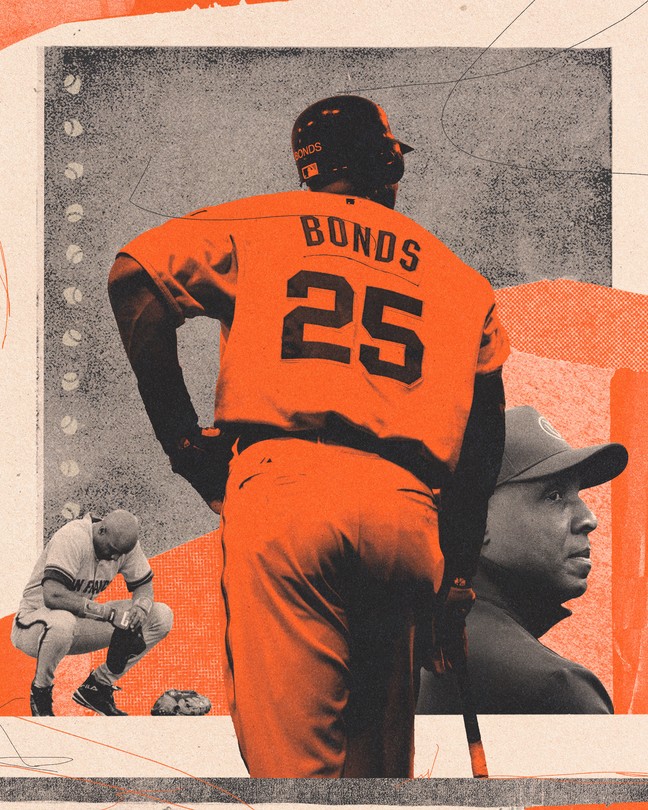
He was baseball’s ultimate slugger—and its biggest heel. Two decades after the steroid scandal that upended his career, America still doesn’t know what to do with him. Illustration by Alicia Tatone. Sources: Jeff Boan / AP; Jeff Chiu / AP; Rich Pilling; Getty. When Barry Bonds shakes my hand, he squeezes my metacarpals like he’s gripping one of his old maple-wood bats. Then he looks directly at me and past me at once, like I’m some journeyman pitcher whose changeup he’s about to take deep. He’s no longer the 228-pound slugger you remember—a decade of cycling has made him much leaner than the previous time he was in the public eye. He’s also older now, a grandfather, his stubble flecked with white; in 12 days, he’ll be 61.
Bonds signs some autographs, then takes a seat on the bench in the Giants dugout next to his mother, puts his head in his hands, and sighs. It’s the second Saturday in July at San Francisco’s Oracle Park, and we’re just over an hour away from Game 2 of a three-game series against the Los Angeles Dodgers, the defending (and future) World Series champions. Last night, Shohei Ohtani, today’s starting pitcher, who will also bat leadoff, crushed a home run over the brick wall in right field and into the San Francisco Bay, where Bonds deposited 35 of his own 762 career home runs. Those 762 home runs are still a Major League record, albeit one with an enormous caveat. They’re what I’ve come here to remember.
Today is Barry Bonds Bobblehead Day. The first 20,000 fans in attendance will take home a tiny Bonds with a nodding oversize dome. On the Jumbotron, we’re watching a video of Bonds in which the Giants broadcaster Duane Kuiper narrates Barry Bonds highlights. Fans in Barry Bonds jerseys swarm the dugout’s edge, shaking their boxes of toy Barry Bondses and pleading for his autograph. The adult cries are easy to ignore, but the screams of each kid slice the air. I love you, Barry! GOAT! Sign for my abuela, Barry. GOAT! Over here, Barry! For my dad, Barry. Yo, GOAT!
It’s startling to see such adulation for a player so long regarded as a villain. Throughout much of his career and his retirement, Bonds has been baseball’s ultimate antihero—because of the steroids he used to propel himself past Hank Aaron’s home-run record, because he denied having knowingly used them, because of his churlishness and arrogance, because of the allegations of assault from his first wife and a former girlfriend.
Yet a new generation of fans now marvels at Bonds’s achievements, and even older fans seem willing to privilege the memories of his otherworldly feats over those of his glaring flaws. Last year, the Pittsburgh Pirates inducted him into their Hall of Fame. In February, in homage to Bonds’s number, 25, the mayor of San Francisco declared February 5—2/5/25—Barry Bonds Day. At the end of today’s game, Ohtani will request his own Barry Bonds bobblehead.
Despite all the love, in the dugout, Bonds seems less than ecstatic. Kuiper has teed up a replay of Bonds stealing his 500th base, noting that Bonds remains the only player in baseball history with 500 steals and 500 home runs. Bonds interjects that he’s also the only player with 400 steals and 400 home runs, then breaks into a rueful laugh. Kuiper, once a sure-handed Giants utility infielder, misses the aside, gazing at his script.
“Kuip wasn’t even going to give me that,” Bonds says to me in the dugout.
I tell him he has to set the record straight.
“Listen. We put this together so quick,” Bonds says, shaking his head. “Some of this, man, we’re just winging.”
The name of the video we’re watching, “The House That Barry Built,” is a play on the New York sportswriter Fred Lieb’s famous nickname for Yankee Stadium, “The House That Ruth Built.” The Giants’ ballpark was home to almost every one of Bonds’s milestones—his 500th, 600th, and 700th home runs, as well as the ones that eclipsed the totals of Willie Mays (660), Babe Ruth (714), and Hank Aaron (755). This was by design, Bonds has claimed. “My IQ and skill on the baseball field was such that I could do it whenever I wanted to,” he once said. “And the only time I was going to do it was at home in front of my family, and San Francisco is my family.”
That was classic Bonds: boastful and boorish. As a player, he saw himself as an independent contractor, famously securing his own trainers and four lockers all to himself. But local writers have told me that he’s changed, that he can be charming now. He often drops by Giants batting practice, where he’s quick with a smile and a piece of advice. Front foot down into the ground.Step up with intention. The former Giants third-base coach Matt Williams says Bonds frames tips for players in terms they can understand. And occasionally, he’ll step into the batting cages himself in jeans and flip-flops and do things no one else can.
In addition to cycling, Bonds has, improbably, become an accomplished breeder of miniature schnauzers. He once accompanied his sister to the Westminster Kennel Club Dog Show, where they showed one of his dogs, Rocky. (The names of their dogs—Rocky, Apollo, Adrienne—nod to Bonds’s old neighbor Sylvester Stallone.) Rocky failed to win the title, but Bonds brought a Zen approach to the competition. “The reward,” he said, “is getting here.”
Michael Zagaris, a photographer who covered the Giants for decades, says that these days, Bonds is like your gruff dad cutting up at the family reunion—now the old man smiles? Now he jokes? Where was this guy 20 years ago?
Of course, Bonds has reason to charm: He’s in baseball purgatory. For 10 years, he was on the main ballot for the National Baseball Hall of Fame, and for 10 years, the Baseball Writers’ Association of America failed to vote him in, just as they declined to vote in the other two most prominent sluggers of the steroid era: Mark McGwire and Sammy Sosa. This year, Bonds had another chance of being inducted, and on Sunday night, Major League Baseball announced that he had again been denied entry. And so the question endures: Where can baseball house Barry Bonds’s massive—and massively contentious—legacy?
I turn to ask Bonds about a home run he hit against the Dodgers in 1997, but now it’s my turn to miss a sign. He’s sitting ramrod straight against the dark-green wall, his face turned to stone, his mouth in a twist. I face center field, and there on the giant video screen is a photo of Bonds with both his godfather, Willie Mays, the greatest center fielder to ever play the game, and his father, the former Giants All-Star Bobby Bonds, who had been tagged to become the next Mays before injuries and alcoholism derailed his career.
On-screen, Bonds explains what it was like to grow up in Bobby’s house: “My whole career was based on my godfather and my dad,” he says, “and the level of competition that we’ve had since I was a little boy.” He adds: “So you can imagine what was going on between me, Willie, and my father through my whole life in the privacy of our homes.”
There were tiers, he says: Willie Mays was God. Bobby was next. And Barry was on the ground. It was only when he was 39 years old and passed Mays in career home runs, he tells Kuiper, that he “no longer had to stay on the floor.”
Kuiper asks if Bobby really meant it, “or was he just egging you on?”
“No,” Bonds says. “He meant it.”
The foundation of the Baseball Hall of Fame rests on a myth: that in 1839, in the upstate–New York hamlet of Cooperstown, a West Point cadet and future Civil War general named Abner Doubleday drew a diamond in the dirt and invented baseball. Doubleday likely never lifted a bat, but the tale took hold. As the centennial of the game’s apocryphal founding neared, Cooperstown’s most prominent citizen at the time, Stephen Clark, an heir to a massive sewing-machine fortune, created the Hall of Fame. In 1939, with the town festooned in red, white, and blue, the hall officially opened, and one of its inaugural inductees, Babe Ruth, waved to the crowd.
Two hundred and seventy-eight players have now been inducted, and each July, all living members are invited to welcome the incoming class. The place can feel like a tourist trap. But step inside and face the plaques of Jackie Robinson and Roberto Clemente; look into Ruth’s sad, deep-set eyes. Behind all the kitsch, a certain mythos endures.
There are currently two ways into the hall. Recently retired players are typically first considered by the Baseball Writers’ Association of America; for candidates to be inducted, they must receive 75 percent of the group’s votes. If players aren’t inducted after 10 years on the ballot, their case can be taken up by the Contemporary Baseball Era Committee—a group of former players, executives, and media members that convenes every three years to reconsider candidates who played after 1980 and may have been overlooked by the BBWAA voters.
Joining Bonds on the contemporary-era ballot this year were two other stars of the steroid age. Roger Clemens, one of the game’s greatest and surliest pitchers, and the slugger Gary Sheffield were both accused of using performancing-enhancing drugs in the 2007 report overseen by former U.S. Senator George Mitchell.(Clemens testified before Congress that he had never used PEDs and was found not guilty in an ensuing perjury trial; Sheffield has claimed that he never knowingly used banned substances.) As with the BBWAA ballot, candidates on the committee’s ballot need to receive 75 percent of votes to be inducted.This year, only one player was elected: Jeff Kent, a former Giants teammate of Bonds’s. Because Bonds received fewer than five votes, he will not be on the next ballot, in 2028.
Kent’s selection must have made Bonds’s poor showing particularly bitter. After Kent joined the Giants in 1997, his offensive numbers surged.Opposing pitchers often walked Bonds, opting to face Kent instead. With more good pitches to hit, Kent won the National League MVP Award in 2000 ahead of Bonds (who claimed the award the next four years in a row). As a ballplayer, Kent was as irascible as Bonds; the two alphas reportedly brawled behind clubhouse doors, and famously clashed in the dugout during a 2002 game, when Bonds lunged for Kent’s throat and pushed him against the wall. After the fight, Bonds and Kent both homered. Neither would yield, but each made the other better.
Now their long standoff continues:Kent will be inducted into the hall in July, whereasBonds will next be eligible in December 2031. If he gets fewer than five votes that year, he’ll be permanently shut out. But any hard feelings remain private. On Instagram, Bonds graciously congratulated Kent and his family; Kent, in an interview with reporters, reflected on how he and Bonds knocked heads “out of frustration and love.” He added, “I don’t think I ever saw a better player play the game overall.”
The debate over Bonds’s candidacy has spanned four presidencies and outlasted many of the newspapers that once printed his box scores. For old-school hard-liners, the answer is simple: You doped? You’re out. That was the perspective of the late Cincinnati Reds second basemanJoe Morgan, who was inducted in 1990 and later served on the hall’s board. “We hope the day never comes when known steroid users are voted into the Hall of Fame,” he wrote in a 2017 open letter. “They cheated. Steroid users don’t belong here.” It seems to have been the view of the majority of voters again this year.
Frank Thomas, the White Sox first baseman who hit 521 career home runs and was admitted to the Hall of Fame in 2014, opposes the induction of known users of PEDs. But he acknowledges that these players are part of the game’s history, and has suggested that the hall give them their own wing.That proposal reckons with the reality that Major League Baseball was all too eager to look the other way during the high steroid era, which sent TV ratings and ticket sales soaring after the strike-shortened 1994 season had badly hurt the game’s popularity and long-term profitability. Thomas’s proposal also acknowledges that the hall may have already admitted players who used PEDS. The Red Sox slugger David Ortiz reportedly failed a drug test in 2003, though he has denied using steroids, disputes the results of his failed test, and stressed that he never failed a test after MLB implemented mandatory testing in 2004. In his memoir, the Mets catcher Mike Piazza confessed to using substances that were later banned. Both players are in the hall.
A confession has not been enough to help the other long-ball hitters of that generation.Mark McGwire opened up about his steroid use in an emotional interview with Bob Costas in 2010 and apologized to the family of Roger Maris, whose single-season record he surpassed. In 2024, Sosa admitted he’d “made mistakes,” and last fall, he was inducted into the Cubs Hall of Fame. But neither he nor McGwire is in the Hall of Fame, nor did they appear on the ballot this month.
Bonds has never apologized. Yet he was the one who was on the ballot for a simple reason: Before he turned to steroids, he was the best all-around player in baseball for more than a decade, winning his first three National League MVP Awards and eight Gold Gloves.His career statistics will be forever marked by an asterisk, but that doesn’t erase his singular greatness. His name alone inspired fear:Opponents intentionally walked him more than any other player in history, including, once, with the bases loaded.
Ed Montague umpired for 34 seasons and recalls Bonds’s ability more clearly than most. The San Francisco native stood at first base when Pete Rose broke Ty Cobb’s hit record and was there in short center when Bonds passed Babe Ruth in home runs. “He’s probably the best player I ever saw outside of Willie Mays,” Montague says. No one knew the strike zone better. “I asked him one day, ‘What do you look for?’ He goes, ‘I’m only going to get one pitch, and when I see it, I’m going to hit it.’ And you know what? He did. He was just locked and loaded every time,” he told me. “He looked like a home run waiting to happen.”
The Hall of Fame voters who couldn’t bring themselves to cast a ballot for Bonds likely demurred because of a provision in the voting guide. Known as the character clause, it states: “Voting shall be based upon the player’s record, playing ability, integrity, sportsmanship, character and contributions to the team(s) on which the player played.”
Integrity? Sportsmanship? Character? Bonds goes down as one of the game’s all-time villains, and not just because of the steroids. In divorce proceedings in 1995, his first wife, Sun, alleged that he’d serially abused her, including pushing her to the ground and kicking her while she was eight months pregnant. (Bonds has denied those allegations.) And according to his ex-girlfriend Kimberly Bell, when their relationship soured, Bonds threatened to burn down the house in Arizona he’d helped her buy, cut open her breasts and remove her silicone implants, and cut off her head and leave her in a ditch, adding that if she vanished, no one would be able to prove that they even knew each other. But Bell did not vanish; she would become a witness for federal prosecutors, testifying that Bonds had told her he’d taken steroids and that they’d transformed his body, giving him acne and shrinking his testicles. (Bonds has denied experiencing that effect. He did not respond to interview requests or a list of questions for this story, and did not comment on Bell’s allegations.)
To weigh Bonds’s flaws as a person against his ability as a player can feel like an impossible task. “Look,” Howard Bryant, the author and baseball historian, told me, “if Barry Bonds gets into the Hall of Fame, he deserves it. If Barry Bonds does not get into the Hall of Fame, he deserves it.”
Character and integrity have always had elastic definitions for Hall of Fame voters. In the early 20th century, the New York Giants manager John McGraw carried a piece of rope from a lynching as a good-luck charm. There is no special note in the hall about his keepsake. We are also living at a time when the entire nation’s ideas of character and integrity seem to have shifted. The president of the United States has lately made the Hall of Fame bids of unlovable ballplayers a side project. Donald Trump has lobbied for the hall to induct Pete Rose, who was long on baseball’s ineligible list for betting on games he played in and managed; in 2027, Rose will be eligible for election to the Hall of Fame for the first time. Trump has made a similar case for Roger Clemens. But like Bonds, Clemens received fewer than five votes on Sunday. For now, the message of the Contemporary Baseball Era Committee is clear:The Hall of Fame still has no place for these players.
After that day in the dugout, I asked Bonds to join me for a bike ride. I’d heard from some local sportswriters that he recoils at the word interview and might be more inclined to talk if I could get him doing something he enjoys. Bonds expressed interest, but when he learned that I was also interviewing people close to him, he declined my invitation. So I continued talking to people who knew him. What I kept hearing was that to understand Barry, you had to understand Bobby. You had to understand what it was like to live in the house of Bobby Bonds, the man who never became the next Willie Mays.
In a sense, it would have been a young ballplayer’s dream to grow up in that house, where Mays played cards and Hank Aaron sometimes dropped by to visit. A hilltop paradise where Barry and his brothers took batting practice in the backyard and a baseball is still lodged in the crook of a neighbor’s birch tree. But it could also be a brutal clubhouse where young Barry was the perpetual rookie.
Bobby was the son of a laborer and boxer. The family had come to California from Texas as part of the Great Migration. As a kid in Riverside, 50 miles east of Los Angeles, Bobby went to work as a caddie and a construction gofer. A four-sport star, he became the top prep athlete in Southern California and the 1964 long-jump state champion. According to Jeff Pearlman’s 2006 biography, Love Me, Hate Me: Barry Bonds and the Making of an Antihero, Bobby also became an alcoholic, like his own father, taking his first sip before his freshman year of high school.
It was around this time that Bobby fell for the girl next door, Patricia Howard. They married in 1963, before they’d even graduated; soon after, Bobby signed with the Giants. Barry was born in 1964, and the following year, Bobby reported to Class A ball in Lexington, North Carolina, in the heart of the Jim Crow South. The team’s sole Black player, he was harassed by fans, teammates, and opponents. When Pat and Barry came to watch games, they had to sit in rickety seats known as the Chicken Coop.
As Bobby once said, he took it out on the ball. Slugging his way north to the Giants’ AA affiliate, he roamed the outfield in Waterbury, Connecticut, and finished third league-wide in homers. He also made a plan. “When Barry is old enough for school,” he told a reporter, “I’m going to own a house.”
In 1968, while playing for the AAA Phoenix Giants, Bobby got the call to the big leagues and hit a grand slam in his debut, against the Dodgers. Grand slam. Bobby could barely believe it. Willie Mays, whose locker was near Bobby’s, mentored the rookie outfielder, and loaned him cash toward the house he bought 20 miles south of San Francisco, in San Carlos. It had four bedrooms, vaulted ceilings, and a view of the Western Hills.
But there was one thing that Willie couldn’t help Bobby with. Booze was always on hand in those ballparks, and Bobby could be a mean drunk. Pat asked Willie if he would help look after Barry, who was then 5 years old. Willie agreed—he loved Barry. He teased him, gave him chewing gum, let him ride in his pink Cadillac. In 1970, when Bobby and Willie collided while running down a ball along the warning track in right-center field, Barry got mad at Bobby for hurting Willie.
In 1972, the cash-strapped Giants traded a fading Mays to the New York Mets. Bobby said he felt as if he’d been cut in half. He was soon arrested for drunk driving and then, a week after Thanksgiving in 1973, was arrested again, this time after an altercation with police. His body was falling apart. Left ankle. Right ankle. A broken bone in his hand. Pat filed for divorce, though it was never finalized.One fall day in 1974, Bobby was out fishing when he got the news: He’d been traded to the Yankees. The following year, he was traded again, this time to the California Angels, in Anaheim. Over the next seven years, Bobby would play for eight different teams, passing in and out of Barry’s life.
Barry’s childhood friend Clarke Nelson still remembers the day in sixth grade when he heard on the radio that Bobby had been traded to the Angels. Since they’d met, he and Barry had competed in everything: ping-pong, basketball, handball. It was at the handball court where he told Barry the news. Barry responded with just one word: Whatever. Bobby was coming home to California, closer to San Carlos, but it would still be Pat who drove Barry to practice, Pat who went to Barry’s school plays, Pat who signed Christmas gifts “From Dad.”
When he was in town and Barry had a Little League game, Bobby would sometimes sit high up on the hill in his parked car and watch. Barry sought solace in sports and his friends. When they played pickup hoops, Barry gave everyone nicknames: “Piccabutt,” “Arf,” “Bozo,” “Fishfrog.” But Barry was only Barry.
On the final day of eighth grade, Barry approached Nelson after school. I want you to have this, Barry said—a home-run ball from Bobby’s Giants days. Clarke got chills. It was hard for any right-hander to hit a home run in Candlestick Park, where the cold and dense Pacific winds funneled in from left center. How many home runs did those winds take from Mays? Fifty? A hundred? But Bobby had gotten ahold of this one and signed it with an ink print of his thumb. Over the years, Clarke would take out that ball and study the whorls of that print—a reminder of boyhood, back when his friend was simply Barry.
Barry Bonds keeps a tight circle, but another childhood friend has always been in it: a corrections officer named Bobby McKercher. For years, they shared the keys to each other’s homes, and even now, McKercher can drop into Bonds’s life unannounced. They played on the same Little League team and then went off to the sports powerhouse Junipero Serra High, where McKercher played shortstop and Barry hit.467.Once, McKercher recalls, a pro scout asked if Barry’s aluminum-bat power could hold up with wood. Bonds stepped up to the plate with a wooden bat and sent the ball 50 feet over the right-field fence.
They were both drafted out of high school—Barry by the Giants and McKercher by the Texas Rangers. Bobby Bonds told McKercher what he’d told Barry: Insist on your worth. He oversaw Barry’s negotiations with the Giants and held out for more money. Management didn’t blink, though, and Barry, along with McKercher,went off to Arizona State instead.
By then, Bobby had retired as a player.According to the Pearlman biography, sometimes he’d show up unannounced at ASU batting practices, sitting in the stands with a bottle in a paper bag and offering unsolicited hitting instruction. In an attempt to make up for his shortcomings as a father, he’d given his sona black Trans Am.He’d also given him an ego that got Barry kicked off the team. There are various accounts of how he earned his way back on to it. According to Martin Tarr, one of Barry’s college teammates, the coach said he’d have to run 100 laps of the warning track around the ballpark—20 miles. If he needed to walk, he’d have to walk backwards. Whatever the penance was, the next day, Barry was back on the roster.
He was drafted sixth overall by the Pirates in 1985, and by 1990 he’d secured his first Gold Glove and his first Silver Slugger. As Barry began his ascent, Bobby continued his freefall. After a round of golf in Half Moon Bay in 1988, he got in another drunk-driving accident and called his agent in tears. “I can’t do this anymore,” he said. “Look at my life. I am killing myself.”
Bobby entered Alcoholics Anonymous. Here, he could list those he’d harmed, including Pat and Barry,and take the steps to make things right. The anonymity gave him space to recover. You’re not the California long-jump champion; you’re not the next Willie Mays; you’re an alcoholic. And just for today, you’re sober.
In December 1992, Bonds, the reigning MVP, signed with the Giants, securing what was then the biggest contract in baseball history. Bobby was hired as a hitting coach undernewmanager Dusty Baker, whose own father had coached Bobby’s Little League team back in Riverside. At times, Bay Area baseball felt like one big backyard. In his first year back in San Francisco, Bonds had the season of his life, hitting .336 with 46 home runs and winning another MVP title. He was a revelation, a player with the power of Ruth and the quicksilver speed of Mays.
Another player, another man, might have been content with such achievements. As measured by every metric, as acknowledged by every piece of awards hardware, he was the best player in baseball. And yet he spent the 1998 season watching as America swooned over McGwire and Sosa.They had always been formidable sluggers, but suddenly they became superhuman, finishing the year with 70 and 66 home runs, respectively—then the two highest totals ever.
Bonds had learned from an early age to exploit every advantage to win. The league didn’t ban steroids until 1991, and wouldn’t introduce mandatory drug testing until 2004.Was it really cheating if there wasn’t even a test? Most of all, Bonds wanted to keep hitting home runs for as long as possible. Bobby had told him to play until they tore the jersey off his back.
According to the Pearlman biography, in the winter of 1998, Bonds traveled to Orlando to visit Ken Griffey Jr., one of the few other players who knew what it was like to face generational expectations. The Giants slugger told Griffey that he was going to reach for some “hard-core stuff”: golden apples, magic beans. The shit.
Bonds has refused to address Pearlman’s reporting; Griffey has claimed that he has no memory of the conversation. What’s not in question is that Bonds hired a personal trainer, Greg Anderson, who began supplying him with a pair of steroids, “the clear” and “the cream,” developed by the Bay Area Laboratory Co-operative, known as BALCO, a company that ostensibly provided athletes with nutritional supplements.
When the Cardinals visited that July, McGwire was set to tie Babe Ruth for most homers in a five-year span. At batting practice, ropes warded off fans and media straining to see McGwire. Bonds tore the ropes down, shouting, “Not in my house!”
Over the next several years,Bonds’s shoulders flared, his frame expanded, his head ballooned, and his shoe size grew from 10 ½ to 13. His statistics from 2001 to 2004 scan like typos. In 2004, he was intentionally walked more than any single team. Nearly 40 percent of his at bats ended in a walk or a home run. Major League Baseball wagged a finger with one hand and palmed gate receipts and a new TV deal in the other.
On August 7, 2007, a 42-year-old Bonds hit home run No. 756, eclipsing Hank Aaron’s record. He celebrated at home plate with his son, Nikolai,as his second wife, Liz, and his daughters, Shikari and Aisha Lynn, cheered.Bonds eyed 800, but by then, MLB had had enough. When his contract expired at the end of that season, no team returned his agent’s calls. A criminal investigation into BALCO’s operations had briefly landed Greg Anderson in prison for steroid distribution. Bonds, who told a grand jury in 2003 that he thought the substances Anderson provided were flaxseed oil and arthritis cream, wasconvicted in 2011of obstruction of justice. Although that conviction was overturned, the San Francisco Chronicle reporters Lance Williams and Mark Fainaru-Wada offered damning evidence in their book, Game of Shadows,that Bonds had deliberately sought out designer drugs that were undetectable by standard testing.
It was in the middle of his 2011 trial that Bonds cycled across the Golden Gate Bridge for the first time. On the bike, he found a measure of peace. He’s now ridden more than 54,000 miles, which would have taken him across America and back nine times.
In August 2018, the Giants held a ceremony to retire Bonds’s number. Mays, 87 years old and nearly blind, was not on the program of speakers, but he rose from his seat unprompted. Dusty Baker guided him to the podium.
“First of all: Where’s the podium at? Everybody having a day here?”Mays’s high, thin voice still carried the South. “I don’t like to do things like this, but the boy that is here today, he was like my little son. I had him since he was 5 years old and his mother said to me, ‘You’ve got this kid. Take him. You take care of him while we’re here in San Francisco.’”
Mays sang of Bonds’s greatness and made a case for his entry into the hall. When Bobby first told him that his kid could hit a ball farther than Mays could, Mays was skeptical, so they had a competition. “And this guy killed me,” Mays said.He began to understand Barry’s power.“The Hall of Fame is a type of fraternity that when you get there, you’ll say, ‘Man, how did I get here?’ And I want him to have that honor.”
When it was Bonds’s turn to speak, he talked about his father. He recalled that when Bobby was dying of cancer, he asked his father why he’d been so hard on him. “As long as you were going to chase my approval,” Barry recounted Bobby saying, “nothing was going to stop you from being the best you could be.”
According to Game of Shadows, on Bobby’s deathbed, he asked Barry to stop using steroids, explaining thathe wanted his son to think long-term. When Willie visited him in the hospital, Bobby made a request of him too: “You’ve got to take care of Barry. He’s not going to listen to other people like he does you and me.” On August 23, 2003, Bobby Bonds died at the age of 57 inhis San Carlos home, Barry at his side.
As Barry approached that same age, he seemed to gain a clearer perspective on his knotted legacy. In a rare interview he gave in 2016, he admitted that the way he’d conducted himself as a player was “straight stupid.” But once the persona had taken hold, he’d doubled down. “I’ve created this fire around me, and I’m stuck in it,” he said, “so I might as well live with the flames.”
For 22 seasons, Barry Bonds strove to become the player his father envisioned. And the remarkable thing is that Barry exceeded those expectations.Long before the steroids, he really was the next Willie Mays. He may have been the best player to ever swing a bat. And then he became something else.
Now the two figures who pushed him toward greatness are gone.In June 2024, a 93-year-old Mays died of heart failure at a private care facility in Palo Alto. A memorial was held at Oracle Park, where he was given full military honors for his service in Korea; a pair of buglers played “Taps” and presented his son, Michael, with an American flag. As Michael began his eulogy, he looked out at the crowd and locked eyes with Bonds. “Barry,” he said, “you are the truth.”
And what is that truth? Perhaps some version of it will be told by Bonds himself. In 2023, HBO announced that a Barry Bonds documentary was in the works from the team behind O.J.: Made in America and The Last Dance, about Michael Jordan’s final championship run with the Chicago Bulls. But no release date has been set, and according to one producer I spoke with, the project is “on the shelf.”
I keep coming back to a moment in July—the instant he took in the sight of Willie and Bobby, and his mood shifted. The day was supposed to be a celebration, but suddenly it felt more like a wake.The intensity of his isolation lingered until the Dodgers manager and former Giants outfielder Dave Roberts wandered into the dugout and put an arm around his old teammate.
Bonds now has a house in Tiburon, in Marin County, at our country’s jagged edge. He takes long bike rides past the eucalyptus groves and over the rolling green hills, then posts his routes and the occasional group photo on the fitness app Strava, where he praises his fellow cyclists. On one stretch that he frequently rides, the app has bestowed him with a prized title: Local Legend.
Off the bike, he prefers solitude. His daughters have told him to get out more, and Bobby McKercher says that he should come back to the other side of the Bay—there are plenty of good places to ride over there.But Barry won’t budge. He’s home. Secure in the vast rooms are all the memories he knew he’d make. Except for one.