Recent Oscar-nominated films increasingly feature children in peril, creating an 'anti-coming-of-age' subgenre. These movies explore adult failure to protect youth amid conflict and uncertainty, reflecting societal anxieties about the future.
Key Takeaways
•Oscar-nominated films like 'Sirāt', 'Hamnet', and 'Train Dreams' prominently feature children in dangerous situations, marking a grim cinematic trend.
•These 'anti-coming-of-age' stories focus on adults failing to protect children, resulting in lost innocence or early death, often within unresolved political conflicts.
•The films use horror techniques—claustrophobic cinematography, disorienting violence, assaultive sound—to evoke anxiety about improving circumstances for future generations.
•While some films end ambiguously or bleakly, others show characters finding meaning in short lives or children determining their own futures despite adversity.
•Directors connect these fictional portrayals to real-world issues, using imagery like the Napalm Girl photo to remind audiences of actual childhood suffering.
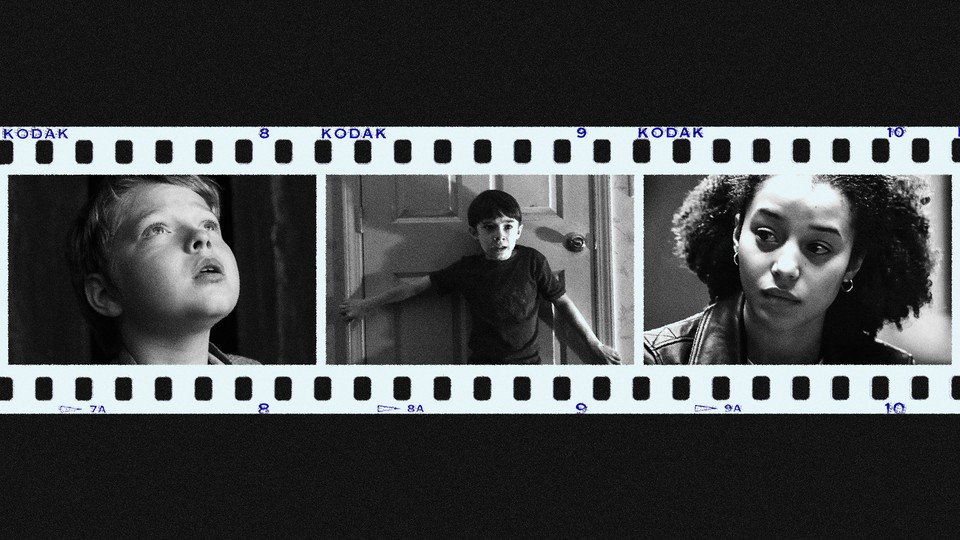
Call it the anti-coming-of-age story. Illustration by Lucy Naland. Sources: Focus Features; Warner Bros. / Everett Collection.This article contains spoilers for the films Sirāt, Hamnet, Train Dreams, The Voice of Hind Rajab, If I Had Legs I’d Kick You, Frankenstein, and One Battle After Another.
For months, I could not stop talking about the film Sirāt—or rather, the experience of watching it. I peppered my praise with vague disclaimers, in an effort to avoid spoilers: “You have to see it,” I told friends, “but you’ll probably find it upsetting.” I know I did: The thriller, about a man named Luis (played by Sergi López) searching for his missing daughter among LSD-addled ravers in the southern Moroccan desert, is packed with transfixing but brutal moments. One scene midway through startled me so much that I yelped. Luis is helping other travelers move their vehicle while his son, Esteban (Bruno Núñez Arjona), plays with his dog, Pipa, by a cliff. Worried about Esteban’s safety, Luis instructs the boy to go sit inside the family van, and he obeys. Then the van rolls backwards, Esteban screams for help, and both he and his beloved pet plummet to their deaths.
A long list of children have perished on the big screen; blockbusters have been claiming kids’ lives since poor little Alex Kintner spent a few too many minutes playing in the water in Jaws. But of late, this plot point is omnipresent—particularly among the nominees for this weekend’s Oscars. The 11-year-old titular character in Hamnet, up for Best Picture, succumbs to the plague. In Train Dreams, another Best Picture contender, the protagonist’s toddler and wife vanish in a fire. And The Voice of Hind Rajab, which is competing against Sirāt for Best International Feature, dramatizes the real-life killing of a 6-year-old Palestinian girl caught in the cross fire of the Gaza war in 2024. Academy voters, it seems, were irresistibly drawn this year to movies featuring children in jeopardy.
These stories go beyond supplying shock value. Despite their obvious differences in setting and premise, each one conveys the difficulty of imagining a future amid an apprehensive present. The bulk of Hamnet, for instance, explores how the boy’s parents fail to process their grief and drift apart after his death. Train Dreams, too, largely observes how the disappearance of his child leaves the bereft father rooted to the stretch of land on which he’d last seen her, convinced that she and her mother will come back. The recent cinematic landscape has been marked by films like these, which rely on provocative scenes of children being tormented by man-made conflicts, natural disasters, and horrible accidents. These scenes complicate the emotional journeys of the adult characters while tapping into the dread that viewers themselves may feel about the world around them.
Call this unfortunate, emerging subgenre the anti-coming-of-age story. The plots tend to go something like this: Adults fail to protect a child—or sometimes a childlike adult—and as a result, the kid loses their innocence or their life punishingly early. These youthful characters are usually in supporting roles, and they’re born amid unresolved political conflicts (One Battle After Another, Avatar: Fire and Ash), left in the care of troubled guardians (If I Had Legs I’d Kick You, Die My Love), or are taken advantage of for their naivete (Bugonia, Frankenstein). In the movies Bring Her Backand Weapons, supernatural forces take over children’s minds. An adaptation of Stephen King’s The Long Walk, perhaps his novel with the highest underage body count, hit theaters in September. Even the two biggest superhero hits of 2025—The Fantastic Four: First Steps and James Gunn’s take on Superman—featured set pieces in which the lives of literal babies were threatened.
The bulk of these anti-coming-of-age movies play like horror flicks even when they don’t explicitly fit the genre. The suffocating camerawork used throughout If I Had Legs I’d Kick You; the disorienting violence of Die My Love; the assaultive sound design of Sirāt—each evokes the anxiety and hopelessness its characters feel about improving their circumstances, for themselves and their offspring. Doubt courses through the films’ endings: The mother in If I Had Legs I’d Kick You promises to be a better parent, but that’s tough to believe after almost two hours of watching her reject the role. The mother in Die My Love adores her son, but she ultimately deserts her family and walks into a forest fire naked—a surreal visual, and a choice that leaves her and her family’s fate ambiguous. Sirāt, too, signals a deeply uncertain future for Luis; itconcludes with him on a train, heading to an unknown destination.
Many of these films earn their ruthless plot points by rendering them plausible. Some deliberately echo reality, reminding audiences to take note of the pain that kids can experience every day. In Sirāt, snippets of radio broadcasts about an unspecified war play in the background, casting a bleak shadow over Luis’s search for his daughter. In Weapons, the father of one of the young victims has a nightmare of a giant assault rifle hovering in the sky. The children also run away from their homes, their arms outstretched behind them—a pose influenced by the infamous Napalm Girl photograph taken during the Vietnam War. “I think that image is so awful, and the way she’s holding her arms out just killed me,” the director Zach Cregger told Entertainment Weekly. “I think there’s something really upsetting about that posture.”
Not every movie that portrays a child in trouble ends on a worrisome note. The characters in Hamnet and Train Dreams eventually come to terms with how every life—no matter how short or unremarkable—contains meaning. The action in One Battle After Another hinges on a teenager who was abandoned by her mother, raised by a less-than-responsible parent, and then kidnapped by her biological (and bigoted) father, yet she emerges as the rare child in peril who determines her own future. And Guillermo del Toro’s adaptation of Frankenstein, which the writer-director reimagined into a tale about fathers and sons, also leads to a comforting, even cathartic denouement: In its final moments, the guileless, misunderstood Creature reconciles with his creator before walking off to feel the sun on his face.
“Life never calls to tell you, Next week, be careful,” the director Oliver Laxe told IndieWire, about his decision to kill off a child in Sirāt. “The film is about this, about how life doesn’t give you what you are looking for; life gives you what you need, and there is a difference.” That goes for this past year’s grimmest cinematic trend too. These movies reflect a poignant, urgent truth: If we’re not careful with their present, the youngest people won’t get to shape their own future. They’ll be the ones who get left behind.