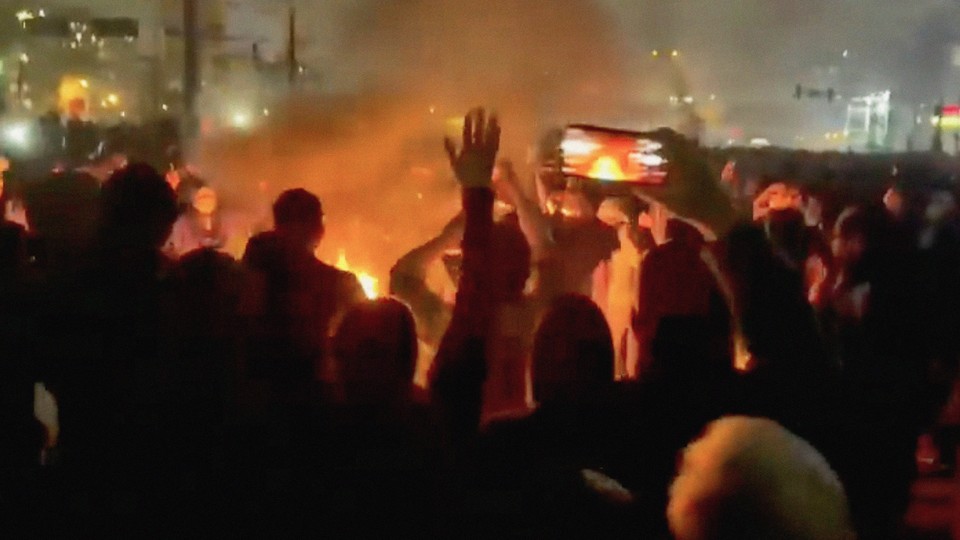
Trump faces a critical decision on Iran: risk military action after encouraging protesters, or face shame for abandoning them. Inaction could embolden the regime, while intervention might deter violence but carries unpredictable consequences.
Key Takeaways
•Trump's public support for Iranian protesters has raised expectations, but inaction risks betrayal and emboldening the regime.
•Military intervention could deter violence and fracture Iran's security forces, but history shows foreign interventions often fail to achieve democracy.
•The regime's brutal crackdown has killed thousands, highlighting the high stakes of Trump's choice between action and inaction.
Taking military action is risky. Falsely encouraging freedom fighters would be shameful. UGC / AP The fate of a 2,500-year-old nation and its 93 million inhabitants rests, for now, in the hands of Donald Trump.
On at least eight occasions over the past three weeks, Trump encouraged Iranian protesters to go into the streets, assuring them that the United States had their back and that “help is on the way.” He threatened that if the Iranian regime killed protesters, the U.S. was “locked and loaded” to take action.
“If they start killing people like they have in the past,” he warned, “we will get involved. We’ll be hitting them very hard where it hurts. And that doesn’t mean boots on the ground, but it means hitting them very, very hard where it hurts.”
Despite Trump’s threats, the Islamic Republic commenced what is almost certainly its bloodiest killing binge since its inception, in 1979. The regime itself admitted to 2,000 deaths; human-rights organizations believe that the figure could be higher than 12,000. This death toll likely dwarfs the number of protesters killed by the shah over the 13 months leading to the 1979 revolution.
Trump now confronts a fateful choice. He can make good on his promise and risk the always-unpredictable consequences of military action, or he can face the shame of having given false encouragement to freedom fighters and emboldened one of America’s fiercest adversaries.
If Trump chooses not to act, his encouragement of the Iranian people to rise up, his repeated promises of U.S. support, and his subsequent abandonment of them will be remembered as one of the most callous examples of presidential betrayal in modern history. Expressing moral support for protesters was the right thing to do. But inciting them to rise up and promising intervention, only to watch them get mowed down by the thousands, will be counted as an act of cruelty.
Iranian grievances are local, but revolutions are about psychology, and Trump’s exhortations altered the risk calculus of many protesters. Siavash Shirzad was one of them. His family attempted to dissuade him from going into the streets, but the 38-year-old insisted. As one family member recalled, he said: “This is a celebration of a revolution. Trump said he supports us. I’m going.” That faith cost him his life.
The consequences of inaction are already visible. The regime’s security officials, some of whom may have been on the fence about whether to put down arms or continue killing, will now clearly choose a side. The logic is brutal but simple: Without a credible threat of U.S. intervention, they calculate that the regime is here to stay—making defection a death sentence and ruthless loyalty their only path to survival. Then-President Barack Obama’s decision not to enforce his own “red line” after Syria’s regime used chemical weapons in 2013 helped that country’s then-ambivalent military make the same calculation and presaged another decade of killing.
Both Obama and former Secretary of State Hillary Clinton came to regret that their administration did not do more to help Iranian protesters during the country’s 2009 Green Movement (Clinton later said that this was the single thing she most wished the administration had handled differently). We can be fairly certain, however, that concerns of conscience will not weigh heavily on Trump’s decision making.
What could guide him, however, is concern for the damage that inaction will do to his strongman image. Trump does not enjoy being made to look weak or being ridiculed. And much as the Venezuelan dictator Nicolás Maduro did in the weeks before his capture, Iran’s Supreme Leader Ayatollah Khamenei has over the past week taunted Trump as a “tyrant” who “will be overthrown.” Being made to look ineffectual—particularly at a moment when public opinion would reward him for toughness—could well goad Trump into taking action.
To be sure, there are valid strategic reasons for his reluctance. Most U.S. interventions to exact justice on foreign tyrants have ended poorly. No American silver bullet will cleanly depose Tehran’s Islamist leaders and peacefully transition the country to a stable, representative democracy. Since World War II, fewer than a quarter of authoritarian collapses have led to democracy, and those triggered by foreign intervention have been particularly unlikely to do so. Violent revolutions are coercive contests; they are won by those who can organize force, not mobilize hashtags.
That said, U.S. military action can still constructively shape events, even if it can’t control their ultimate outcome. Foreign intervention will not spawn an Iranian Denmark, in other words, but it could prevent the entrenchment of an Iranian North Korea.
In this context, Trump should be clear about his objectives, focusing on three fronts. He should seek to deter the violence against civilians by signaling that the cost of this slaughter will outweigh the benefits of suppression. He should insist on tearing down the digital iron curtain that has allowed the regime to massacre people in the dark (for the past week, connectivity in Iran has hovered at 1 percent). And he should make a goal of fracturing Iran’s security forces by degrading the regime’s command and control, thereby creating doubt within their ranks and emboldening the population.
On the last point, I consulted with three friends in the U.S. military and intelligence communities who have a century of collective experience dealing with Iran. Johnny Gannon, a Persian-speaking veteran of the CIA, advised that any U.S. action should serve to “demoralize, damage, and denigrate” the adversary. He paraphrased Machiavelli’s advice to the Prince about the risk of half measures: “One should either caress a man or crush him. If you injure him, you should do so in such a way that you need not fear his revenge.” If you aim for the supreme leader, you best not miss.
A retired senior U.S. military official who has studied Iran’s Islamic Revolutionary Guard Corps for decades recommended striking the country’s missile capabilities and also aiming for command centers, such that the regime would be unable to coordinate internally and protesters could reemerge without fear. According to another former intelligence official, Trump’s action must convince the IRGC that it has just three options: change voluntarily, be changed by protesters, or be changed by Donald Trump.
The Islamic Republic may have prevailed in this latest battle, but it is destined to lose the war against its own society. The medium-term bet on who will prevail between an 86-year-old dictator and his young society is clear. Khamenei will soon be vanquished by time, and 47 years of the Islamic Republic’s hard power will eventually be defeated by the soft power of a 2,500-year-old nation that wants to reclaim its proud history.
Trump appears relaxed about the fate of Iran. Yet the machinery of war is already in motion: The USS Abraham Lincoln, an aircraft carrier, is reportedly en route to the Middle East. Given their violent history with Trump, Iran’s leaders know they cannot rest easily.
After Trump’s first term, one of his Cabinet secretaries reportedly quipped that whereas Henry Kissinger had cultivated the “madman theory” to convince adversaries of President Richard Nixon’s volatile unpredictability, Trump’s version was unintentional.
With Nixon, it was a strategy, the former official said. With Trump, all foreign leaders had to do was watch CNN.