The article explores America's historical struggle with monarchical symbols in its presidency, from George Washington's formal levees to modern debates over presidential power and ceremony. It traces how early republicans resisted royal trappings but now sees a resurgence of such affectations.
Key Takeaways
•George Washington's presidency sparked intense debate over whether republican leaders should adopt monarchical rituals like formal levees and titles.
•Early Americans feared presidential power could become king-like, with conflicts over coin designs, titles, and ceremonies reflecting this tension.
•Thomas Jefferson's rejection of royal trappings established enduring republican norms, but recent administrations have revived monarchical affectations.
•The article warns that vigilance against royal symbolism remains crucial to preserving democratic values.
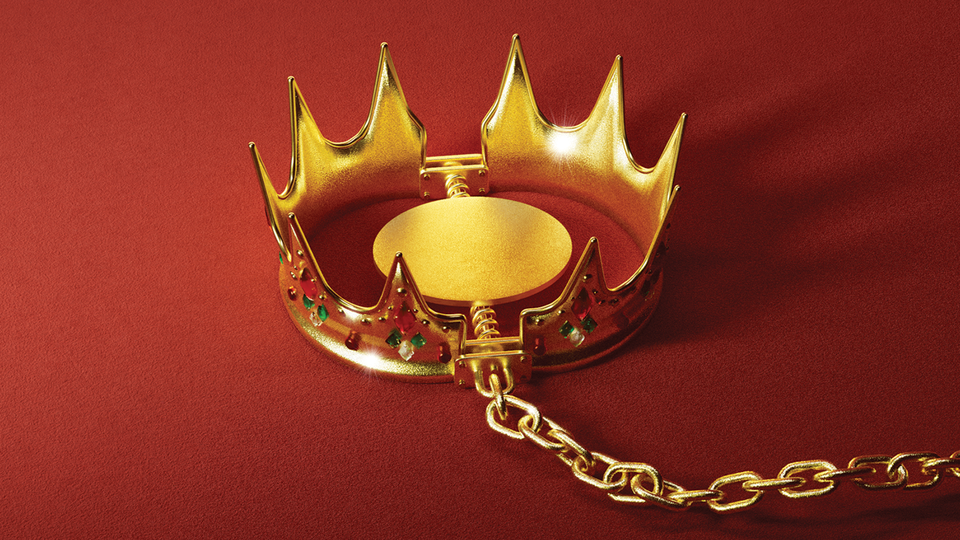
America went to extraordinary lengths to throw off the rituals and titles of monarchy. Why would we fall for royal trappings today? Illustration by Matteo Giuseppe Pani. Source: Pieter Ferreira.As president, George Washington received visitors once a week, for exactly half an hour. These “levees,” as they were called, were not loose occasions. Washington stood by the fireplace in a dining room cleared of its chairs. Dressed in a black velvet suit, hair powdered, hat in hand, he greeted guests with a formal bow. Handshakes, familiar and egalitarian, were prohibited. Conversation was sparse. The president, per Alexander Hamilton’s instructions, might talk “cursorily on indifferent subjects,” but nothing more. Then, after having been seen by the guests, he was to promptly “disappear.”
If little was said at Washington’s levees, much was said about them, beginning with the fact that the entire practice was imported from the royal courts of Europe. For Hamilton and others close to Washington, this was precisely the point. The public needed to appreciate the full “dignity of the office,” a goal best accomplished by setting a “high tone in the demeanour of the Executive.”
For those opposed to Washington’s administration, the tone was entirely too high. The president’s bows were aloof and stiff. The guests were sycophantic, exhibiting the “cringing servility” of courtiers. All of it reeked of royalty. After attending a levee in December 1790, Senator William Maclay of Pennsylvania confessed to his diary the hope that Washington might just die. “If there is treason in the wish, I retract it,” he wrote. But if the president “were in Heaven,” he continued, “we would not then have him brought forward as the constant cover to every unconstitutional and irrepublican act.”
A senator in 1790 would seem to have had larger worries than the choreography of presidential receptions. The United States was deeply in debt, vulnerable on the international stage, and operating under a new, controversial Constitution. But to Maclay and his opponents alike, great problems of policy were inseparable from small matters of ritual. Some, like Hamilton, strained for legitimacy in the rites and practices of monarchy. Others feared the dire effects of what Maclay derided as “all the fooleries, fopperies, fineries, and pomp of royal etiquette.”
Washington, of course, would come to be remembered for his restraint—his reluctance to take power, his keen awareness of his own stature, and his willingness to step away after two terms. Yet in the moment, none of that felt assured, and his presidency was marked by a fierce struggle over symbols and ceremonies—over how nearly a republic should allow its first president to resemble the monarch it had only recently cast off.
It was not hard to imagine Washington as a king. Many Americans already did, if not exactly in title. Going back to the early years of the Revolution, Washington occupied the position left vacant by the English monarch, one George succeeding another. In October 1775, the poet Phillis Wheatley concluded an ode she sent him, “A crown, a mansion, and a throne that shine, / With gold unfading, WASHINGTON! Be thine.” Wheatley made her offer before he’d even succeeded in expelling the British from Boston. The triumph of the War of Independence would only affirm his elevation; Americans adapted monarchical practices such as celebrating the leader’s birthday and singing “God Save Great Washington.”
Still, some worried that the indispensable man was too indispensable. The people, John Adams noted during the war, had come to “idolize an image which their own hands have molten.” When Washington famously refused the power that could have come with such popular esteem, the move only elevated that esteem. In the 1780s, one Mary Meanwell told a Philadelphia newspaper, “I respect our great general, but let us not make a GOD of him.”
The ambiguities surrounding Washington haunted the Constitution’s definition of the presidency. At the Convention in 1787, during which Benjamin Franklin noted “a natural inclination in mankind to kingly government,” the very suggestion of an executive seemed a provocation in light of the Revolution. Washington’s presence there, however, gave the delegates confidence to endow the presidency with vague and expansive powers. As one wrote, the Constitution would not have bestowed such great authority on the executive “had not many of the members cast their eyes toward General Washington, and shaped their ideas of the powers to be given a President by their opinions of his virtue.”
The ratification of the Constitution in 1788 and Washington’s unanimous election the following year did little to resolve the tensions around the man and the office. As he prepared to leave for New York City, then the capital, following his election, his former aide James McHenry told him, “You are now a king, under a different name.” Washington’s journey to New York affirmed the sentiment. He was greeted everywhere with the peals of church bells, the firing of cannons, and cheers of “Long live George Washington,” a royalist acclamation repeated by the official who administered the oath of office to him. Washington was sensitive enough to the implications of such fanfare that he included (and later cut, at James Madison’s suggestion) an assurance in his inaugural address that, because he was childless, he could have no heirs to his power.
If the public seemed ready to crown him, Congress was forced to confront what that might mean in practice. After the inauguration, the Senate was snarled for nearly a month on the mere question of what to call the president. Whatever misgivings Adams may have previously entertained about Washington’s lofty status, he told his colleagues that “a royal or at least princely title will be found indispensably necessary to maintain the reputation, authority, and dignity of the President.” Human minds, Adams said, simply could not recognize authority “without a Splendor and Majesty, in some degree.” Adams argued for “His Highness” or “His Most Benign Highness” at the minimum; others suggested possibilities including “His Majesty” and “His Elective Highness.”
Similar anxieties surfaced in 1792, as the House considered what symbols should represent the new government on its coins. When Hamilton moved to create the United States Mint, he argued that coins were “vehicles of useful impressions” and that they ought to be “emblematical” in their use of symbols. The implication was hardly in doubt. Washington, the most powerful national emblem, had already appeared on privately issued coins and would of course grace the first national coins under the new Constitution. When the matter came before the House of Representatives, a fierce opposition noted that putting living people on coins was the stuff of flattery and the “idolatrous practice of monarchies,” or, perhaps worse, the tyrants of ancient Rome. One congressman suggested that Washington should sooner cut off his own hand than sign a bill that would see his likeness on a coin, a move that would put him in the company of Nero and Caligula.
As it happened, Washington didn’t have to choose between signing the bill and cutting off his hand. The House defeated the measure, and the now-familiar female figure of liberty found her way onto American coins. Nor was Washington ever addressed as “His Highness” or, as he reportedly preferred, “His High Mightiness, the President of the United States and Protector of Their Liberties.” Despite the wishes of Adams (whom opponents came to call “His Rotundity” during the debate), the Senate ultimately settled on the spare and republican address that we still use: “Mr. President.”
The fights over who and what Washington was continued to define his presidency, and many in the public still celebrated him as something like a king. But determined opposition, combined with Washington’s own restraint, tamed the presidency’s regal inheritance. Adams, Washington’s successor, possessed monarchical impulses, but not a monarchical aura. His pretensions—riding around in a grand coach and continuing the weekly levees—as well as his administration’s notorious effort to enforce deference in the 1798 Sedition Act, fell flat. His failure cleared the way for Thomas Jefferson, who rejected royal trappings altogether. He walked to his inauguration, abandoned formal receptions, and favored plain dress.
Jefferson’s triumph was so complete that the conflict over Washington’s image and authority is largely forgotten. Although Americans continue to debate the extent of presidential authority, they take for granted the unassuming republican rituals of power. Now, though levees may not exactly be back, royal affectations and the disputes that go with them are. The Oval Office has been got up in Louis Quatorze decor. Meetings there unfold with throne-room theater—Donald Trump seated at his desk, with visitors made to stand beside him in supplication. At Trump’s orders, the East Wing is giving way to a massive ballroom, funded through courtly patronage, while the mint contemplates a $1 coin with his likeness.
When the House debated putting Washington’s visage on a coin in 1792, Representative John Page of Virginia called for “republican cautions” against such kingly notions. Members of Congress had a duty, he said, to “keep the eyes of their constituents open, and to watch over their liberties” before they were lost. Such vigilance has mostly been absent from the current Congress. The deference with which that body has bowed to presidential fiat would make Page and William Maclay shudder. We unlearned the habits of monarchy once; we may need to do it again.
This article appears in the February 2026 print edition with the headline “Foolery, Foppery, and Finery.”