A Blockbuster That Understands Ambition
TL;DR
Rafaela Jinich shares her cultural favorites, highlighting how The Devil Wears Prada inspired her journalism career through its portrayal of ambition. She also discusses World Cup nostalgia, Agatha Christie novels, and other personal entertainment recommendations.
Key Takeaways
- •The Devil Wears Prada is praised for its unsentimental understanding of ambition and its influence on the author's career path.
- •The World Cup holds deep cultural significance for Colombians as a moment of national unity and collective attention.
- •Agatha Christie's mystery novels offer re-readable enjoyment with enduring quotes and surprises.
- •Shakira's music represents cultural roots combined with global ambition, with older songs holding particular emotional resonance.
- •Art that encourages slowing down and sustained attention, like Monet's Water Lilies, is particularly valued.
Tags
Welcome back to The Daily’s Sunday culture edition, in which one Atlantic writer or editor reveals what’s keeping them entertained. Today’s special guest is Rafaela Jinich, an assistant editor who works on this very newsletter and has written about the secret to loving winter and the upside of not fitting in.
Rafaela credits Andy Sachs in The Devil Wears Prada with kick-starting her interest in journalism. She is also looking forward to the World Cup, has a soft spot for Shakira, and enjoys rereading Agatha Christie’s mystery novels.
— Stephanie Bai, senior associate editor
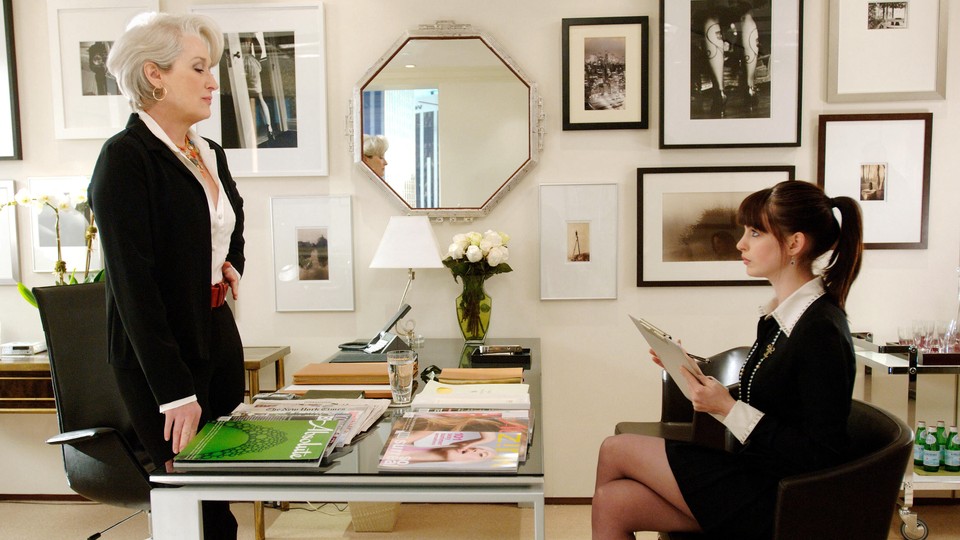
My favorite blockbuster: The Devil Wears Prada. I don’t know how many people can say they decided to become a journalist after watching this movie—but I did. In middle school, I was convinced that I wanted to be Andy Sachs (it felt safer than aspiring to be Miranda Priestly). Although I don’t dream of fashion journalism anymore, being in the media industry is still something I find myself marveling at, and this film remains a constant reference point for me.
Its appeal isn’t just the clothes or the drama—though those do help. I’m drawn to the movie’s unsentimental understanding of ambition: the cost of wanting something so badly that the quiet humiliations you endure along the way mean little compared with the potential rewards. Even though Andy ultimately quits because of everything she’s been through, the movie isn’t shy about showing the joy she takes in. Plus, I could watch Anne Hathaway and Meryl Streep in anything. When the sequel arrives in May, I’ll be listening for a perfectly delivered Miranda line that’s on par with “Florals? For spring? Groundbreaking.” [Related: Five movies that changed viewers’ minds]
The television show I’m most enjoying right now: Hot take: I’m not really into TV shows. I admire the craft; I just rarely commit.
The upcoming event I’m most looking forward to: The World Cup. I grew up in Colombia, where the tournament was never just about soccer. Streets emptied, schedules shifted, and daily life reorganized itself around kickoff times. For Colombians, the World Cup is one of the few moments when national feeling becomes both visible and communal—when history, hope, and collective attention briefly converge around a soccer field.
The best work of nonfiction I’ve recently read: Unbroken, by Laura Hillenbrand—an unsparing and immersive account of survival that traces the life of an Olympic runner turned World War II prisoner of war.
An author I will read anything by: There’s something deeply reassuring about a writer who knows exactly what kind of story he’s telling and can explain complex systems by putting people at their center. For me, that’s John Grisham.
A musical artist who means a lot to me: Shakira—especially her older songs “Antología,” “Pies descalzos, sueños blancos,” and “Inevitable.” Her music has been a steady presence in my life, and she has a song for every emotional register. She shaped my sense of what it looks like to be culturally rooted and globally ambitious at the same time.
The last museum or gallery show that I loved: Rashid Johnson’s “A Poem for Deep Thinkers” at the Guggenheim. The hanging plants and sculptural installations transformed the museum into something unsettled and alive.
A piece of visual art that I cherish: I’m drawn to art that asks you to slow down. Monet’s Water Lilies paintings make it easy to lose your bearings. They reward sustained attention; when you step away, your sense of time feels gently recalibrated.
A cultural product I loved as a teenager and still love, and something I loved but now dislike: I don’t know if this qualifies as a cultural product, but I will never stop borrowing (stealing) sweaters from my mom’s closet. Great quality, endless variety, and somehow always better than anything I buy for myself.
Something I loved as a teenager and now disavow is camo clothing. In my defense, it was a trend—one best forgotten.
Something I recently reread: Agatha Christie’s mystery novels. They’re the kind of books you can dip back into easily and unearth new surprises from. One line from Murder on the Orient Express has always stuck with me: “The impossible cannot have happened, therefore the impossible must be possible in spite of appearances.”
A favorite story I’ve read in The Atlantic: Faith Hill’s story “The Nocturnals”—a beautiful feature about the people who work through the night. It reframes darkness not as emptiness, but as a world of its own, full of life and meaning.
My favorite way of wasting time on my phone: Beli, an app for logging and rating restaurants, indulges my affection for food and trying new places. I spend an embarrassing amount of time ranking bakeries around the city: For any New Yorkers in pursuit of the perfect pastry, Librae, Red Gate Bakery, Nick + Sons, and L’Appartement 4F are a few of my top contenders.
The last debate I had about culture: Do audiobooks count as reading? [Related: We’re all reading wrong.]
A good recommendation I recently received: A friend said that I should read Half of a Yellow Sun, by Chimamanda Ngozi Adichie. The novel tells the story of the Nigerian Civil War by exploring how people thought, argued, and survived during that time, balancing political history with the themes of friendship and love. [Related: Chimamanda Adichie is a hopeless romantic.]
The last thing that made me cry: I was not emotionally prepared to watch Zootopia 2.
The Week Ahead
An Extraordinary Account of a Dangerous Marriage
By Sophie Gilbert
One afternoon in 2024, when her session in court had ended unusually early, Gisèle Pelicot went to the Leclerc supermarket in Carpentras, a picturesque town in Provence. She asked to meet the security guard who, four years earlier, had confronted her husband, Dominique, after observing Dominique trying to use his phone to film up the skirts of unsuspecting female shoppers.
The guard had been irate at the time. He had been thinking, he later told the Daily Mail, about his mother and sister, who shopped at that supermarket and might have been vulnerable to this creep with a cameraphone. Police officers who arrested Dominique Pelicot went to his home, seized his personal devices, and found more than 20,000 images and videos of Dominique—and of other men he had invited into his home—raping his drugged wife.
Gisèle Pelicot wanted to thank the guard, who she believes saved her life. Prior to her husband’s arrest, her physical health had been deteriorating due to almost a decade of being drugged and violently assaulted. Had no one intervened, she thinks, he eventually would have killed her.
Read the full article.More in Culture
Take a look at the top entries in this year’s Sony World Photography Awards Open Competition.
Play our daily crossword.
Explore all of our newsletters.
When you buy a book using a link in this newsletter, we receive a commission. Thank you for supporting The Atlantic.