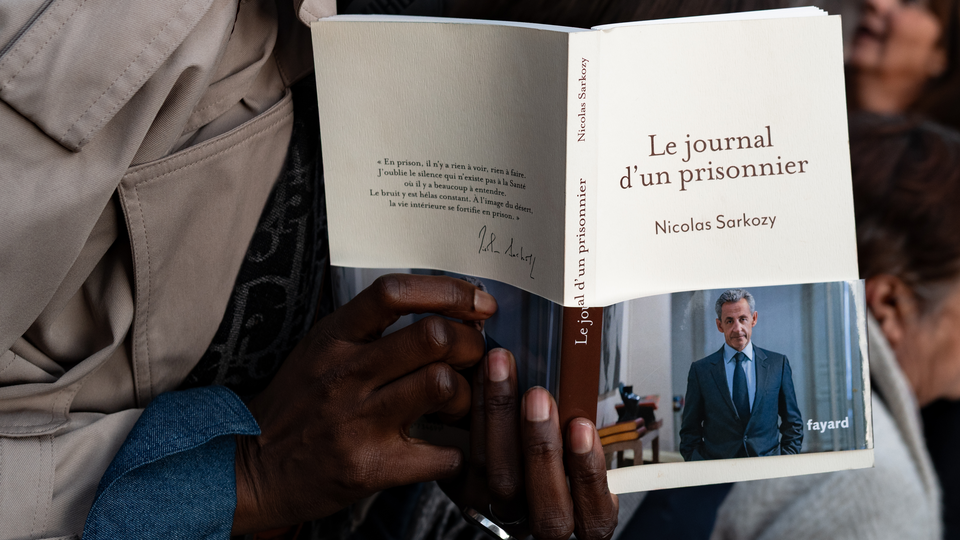
Nicolas Sarkozy's prison memoir reveals his dramatic response to corruption convictions, drawing parallels with Donald Trump. His political shift toward the far right and ongoing legal battles highlight France's changing attitudes toward graft.
Key Takeaways
•Sarkozy's memoir unintentionally comically details his prison experience while he compares himself to historical martyrs, similar to Trump's self-flattering analogies.
•His conviction for taking Libyan funds reflects France's toughening stance on corruption, contrasting with past tolerance for political misconduct.
•Sarkozy's embrace of the far right, after Marine Le Pen supported him, could reshape French politics by uniting conservative factions.
•The case underscores parallels between French and American political scandals, including accusations of 'lawfare' and populist challenges to judicial systems.
•Sarkozy's ongoing legal troubles and influence suggest he may continue to impact French politics, potentially aiding the far right's rise to power.
Nicolas Sarkozy’s memoir is a masterpiece of unintentional comedy. Credit: Jerome Gilles / NurPhoto / Getty France and America have much in common: parallel 18th-century revolutions, a shared commitment to universal ideals, the same three colors on the flag. And both countries have recently put their institutions through an unprecedented stress test. They each put a flamboyant ex-president on trial for serious, election-related crimes.
Nicolas Sarkozy, whose Paris corruption trial ended in September, responded to his accusers with the kind of bombast and fury that have long been Donald Trump’s trademark. He likened himself to Alfred Dreyfus and Edmond Dantès, unjustly maligned heroes of French history and fiction. Trump went further during his own trials, invoking Nelson Mandela and Mother Teresa—but he has always been prolific with his self-flattering analogies, having likened himself to Abraham Lincoln, George Washington, Winston Churchill, and Elvis Presley.
The French can now make a flattering comparison of their own. Sarkozy was convicted of conspiring to fund his 2007 campaign with millions of euros from Muammar Qaddafi, the former Libyan dictator. Unlike Trump, he was given a five-year sentence and went to prison. The humiliation led him to embrace the far right, a choice that may reverberate through French politics. The first former French president in modern history to serve time, he was released in November pending an appeal. He served three weeks at La Santé, a prison notorious for overcrowding, vermin, and violence. (As a VIP, Sarkozy had his own cell and bodyguards.)
The conviction was a victory of sorts for France’s justice system, which held up under a withering campaign of abuse by Sarkozy and his allies. The judges ruled that Sarkozy was guilty of “exceptionally serious acts, likely to undermine the citizens’ confidence in those who represent them and who are supposed to act both in the general interest, and in the interest of the institutions of the republic itself.” It was a victory for France’s media, too: A left-wing digital newspaper, Mediapart, broke the story of Sarkozy’s Libya connection in 2012, setting off the judicial inquiry.
Admittedly, not everyone felt that way. The French retain a quasi-monarchical reverence for the presidency, and Sarkozy played on those feelings with a typically hyperbolic effort to reclaim the narrative, as if he were Napoleon escaping from Elba. His book The Diary of a Prisoner, rushed into print in December barely a month after his release, starts with Sarkozy entering prison carrying a biography of Jesus. What follows is a masterpiece of unintentional comedy, as Sarkozy describes the privations of his “hell”: the awkwardly placed mirror, the uncomfortable bed, the “not very appealing” food, and the man in the neighboring cell who insisted on performing songs from The Lion King at odd hours.
This self-aggrandizing aria found a large audience, selling more than 100,000 copies in its first week and topping the charts on Amazon. It is a fitting coda to a political career whose hallmark—as Sarkozy concedes in the book—has been audacity rather than talent. He first gained a national profile in 1993 when a man strapped with explosives and calling himself the “human bomb” entered a kindergarten in the Paris suburb where Sarkozy was mayor, took the children hostage, and threatened to blow them up. Sarkozy rushed to the scene, passed through the police cordon, entered the school alone, and managed to negotiate the children’s release. (The police then shot the man dead.)
Like Donald Trump, Sarkozy has always had a rabid hunger for attention. The French media used to call him a bête de scene, a “stage animal”; one of France’s most famous rappers, Kaaris, has admiringly called Sarkozy the “most gangster” of all of France’s politicians. And like his American counterpart, Sarkozy demands total loyalty. An editorialist for Le Monde once wrote that with Sarkozy, it is “allegiance or vengeance.”
When Mediapart first reported the claim that Sarkozy had taken 50 million euros from Qaddafi, many people didn’t know what to make of it. The crime seemed audacious even for him, and the story was hard to follow, full of unreliable middlemen and documents of uncertain authenticity. (Mediapart produced an excellent documentary laying out the background of the case and the strong circumstantial evidence.)
I remember feeling a little baffled even after I met one of the central figures in the drama: Saif al-Islam Qaddafi, the late dictator’s son, who claimed to have helped provide money to Sarkozy’s 2007 campaign. This was in 2021, and Saif al-Islam—who had spent a decade in hiding after being kidnapped by rebels in 2011—said some unhinged things during our interview. But I remember being struck by the conviction with which he predicted that Sarkozy would end up in jail.
The truth is that the accusations are not so strange. There is a long and sordid history of French politicians squeezing money from African dictators, a legacy of the postcolonial nexus of cash and influence known as Françafrique (the word itself is a double entendre, meaning both “France-Africa” and “France-cash”). One of the men who oversaw this system, Robert Bourgi, published a book in 2024 titled They Know I Know It All, which details the regular delivery of millions of dollars in cash—including banknotes stuffed into djembe drums—from African heads of state to the campaigns of prominent French statesmen.
My own guess is that Sarkozy may have justified the gambit to himself on the grounds that Qaddafi owed France. The Libyan regime appears to have been responsible for the bombing of a Paris-bound civilian flight in 1989 that killed 170 people. Tripoli later paid compensation to the victims’ families. For Sarkozy—who, at 5 foot 5, is an inch shorter than his idol Napoleon—a debt to France might as well be a debt to him.
Sarkozy’s prison sentence may also reflect a toughening of French attitudes toward corruption, which were once relatively lax. No one made much fuss in 1994, when it emerged that François Mitterrand, the long-serving French president, had lodged his mistress and their daughter in a luxurious Paris apartment at the state’s expense. But in 2017, the conservative politician François Fillon was accused of arranging fictitious government jobs for his wife and children, and it destroyed his campaign for president. The French far-right leader Marine Le Pen was convicted early last year of diverting European Parliament funds to pay for her staff’s salaries, and she was sentenced to a five-year ban from public office (she is currently appealing it).
This reduced tolerance for graft has coincided with powerful populist currents in recent years, leading many French political figures (including at least one on the far left) to shed their former respect for the judiciary and accuse their enemies of fabricating legal cases against them. Sarkozy has banged this drum louder than anyone, asserting that leftist judges have targeted him through a “hatred without limits.” This has been a frequent refrain on CNews, the French equivalent of Fox News (owned by Sarkozy’s close friend, the billionaire Vincent Bolloré). Across the Atlantic, Trump has made similar accusations of “lawfare” against him by the Biden administration, which are now gospel in the MAGA movement.
Unlike Trump, Sarkozy is a figure of the center right. He supported Emmanuel Macron, France’s embattled centrist president, in both the 2017 and 2022 elections. Sarkozy has vigorously defended the “republican front” that has, for decades, joined the right and the left in an agreement to keep the French extreme right, with its historic connections to fascism, out of power.
But the bombshell buried within Sarkozy’s melodramatic Diary of a Prisoner was his declaration that he no longer sees any reason to hold the far right at bay. This volte-face was not just about electoral politics. As Sarkozy notes appreciatively in his book, Le Pen, unlike many other political luminaries, came out in support of him after his sentencing. Sarkozy adds that Le Pen may have been motivated by her own legal troubles: “No doubt the judicial situation could bring us together.”
Here was yet another parallel with Trump, whose sympathy for fellow defendants has prompted him to pardon a rogue’s gallery of convicts including Juan Orlando Hernández, the former president of Honduras convicted of conspiring with drug cartels to move hundreds of tons of cocaine to the United States.
Sarkozy’s legal troubles are far from over. In addition to the Libya-related verdict that he is now appealing, he has been convicted in two other corruption trials since he left office in 2012, and he faces separate charges of trying to pressure a key witness in the Libya case. The French public’s patience with him appears to be wearing thin. In a poll conducted in late September, a solid majority said that they found the verdict against him to be fairly administered, and 72 percent said they were shocked by the right-wing slanders against the judges in the case.
But Sarkozy likes long odds. “The rest of the story has not been written,” he posted on social media after his release from prison, and he does not seem to be envisioning a quiet retirement. Sarkozy still has a powerful voice in conservative circles, and if he chooses to throw his weight into a new union des droites, as many in France now fear, he could play a key role in bringing the far right to power for the first time.
That would be an odd sort of victory, because Sarkozy’s party, the Republicans, would be swallowed by Le Pen’s much larger Rassemblement Nationale. But sacrificing principles for power is not likely to be a hard choice for Sarkozy. He may choose to see the merger as a chance to return from the political graveyard for a last laugh at his enemies. There, too, he would be following a script written by Donald Trump.