The Venezuelan opposition faces a critical choice after the U.S.-backed removal of Maduro, with historical parallels to 1958 suggesting potential for democratic breakthrough through sustained activism and pressure on the new regime.
Key Takeaways
•The U.S. has backed Maduro's vice president Delcy Rodríguez over popular opposition leader María Corina Machado, creating an existential dilemma for Venezuela's democratic forces.
•Rodríguez faces pressure from both U.S. demands (particularly regarding oil) and regime insiders who fear prosecution if they relinquish power without immunity guarantees.
•The 1958 precedent shows that even when a strongman's successor initially takes power, political concessions can eventually be forced through sustained opposition pressure.
•The opposition's best strategy involves remaining active through protests and organizing to exploit tensions within Rodríguez's government and international attention on Venezuela.
•Institutional power remains with the old regime, making democratic change dependent on the opposition's ability to create instability that forces political openings.
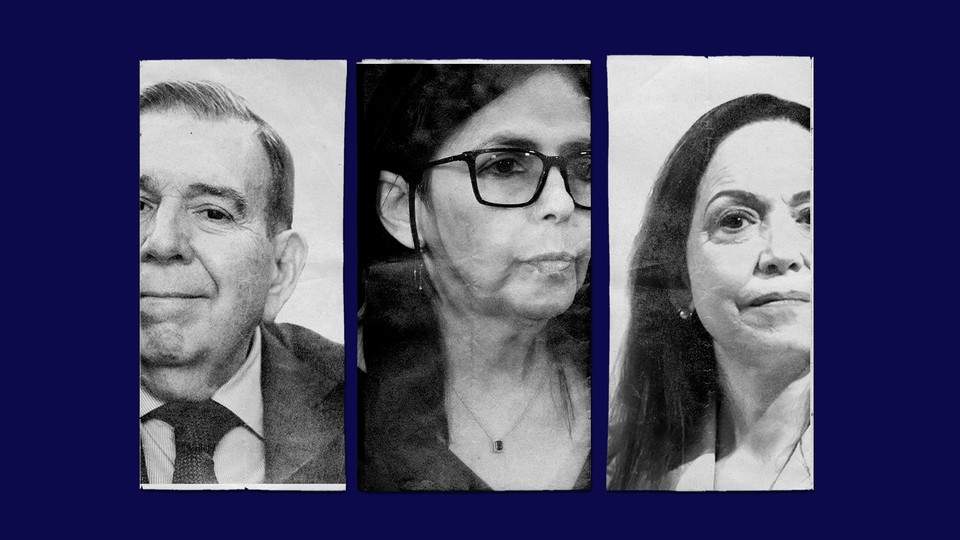
As bad as things look, the country’s democratic forces broke through a similar jam in 1958. Illustration by Akshita Chandra / The Atlantic. Sources: Federico Para / AFP / Getty; Mateo Lanzuela / Europa Press / Getty; Rune Hellestad / Getty. The Trump administration’s forceful removal of Nicolás Maduro from office has not liberated the Venezuelan opposition so much as confronted it with an existential choice.
President Donald Trump stated at a news conference that María Corina Machado—the charismatic Nobel Peace Prize winner who is far and away the most popular Venezuelan politician—lacks sufficient “support” and “respect” within Venezuela to govern the country. Instead the United States has backed Maduro’s vice president, Delcy Rodríguez, a powerful insider with experience running Venezuela’s oil sector and intelligence service. Moreover, Washington expects Rodríguez to work with it at the barrel of a gun: It continues to hold Venezuela’s oil exports under military quarantine, and the U.S. president has threatened the interim president with a fate worse than Maduro’s if she doesn’t comply with American directives.
The country’s democratic movement is at a crossroads. It could take the loss and lie low, waiting for the next inflection point—or it could return to protests and organizing, in the hope of changing Trump’s mind or getting Rodríguez to call elections.
So far, Machado has tried to cast the moment as the country’s “hour of freedom.” Edmundo González, the legitimate winner of the 2024 election that Maduro co-opted, has claimed the post of the presidency and called on Venezuelans to back him. But Machado still has not appeared publicly, González remains in exile in Spain, and the opposition has not yet mounted any substantial public protest.
Institutionally, the old regime remains in place. The ruling party still dominates the country’s National Assembly, which is run by Rodríguez’s brother. The judiciary is stacked with regime allies, as is the electoral council. Venezuela’s military ranks have grown over the past decade and have become ever more entwined with the country’s economic system and governance.
Rodríguez will have little incentive to open up the country’s political system. More than a dozen powerful officials and military figures have been, like Maduro, indicted in U.S. courts. They face dim prospects if they hand over power without securing guarantees of immunity. Their most logical move is to dig in—and publicly, that’s exactly what they have done. Rodríguez has forcefully denounced the U.S. intervention and asserted that Maduro remains Venezuela’s rightful leader. Other officials have circled the wagons.
Rodríguez could also deliver on one of the key U.S. demands—access to oil—and use that as a bargaining chip against making any political concessions. Trump has repeatedly claimed that Venezuela stole oil from the United States and has put its recovery at the top of his list of demands. So long as Rodríguez keeps the oil flowing northward, Trump will likely support her against the disruption and unpredictability that could follow a transition of power to the opposition.
Yet even with all of that stacked against it, Venezuela’s democratic opposition does have a hopeful historical precedent to draw on. In January 1958, the country’s longtime strongman, Marcos Pérez Jiménez, was forced from office only to be succeeded by one of his most powerful officials, the naval commander Wolfgang Larrazábal. But Larrazábal could solidify control of neither the military nor society. He presided over coup attempts, public upheaval, and the erosion of American support.
Finally, Larrazábal agreed to allow major political parties to compete in national elections. He stepped down and ran as a candidate, losing to his popular opponent, Rómulo Betancourt. To the surprise of many, Larrazábal conceded and called for a peaceful transition to democracy.
Now as then, a strongman has been dislodged in Venezuela, and the field of possibilities has expanded. Like Larrazábal did, Rodríguez brings experience and continuity to her role. Also like him, she will be seeking to control substantial centrifugal forces as U.S. threats compel her to make decisions that will rankle insiders and possibly the public. Those tensions could ultimately destabilize the regime and open a new opportunity for democracy.
That opportunity can best be seized if the opposition remains active and tries to back the regime into a corner. Doing so may involve renewing street protests with the knowledge that the world’s eyes are fixed on Venezuela, perhaps making it harder for Rodríguez to repress demonstrations and jail opposition leaders at scale.
Rodríguez’s government likely hopes that an atmosphere of fear and prior repression, coupled with surgical raids to disrupt organizing, will keep Venezuelans at home. But the country’s opposition has demonstrated its savvy and motivation, most notably with its election-monitoring operation in 2024, which succeeded in proving to the world that Maduro had not won. By regrouping now, the opposition could force Rodríguez into political concessions—perhaps not unlike the ones that allowed Venezuela its democratic breakthrough in 1958.