Iran's attacks expose the Gulf's deep vulnerabilities, threatening its economic stability and essential resources like water and food supplies. The region's prosperity, built on the assumption of Iranian restraint, is now at risk as the conflict continues.
Key Takeaways
•Iran's missile and drone strikes reveal critical vulnerabilities in Gulf countries, including reliance on imported food and desalinated water.
•The conflict threatens the Gulf's reputation as a safe haven, potentially damaging tourism, real estate, and foreign investment.
•Essential infrastructure like desalination plants and oil supply routes are at risk, with potential global economic impacts.
•Gulf leaders have limited influence over the war's course, leaving them exposed to escalating threats and regional instability.
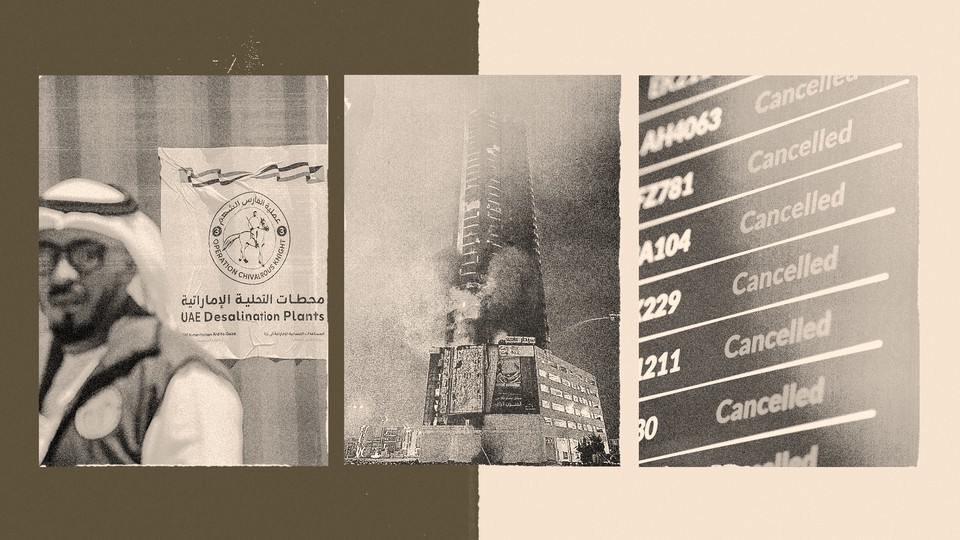
Iran is exposing their vulnerabilities. Illustration by The Atlantic* From the moment the first Iranian missiles appeared in the sky over the Persian Gulf this past weekend, the target countries’ effort to intercept them was accompanied by an equally vigorous effort to reassure residents, tourists, and investors that they had nothing to worry about. The president of the United Arab Emirates was filmed calmly strolling through a Dubai mall, and an army of online influencers downplayed the images of burning hotels and closed airports. “Given Europe’s crime rates, Dubai is statistically safer even with missiles flying,” Pavel Durov, the CEO of the messaging app Telegram, wrote on X. “Can’t wait to be back.”
But even the optimists acknowledge that the longer the war goes on, the more the Gulf region’s extraordinary vulnerabilities will be exposed. The risks to the UAE, Saudi Arabia, Qatar, Bahrain, and Kuwait go beyond interrupted oil and gas sales: In an arid region with few other resources, everyone is dependent on a daily influx of food and desalinated water along supply routes and pipelines that could be struck from the air. The Gulf has transformed in the past half century from a sparsely populated desert into a postmodern hub of migration and commerce with some 60 million residents. All of that prosperity rested on the slender premise that Iran would never do what it is doing now.
“If this goes on for another week or two, okay, tourists and investors will come back; the losses can be made up,” one Emirati, who requested anonymity because he did not want to appear skeptical of the government’s hopeful messaging, told me. “But if it goes on longer than that, God knows what happens.”
The number of missiles being fired at the Gulf countries has dropped substantially in recent days, thanks to American and Israeli efforts to destroy Iranian launchers. But even a trickle of drone strikes, if they continue for months, could damage the Gulf’s brand as a haven within a volatile region.
Dubai, the UAE’s largest city, may be especially exposed to that kind of reputational risk, because its economy is so dependent on tourism, real estate, and foreign investment. But the entire Gulf region has become a hostage of the ongoing war. Qatar has fewer air defenses than its larger neighbors, and its energy minister, Saad al-Kaabi, made the startling claim today that all Gulf oil and gas producers could be forced to stop production within days. The war, he told the Financial Times, could “bring down the economies of the world.”
Foreign workers are a huge percentage of the region’s population, and already thousands have fled in recent days. The prospect of an even larger exodus is terrifying to many Gulf residents, who rely on expat labor for tasks as varied as babysitting and drilling for oil.
The anxiety has been amplified by the opacity of Iranian and American calculations: No one can say for sure what will satisfy President Trump, or what logic is determining Iran’s choice of targets.
Of the hundreds of missiles and thousands of drones that Iran has fired at the Gulf States since the conflict started, most appear to have been aimed at American military bases. But others struck symbolic sites such as Dubai hotels. These attacks on economic targets appear to be part of an Iranian effort—so far unsuccessful—to persuade the Gulf’s leaders to pressure the United States to end the war, I was told by a senior Gulf official, who spoke on condition of anonymity. He added that Iran’s choices appeared to conform to a familiar escalatory ladder, starting with less vital targets.
There are signs that Iran is moving up the ladder: It has conducted strikes on several Gulf ports, and the regime’s threats to attack any oil tankers trying to pass through the Strait of Hormuz have effectively closed that waterway, the conduit for 20 percent of the world’s oil supplies.
The most frightening possibility, according to some of the Saudis and Emiratis I spoke with, would be an Iranian strike on the water supply. The Arabian peninsula has no rivers or lakes, and all of the Gulf countries depend on enormous quantities of water pumped from a network of desalination plants on the coast. Those facilities, which account for about half the planet’s desalination capacity, are usually conjoined with power plants, making the complexes an even more vulnerable target.
“This has been an existential worry in the Gulf,” the University of Utah professor Michael Christopher Low, who has written extensively about water scarcity, told me. Striking at the plants would qualify as a war crime under the Geneva Conventions, he added, but it would not be an unprecedented move.
In 1991, as Saddam Hussein’s forces were retreating from the advancing coalition army, they sabotaged Kuwait’s desalination and electricity plants, leaving that country crippled. And in 2022, Houthi rebels struck at a desalination plant and power plants in southern Saudi Arabia, though the damage appears to have been limited. (The Houthis have not yet joined the current war, despite their deep ties to Tehran, and could still do so.)
The likelihood of this kind of attack could also depend on what happens inside Iran in the coming weeks and months. One of the many scenarios being discussed in foreign ministries around the region is the possibility that the Iranian regime could split into competing factions or descend into a civil war, much as Syria and Libya did more than a decade ago. That kind of chaos could easily spill over Iran’s borders, and not just by land; the Persian Gulf is narrow, and would not pose much of an obstacle to terrorists or insurgents who cross it in speedboats.
Any one of these grim contingencies could be a strategic blow to the United States, which depends on a network of bases in the Gulf to maintain its military power across the Middle East and Africa. And a destabilized Gulf could punch a hole in the global economy, which remains dependent on Arabian oil supplies.
“This is the scenario the Gulf has feared for years,” Kristian Ulrichsen, a researcher at Rice University’s Baker Institute for Public Policy, told me. “They are caught in the middle of a war that didn’t involve them directly, but they are on the front line and bearing the brunt of the backlash.”
For the moment, the Gulf’s leaders can do next to nothing about any of this. They had little or no influence over the decision to start this war, and they cannot directly change its course. They would love to see the end of the Iranian regime now firing missiles at them. But they are wise enough to know it could be followed by something worse.
*Illustration sources: Ali Moustafa / Getty; Anadolu / Getty; Marcin Golba / NurPhoto / Getty