The controversial French novel 'The Camp of the Saints' has been republished and embraced by MAGA conservatives, revealing their apocalyptic worldview where migration threatens Western civilization. The book's dehumanizing portrayal of migrants and its influence on figures like Stephen Miller and Steve Bannon highlight how dystopian fiction shapes immigration politics.
Key Takeaways
•The novel 'The Camp of the Saints' depicts migration as an existential threat to European civilization, using dehumanizing imagery that resonates with nationalist conservatives.
•Key figures in Trump's administration, including Stephen Miller and Steve Bannon, have promoted the book, linking its themes to current immigration policies and rhetoric.
•The book's republication and celebration in Washington reflect how European nativist ideas, like the 'Great Replacement' theory, are influencing American right-wing politics.
•Despite its literary flaws, the novel's apocalyptic narrative structures political myths that justify extreme measures against migration, impacting both domestic and foreign policy.
•The tension between America's immigrant history and imported blood-and-soil nationalism reveals contradictions within the conservative movement's embrace of such ideologies.
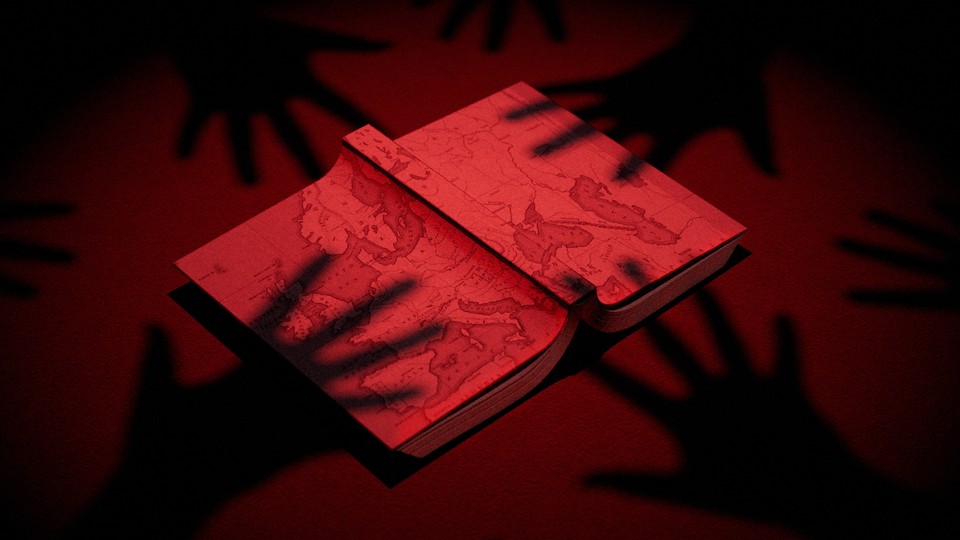
What an apocalyptic French novel about a migrant invasion reveals about the worldview of nationalist conservatives Illustration by Matteo Giuseppe Pani / The AtlanticThis article was featured in the One Story to Read Today newsletter. Sign up for it here.
Not long ago, a book party like this would have been unthinkable: a Washington celebration of one of the most notorious French novels ever written. But on a frigid December night, some 50 people crammed into Butterworth’s, a Capitol Hill restaurant favored by the MAGA elite, to celebrate the rerelease of The Camp of the Saints, which had gone out of print in English decades ago. The dystopian novel by the French author Jean Raspail depicts the destruction of European civilization by barbaric migrant hordes that arrive, uninvited, by boat. It has been mostly reviled since its publication, in 1973. But prominent figures of the French right have hailed it as prophetic, including Marine Le Pen, who first read it at 18 and keeps a signed first edition in her office. The novel has also influenced two architects of Donald Trump’s immigration policies: Stephen Miller, the current deputy chief of staff, recommended it in emails to Breitbart News reporters, and Steve Bannon, the president’s former consigliere, makes frequent reference to it.
Until its retranslation and republication in September by a new publishing house called Vauban Books, The Camp of the Saints had been like samizdat. Worn English-language editions circulated among many hands. When Bannon suggested a few years ago that I read it, I realized that a print copy could cost $200 or more. My new edition cost $25 from Barnes & Noble. And now here it was, being handed out at the party at Butterworth’s put on by the publishing house to guests sampling beef tartare on crostini.
As they sipped their cocktails, Ethan Rundell, who translated the novel and is the editor in chief of Vauban Books, read from a 2011 essay in which Raspail reflected on his novel’s notoriety and relevance. Raspail thought that Europe had not heeded his warning, and predicted that come 2050, “there will be but hermit crabs living in France, of all different origins, all living in the shells cast off by the representatives of a species forever vanished but once known as the French.” But, Raspail continued, there was hope among the so-called isolates, resisters who insisted on the preservation of European culture. “There is another hypothesis: that these last isolates resist so far as to engage in a sort of Reconquista.” The guests juggled their drinks and hors d’oeuvres in order to applaud. Despite the pleasantness of the surroundings—perhaps because of it—the hollow disquiet I’d had since I finally read The Camp of the Saints for myself started to feel even worse.
I do not believe in suppressing books, this one included. The Camp of the Saints is not a good novel, but it is an important one. Dystopian fiction helps structure political myth; political myth helps structure policy. In the same way that The Handmaid’s Tale looms over abortion politics, or The Terminator lurks over artificial intelligence, The Camp of the Saints hangs over immigration politics—for a small but important stratum of right-wing thinkers and politicians. It illuminates much about the worldview of nationalist conservatives who are ascendant in America, France, and many other democracies. The problem is what that light shows: the profound fear that European-American civilization, which in this view is inseparable from whiteness, faces an existential threat from migration—and that extraordinary measures can be justified in response.
The Camp of the Saints is an apocalypse story. Its title is borrowed from the Book of Revelation in verses about Gog and Magog, the satanic hordes who arrive at the end of days. Their “number is as the sand of the sea”; they “went up on the breadth of the earth and surrounded the camp of the saints and the beloved city.” In the novel, the camp of the saints is Europe; Gog and Magog is a migrant fleet, 1 million strong, that sets sail from India. The novel’s infamy is due to its description of this horde as a mindless mass and as “the beast”; it does not have young but “monster children”; it reeks of excrement for miles (“the emigrating Ganges stunk, as never had carnal India stunk before”); its members are shameless people packed so closely together that “over the bodies, between breasts, buttocks, thighs, lips, fingers, ran streams of sperm.” The mass has essentially one speaking member, the “coprophage” (literally “shit-eater”), who leads the fleet while his demonic and deformed monster child sits on his shoulder. “It was thus that, in shit and lust—but also hope—the Last Chance Armada pushed on towards the West,” Raspail writes. He affords the foreigners no humanity whatsoever. They are on par with zombies or space aliens.
Raspail, who died in 2020, was a writer mostly of travelogues who won some of France’s most prestigious literary prizes. By his account, the idea for the novel came to him when he was staying in a large villa overlooking the Mediterranean and an unshakable question occurred to him: ”And what if they came?” His defenders say his critics are too obsessed with his grotesque descriptions of the horde. “The novel isn’t directed against migrants; it’s directed against French people,” Rundell told me. “They were almost generic threats that appeared in the horizon.” The book, he said, is “not about the fall of the West, because the West has already fallen. It just doesn’t know it. It’s a revealing.”
Raspail does indeed spend most of his novel skewering French elites. They are so addled by aspirations to universal humanitarianism, by guilt over colonization, even by Catholic social teaching about immigration, that they invite their own destruction. They cannot see that the migrants already in France are a fifth column that will aid the invaders in their quest. In the novel, the country’s hapless president notes that “there will still be genocide, but we’re the ones who will disappear.” One of Raspail’s heroes replies in the affirmative: “We’ll die slowly, eaten away from the inside by millions of microbes injected into our body.” The French army, thoroughly rotted from within by self-hatred, abandons its mission and deserts rather than open fire on the migrants.
What people say they admire about Raspail is his prescience. The Atlantic’s 1994 cover story about global demographic trends opened with a discussion of The Camp of the Saints, “a controversial and nowadays hard-to-obtain novel.” Éric Zemmour, the right-wing French pundit and former presidential candidate, called Raspail a Cassandra who “foresaw the ‘Great Replacement’ of Europe’s peoples by their counterparts from the Global South.” In 2022, Viktor Orbán, the prime minister of Hungary, gave a speech recommending The Camp of the Saints “to anyone who wants to understand the spiritual developments underlying the West’s inability to defend itself.” Over the past decade, uninvited mass migrations of people to Europe, many of them by boat, and to America via the southern border have prompted debates that Raspail anticipated: Some humanitarians think that borders should be effectively opened to all who desire asylum; policy makers in the European Union and in the Biden administration dithered in dealing with mass migration.
Raspail was wrong, however, in his suggestion that “the servants of the beast” would have made migration uncontroversial. In the novel, he says that “France greedily swallowed the anesthetic: when the time came to cut off both her legs, she would be good and ready for the operation.” In reality, migration and cultural anxieties have become the new fault line of politics in the West. Ordinary people recoil at images of border chaos, here and in Europe; they lodge protest votes against the politicians responsible for the mismanagement and force them out of office. At the same time, many millions of people have assimilated through ordinary channels without heralding the end-time—including, I think, myself, a son of Pakistani immigrants to America.
Raspail’s dehumanizing depiction of migrants is impossible to set aside. “It’s very powerful for its imagery, so one cannot unsee those images once one has imagined them,” Corina Stan, a Duke University comparative-literature professor who has written aboutThe Camp of the Saints, told me. The invasion novel was an established genre when Raspail wrote, but his, according to Stan, “offered a vision of migration that evoked a powerful emotional response. It inspired fear, and that fear could be used for political purposes.”
The novel’s influence has grown in spite of its aesthetic qualities. Even the French characters, who are granted humanity and the power of speech, are thinly constructed: They are either loathsome liars or right-minded dissidents. The heroes of the novel seem to be Raspail in various costumes—here a literature professor or a naval captain, there a junior minister or a duke—all of whom happen to have had some centuries-old ancestor who battled the Ottomans or other invaders. Many of the villains are self-deceiving clergymen, politicians, and journalists who refuse to recognize their impending doom until it is too late. Most of them meet horrific, violent deaths; their female partners are typically raped before being killed.
The dissidents are unable to forestall the apocalypse but usually achieve some catharsis by killing migrants or collaborationists. One hero, the captain of a cargo boat, plows through Indian migrants whose boat capsizes, killing 1,000 of them. “I feel very confident as a professor of French literature that this is not a good novel,” the Stanford scholar Cécile Alduy told me. “From a literary standpoint, the narration is not well organized, the style drags you down, the metaphors are completely outlandish.” The impending apocalypse swamps all other novelistic considerations. “There’s no interiority; there’s no character development; there’s no narrative arc except this invasion,” Alduy said.
One of the oddest characters is a Monsieur Hamadura, a man whom Raspail describes in a separate essay as “a native of Poducherry of the most beautiful Dravidian black,” who despises his fellow people of India, kills many of the invading migrants, and is welcomed by the last-stand colony at the end of the novel after observing, “In my opinion, being white is not a question of skin color. It’s a state of mind.” This is a destabilizing idea: If civilization is a state of mind attainable by the dark-skinned, then migration is not a prelude to disintegration.
Yet any such suggestion is explicitly contradicted by virtually everything else in the novel. At one point, Raspail writes that those cheering miscegenation “were speaking in the name of death. Only a white woman can bring a white baby into the world.” The bombs fall, and the heroes are annihilated. France is the first domino to fall; by the novel’s conclusion, the death of the civilized world is imminent.
Rundell, the translator of the new edition, told me that the book had been unfairly caricatured during the years when it was largely unavailable. “This profoundly dishonest, anti-literary sleight of hand—drive a book out of print, assign it a deeply discrediting reputation, and then use it to score political points against your enemies—was among the reasons we thought it important to give this book a second life.” For those who were especially motivated, the book had gained influence even before copies were easy to come by. A recent New Yorkerprofile of Curtis Yarvin, the far-right, pro-dictatorship thinker admired by J. D. Vance and Peter Thiel, recounts a conversation between Yarvin and Renaud Camus, the French author of the influential pamphlet The Great Replacement. Yarvin broke down crying while discussing The Camp of the Saints, saying, “I want my children to die in the twenty-second century. I don’t want them to experience some kind of insane postcolonial Holocaust.”
The president of the United States employs similarly apocalyptic language about migration; Trump calls for repelling an invasion by immigrants who are “poisoning the blood of our country”; ICE is luring new recruits for the president’s deportation campaign with the slogan “Defend the homeland.”
The Camp of the Saints is just one way that the nativist Francophone right has influenced its American counterpart. The American right may not know Renaud Camus by name, but they are certainly well versed in his arguments that a great replacement of natives is under way. One of the administration’s first executive attacks was an attempt to abolish birthright citizenship, despite its guarantee by the Fourteenth Amendment. After an Afghan national allegedly shot two National Guard members in Washington, D.C., last month, killing one, Trump called for “reverse migration,” a borrowing of the French concept of remigration (an idea that is also attractive to German nationalists in the AfD party).
This haunting image of immigrant-induced Armageddon is influencing not just America’s domestic politics but its foreign policy too. On December 4, the Trump administration published its National Security Strategy, which glossed over great-power competitors such as Russia and China but trained its ire on Europe. The continent’s “economic decline is eclipsed by the real and more stark prospect of civilizational erasure” because of “cratering birthrates,” “migration policies that are transforming the continent and creating strife,” and “loss of national identities and self-confidence.” The administration fears that “the continent will be unrecognizable in 20 years or less,” and calls upon “Europe to remain European, to regain its civilizational self-confidence.”
These declarations have consequences. Secretary of State Marco Rubio has instructed American diplomats abroad to agitate for more restrictive immigration policies in the countries hosting them, according to TheNew York Times. The Trump administration is not isolationist; rather, it wants Europe to be on its side in what it sees as a new clash of civilizations.
There are deeper difficulties with the importation of this European style of blood-and-soil nationalism. America is a much newer country, an accretion of various mass migrations. There was widespread and occasionally violent opposition to migration of Germans, of the Irish, of Eastern Europeans, of Catholics—all of whom were eventually integrated into the body politic. You can see this reflected in the leaders of the Republican Party. Trump is himself the grandson of a German and the son of a Scottish mother; two of his three wives (who gave birth to four out of his five children) were born in Eastern Europe. Rubio is the son of Cuban migrants. Vance is proud to be a Scots-Irish hillbilly whose family has been buried in a cemetery plot in eastern Kentucky for five generations. His wife, Usha, the mother of his three children, was born in California to highly educated migrants from Andhra Pradesh, in India. Because of that simple fact (and notwithstanding her own educational and legal accomplishments), she has been subject to vicious attacks by white supremacists such as Nick Fuentes. The point is not that the Trumps, Rubios, and Vances are not really authentic Americans. The point is that they all are—whatever the devotees of The Camp of the Saints might say about their genealogy.