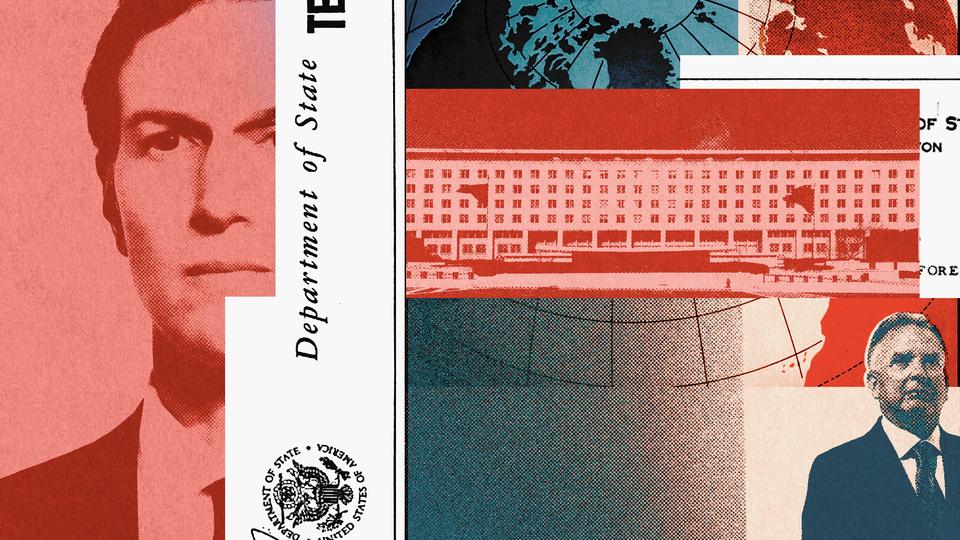
The State Department's traditional diplomatic processes have been sidelined under Trump's second term, replaced by informal channels and personal envoys like Kushner and Witkoff. Career diplomats feel marginalized as policy decisions are made by a small inner circle, leading to fractured alliances and a reliance on backchannels.
Key Takeaways
•Trump's administration has centralized foreign policy decisions within a small circle of personal advisers, bypassing traditional State Department channels.
•Career diplomats are increasingly sidelined, with expertise viewed as a liability and morale suffering due to lack of involvement in key negotiations.
•Allies struggle to navigate opaque diplomatic processes, relying more on backchannels, personal relationships, and lobbyists to engage with the administration.
•The shift toward informal diplomacy risks eroding trust with international partners and continuity in U.S. foreign policy across administrations.
Tags
State DepartmentdiplomacyTrump administrationforeign policycareer diplomats
The once-bustling corridors at Foggy Bottom are tomblike as ambassadors scrap for information. Illustration by Paul Spella / The Atlantic; Sources: Ludovic Marin / AFP / Getty; Krisztian Bocsi / Bloomberg / Getty. By mid-afternoon, the gray, windowless corridors of the Harry S. Truman Building, headquarters of the State Department, feel less like the nerve center of the world’s most consequential foreign-policy institution and more like a catacomb for diplomacy. A disorienting and disheartening quiet has settled in, following last year’s sweeping cuts at State and its sister agency USAID. Today, decisions that once moved through interagency meetings, policy-planning staff, and regional bureaus now seem to drop, fully formed, from a small circle of advisers around President Trump. The traditional (and famously bureaucratic) step-by-step process has been replaced by after-the-fact briefings for the nation’s diplomatic corps, and even those are sporadic.
Trump, in his second term, has plunged headlong into foreign policy, seeking quick, headline-grabbing deals, much as a businessperson might scour the world looking for a new acquisition. While domestic battles over affordability and immigration grind on, he has devoted outsize attention to legacy-defining international targets—at times, with little warning and even less consultation with Congress.
Trump has relied on trusted lieutenants such as his son-in-law Jared Kushner and Steve Witkoff, the real-estate executive turned envoy for all things (officially he is special envoy to the Middle East). They have bounced around various capitals trying to end the war in Ukraine, cement a fitful cease-fire in Gaza, and broker a deal with Iran. Recently in Geneva, the duo held different negotiating sessions on the same day, racing from the consulate of Oman for discussions with Iranian officials on a new nuclear deal to the Intercontinental Hotel Geneva for talks aimed at resolving four years of war in Ukraine. The two men are scheduled to return to Geneva for last-ditch talks with Iran on Thursday.
Several officials in the Middle East told me that diplomats are seldom looped into the discussions Witkoff and Kushner have about regional matters, and instead learn about them after the fact. The pair of businessmen turned diplomatic dealmakers have approached the issues with a preference for quick wins, often absent the nuance and historical and linguistic command that more traditional brokers possess. (Like others who spoke with me for this story, they requested anonymity to protect their jobs.)
“Special Envoy Witkoff and Mr. Kushner regularly communicate with President Trump and his national security team, including Vice President Vance and Secretary Rubio, before, during, and after diplomatic negotiations,” Anna Kelly, the deputy White House press secretary, told me in an email, adding that those who “complain to The Atlantic” aren’t looped in, because they “can’t be trusted not to leak.”
How you feel about all this likely depends on whether you think that America’s diplomats, as a class, have of late fulfilled their mission of protecting and advancing America’s interests abroad. Trump officials I’ve spoken with argue that their approach is nimble, efficient, and avoids the establishment morass that President Obama’s deputy national security adviser famously called “The Blob.” Others argue that the absence of internal temperature-taking and dissent that State can provide, combined with the sidelining of allies’ diplomats, means the administration risks mistaking unanimity for sound judgment and irritating other capitals whose support the United States will one day need. Diplomacy, this argument goes, is not only about leverage, which Washington has in abundance—it is about trust (a word I heard repeatedly from European officials at the recent Munich Security Conference).
“If policy is increasingly informal or driven by personalities, what happens to continuity when there is a change in administrations?” one European official asked me. “Obviously, the alliances will survive. But don’t underestimate the cracks that occur when those channels are broken down.”
Morale at State has suffered not only because some officials disagree with the policy direction (though many do) but also because career foreign-service officers feel sidelined. Their boss, Secretary of State Marco Rubio, is a fixture in Trump’s inner circle, but even that represents a departure from protocol. Rubio, for the first time since Henry Kissinger, is both secretary and acting national security adviser, and his responsibilities appear determined by the crisis of the moment (so much so that his countless jobs have become a meme). As well as serving as the nation’s top diplomat, for instance, he is the official directly in charge of working with the Venezuelan regime in the aftermath of President Nicolás Maduro’s capture. (Several U.S. officials said they were not briefed on that raid in advance.) Rubio is seldom at the State Department, several people told me. Instead he spends more time at the White House to make himself indispensable to the president.
The State Department’s culture has long depended on the belief that expertise accumulates over time—that years spent in Ankara or Accra or Moscow or Beijing are valued in Washington and necessary experience for senior positions in Foggy Bottom. Now some career diplomats tell me their expertise can feel like a liability, proof of their association with a bureaucracy viewed by political appointees as part of the so-called deep state. Meetings are fewer; paper trails are thinner. Proximity to power trumps process. “No one seems to be in the loop on anything, from policy decisions to personnel,” a U.S. official in Asia told me. That includes relationships with allies, which have traditionally been routed through State but now are centered on Trump’s own personal communications with world leaders.
Foreign diplomats in Washington have felt a corresponding chill. Ambassadors accustomed to regular contact with assistant secretaries and White House national-security officials report that they struggle to identify counterparts in the know, and often see their outreach go unanswered. One ambassador told me he called a contact last year at the National Security Council, which also has been slashed, only to receive a message that the number was out of service. In many cases, embassies are left to navigate an opaque landscape of special envoys and informal intermediaries. The suspicion among some Trump appointees that foreign diplomats leak to reporters has further narrowed access. Invitations to working-level lunches are a thing of the past.
There’s plenty for foreign diplomats to do, several of them noted, because they also are responsible for economic and trade promotion across the U.S., and managing the daily affairs of their respective embassies. But when their host governments ask them to decipher Trump’s statements—often on social media—many admit they scramble for answers. Days after the 2024 election, Donald Trump Jr. posted a photo of himself, the president-elect, Elon Musk, Robert F. Kennedy Jr., and House Speaker Mike Johnson aboard Trump’s personal plane, dining on McDonald’s with the caption: “Make America Healthy Again starts TOMORROW.” Countless foreign diplomats asked what I made of it all. (I responded with a shrug emoji.) “Should we presume this is the Trump Cabinet?” one texted me.
Since then, there has been a peculiar inversion: Allies find themselves relying less on official meetings at the State Department and National Security Council and more on back channels, personal relationships, cocktail parties, lunches, and the press. On a recent Monday, I was invited along with journalists from other outlets to an off-the-record lunch for a number of senior European officials visiting Washington. In the past, these sorts of encounters have provided journalists with the chance to learn how foreign officials see the world. This time, it was the visiting dignitaries who whipped out their notebooks and began jotting down the journalists’ reflections.
Complicating matters further, foreign officials who once sought insight, and sometimes reassurance, from members of Congress now often face a different reception. Senator Lindsey Graham of South Carolina, a GOP cheerleader for NATO, critic of Russian President Vladimir Putin, and perceived “Trump whisperer” in diplomatic circles, was downright confrontational with allies in Munich, where Trump’s Greenland ambitions topped the agenda.
“Who gives a shit who owns Greenland?” Graham said at a Politico event. “The point is Greenland is going to be more fortified because Donald Trump, once he feels like it’s his brand or his buy-in, is going to go big.” Graham also met with Danish Prime Minister Mette Frederiksen and called her“little lady,” according to Puck, causing further offense. A spokesperson for Graham didn’t have an immediate comment.
Earlier this week, the government of France summoned Charles Kushner, the U.S. ambassador to Paris, over comments on the State Department’s X account. When Kushner failed to show, the government in Paris reacted to the snub by banning Kushner from speaking with French officials.
To compensate for the frostiness, many foreign governments have sought out intermediaries with direct connections to Trump’s world; lobbyists are making a killing. India retained SHW Partners, led by the former Trump adviser Jason Miller, to manage what federal filings described as strategic engagement with the administration. Pakistan turned to firms staffed by the former Trump Organization hands Keith Schiller and George Sorial. Even stalwart allies paid up: Japan has also hired the well-connected GOP lobbying firm Ballard Partners to advise on bilateral relations, trade, and investment.
Many in the Washington policy establishment (or Blob, if that’s where you’re coming from) were distinctly unimpressed when Trump, for his initial meeting with Putin during Trump’s first term, kicked most of his foreign-policy advisers out of the room. He allowed only then–Secretary of State Rex Tillerson to be present and asked Tillerson to take notes to relay to relevant U.S. officials and foreign counterparts afterward. Now circumventing standard channels is commonplace, and Trump seldom bothers to assign a notetaker.
Last year, Trump traveled to South Korea during the annual meeting of the Asia-Pacific Economic Cooperation (a confab of almost two dozen Pacific Rim leaders). He skipped the actual leaders’ meeting, a stop many presidents prioritize, but met with several heads of government.
During each of his bilateral meetings with Chinese President Xi Jinping, South Korean President Lee Jae Myung, and New Zealand Prime Minister Christopher Luxon, “there were zero career diplomats in the room,” a U.S. official in Asia told me, noting the unusual protocol. “Not just sidelined-–literally not present.”
The official added that this setup fits the administration’s broader intent to favor “political appointees, marginalize senior career foreign-service folks, and create conditions where they either accept irrelevance or retire.”
There was one big diplomatic get-together in Washington recently: the inaugural meeting of the Board of Peace, a new body Trump established to oversee the reconstruction of Gaza (and potentially other post-conflict scenarios). Multiple heads of state attended, all invited by Trump, but the list did not include major democratic allies in Europe, which declined to participate. (Canada’s invitation was rescinded after its prime minister delivered a speech critical of Trump’s foreign policy last month in Davos.) The board relies on support from the State Department. But Trump is the chair, and the executive board includes a Wall Street financier, the president of the World Bank, a deputy national security adviser—and three familiar names: Rubio, Witkoff, and Kushner.