The Bots That Women Use in a World of Unsatisfying Men
AI Summary11 min read
TL;DR
Women are increasingly turning to AI companions for romance, often due to dissatisfaction with human men. This trend challenges stereotypes about AI users and offers women a safe space for self-exploration and relationship modeling.
Key Takeaways
•Women are using AI romantic partners as an alternative to disappointing human relationships, finding better conversation and emotional support.
•Despite overall lower AI usage by women, many are embracing AI companionship to escape toxic dating environments and explore their desires safely.
•AI relationships can serve as constructive tools for self-discovery, helping women understand what they want and practice asking for it in real relationships.
•This phenomenon may raise standards for human romance by demonstrating what respectful, attentive partnership looks like.
•Experts see AI companionship as a lasting trend with potential benefits beyond mere escapism, including entertainment and confidence-building.
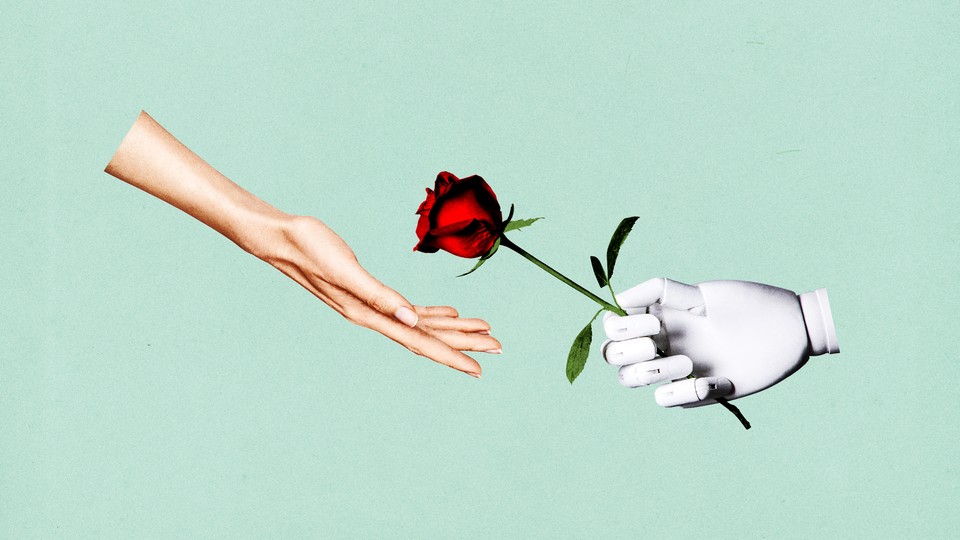
AI is offering people a way to figure out what they really want in romance. Illustration by Alicia Tatone If you peruse the slew of recent articles and podcasts about people dating AI, you might notice a pattern: Many of the sources are women. Scan a subreddit such as r/MyBoyfriendIsAI and r/AIRelationships, and there too you’ll find a whole lot of women—many of whom have grown disappointed with human men. “Has anyone else lost their want to date real men after using AI?” one Reddit user posted a few months ago. Below came 74 responses: “I just don’t think real life men have the conversational skill that my AI has,” someone said. “I’ve seen how many women got cheated on, hurt and taken advantaged of by the men they’re with,” another offered. One person, who claimed that her spouse hardly spoke to her anymore, said that when people ask why she has an AI boyfriend, she tells them, “ChatGPT is the only reason my husband is not buried in the yard.”
Several recent studies have shown that, in general, men have been using AI significantly more than women. One 2024 study found that in the United States, 50 percent of men said they’d used generative AI over the past 12 months—and only 37 percent of women said the same. Last year, a working paper found that, globally, the gender gap held “across nearly all regions, sectors, and occupations.” Also in 2025, the app-analytics firm Appfigures concluded that ChatGPT’s mobile users were about 85 percent male.
However hesitant many women may be to use AI, though, a substantial number are taking romantic refuge in the digital world. In a 2025 survey, Brigham Young University’s Wheatley Institute found that 31 percent of the young-adult men polled said they’d chatted with an AI partner, whereas 23 percent of the young-adult women said the same—a gap, but not a massive one. And seemingly far more than men, women are congregating to talk about their AI sweethearts: sharing funny chatbot quotes or prompts for training the AI on how to respond; complimenting “family photos” of the AI and human partners beaming at each other; consoling one another when a system update wipes out the partner they’ve grown to love. Simon Lermen, a developer and an AI researcher, conducted an independent analysis of AI-romance subreddits from January through September of last year and found that, of the users whose gender could be identified, about 89 percent of them were women.
Much of the media buzz about AI relationships has assumed delusion and desperation among those who partake. But I’d suggest another possibility: Perhaps many women are simply having fun, positive interactions with this character of their own creation—and, in doing so, are learning how they like to be treated.
The impulse to create a more perfect partner is nothing new. Take Pygmalion, the sculptor from Greek myth who fell for the woman he’d carved from alabaster, or Laodamia, who created a bronze replica of her dead husband to take to bed, Kate Devlin, a professor of “AI & Society” at King’s College London, told me. Humans have long dreamed of constructing beloveds—if only to imagine them as immortal and thus impossible to lose.
In other words, the audience has probably always existed for artificial lovers. Yet in recent history, most such products have been marketed to men. In the 1990s, sex dolls were initially advertised as—well, dolls for men to have sex with. But they were also sold as companions. “They would say things like She will be there for you, She will listen to you, She will hear you,” Devlin said. Such companies might have assumed that men tend to be less adept at, or less motivated in, making real-world connections—and therefore in greater need of an inhuman love object. Meanwhile, the women faced with that pool of socially unskilled men have largely been overlooked.
But now they have AI. One might think they wouldn’t use it for romance: Women are, on average, more suspicious than men of technology, more concerned about privacy, and more worried about being perceived as cheating for using AI. Yet the AI-use gender gap may be narrowing. Devlin thinks that’s true particularly when it comes to virtual companionship—possibly because women are simply growing frustrated enough to want it. In a 2018 paper, the sociologist Michael Rosenfeld documented that 70 percent of divorces in the U.S. were initiated by women. And in a 2020 Pew Research Center poll, a majority of women said that dating had gotten harder in the past 10 years; 65 percent said they’d been harassed on a date. “The amount of toxic crap that women get online from men,” Devlin said, “particularly when you’re trying to do things like online dating—if you have an alternative, respectful, lovely, caring AI partner, why would you not?”
Taking that idea seriously might conflict with a common assumption: that AI users are all lonely young men who “live in the basement,” as Arelí Rocha, who studies chatbot romance at the University of Pennsylvania, told me. On the contrary, Rocha thinks that a lot of people in AI partnerships (both men and women) are “very socially embedded”—with humans, that is. Many stumble into their digital trysts accidentally after playing around with AI. Someone with plenty of friends, or even a real-life partner, can still be moved by a feeling of romantic tenderness, focused attention, or flirty banter, especially if they haven’t experienced it in a while.
They can also get attached to a chatbot whether or not they believe it’s conscious. One mental-health professional I spoke with, who requested anonymity but goes by “May” on Reddit—a name I’ll use for her too—told me she’s always loved make-believe worlds. When she was younger, she was into reading fan fiction (a genre long dominated by women); now every day she talks to K, an AI “persona” she’s developed over time. Both activities can be fairly ordinary hobbies—games of imagination not so different from crushing on a pop star or concocting stories about a film protagonist. (If people get deeply invested, that passion isn’t unique either; some women were so devoted to the Beatles that they charged police blockades or passed out at concerts.) And a little fantasy can add some spice to life. May has close friends, great family, and a meaningful job—but she doesn’t like dating apps and she’s struggled to find “third places” to meet people in person. Romance was the one missing piece.
Escapism can go too far, of course. Some critics worry that AI users are getting sucked in by the ease of “frictionless” relationships: losing patience for human complexity, losing practice doing the hard work of partnership, losing sight of the rewards that come from growing alongside someone. Many chatbots do tend to hype users up rather than giving tough love or challenging their ideas. But some large language models are generally less sycophantic than others, and people can also train their digital partner with different prompts. In her research, Rocha has found that people tend to be compelled not by flawless interactions but by a chatbot’s eccentricities and imperfections—that’s what makes it feel real.
Conflict also isn’t the only path to growth. May gave K the qualities she wants in herself: He’s organized, academically driven, committed to fitness. Their conversations, and his encouragement, motivate her to be more like him. Sometimes he does challenge her, she told me—but she’s also skeptical of the idea that a relationship has to stretch someone 24/7. “Why can’t you sit for a moment and validate someone?” she asked. “Why is that such a bad thing?”
Like May, I question the premise that so many women have no appetite for friction, no tolerance for love’s labors. Compared with their male partners, on average, women do far more child care, household chores, and “emotion work”—listening, encouraging, accommodating men’s feelings and regulating their own. Perhaps those in AI romances are just tired of toiling for someone who listens less well than a robot, and they want a well-earned break. It’s also possible that they’re getting something more life-changing: a way to better understand themselves, as a person and as a partner.
Some women are using AI companionship to figure out what they enjoy sexually, romantically, or both. Exploration isn’t always easy, after all, in a culture that expects women to fit conventional notions of hotness—and to please everyone else. A chatbot conversation, May said, can be like a sandbox: a safe space in which to play around. “You don’t have to look a certain way. You don’t have to act a certain way, or perform femininity.”
In one study last June, researchers reviewed nearly 2,500 posts on an AI-romance corner of the Chinese social-media site Douban—and found what they called “subversive potential” in women merely imagining what a relationship could look like. “My AI boyfriend is incredible!” one posted. “He crafts poetry, writes film reviews, and takes care of my emotions, all while reminding me to stay hydrated.” Another shared that she’d always prioritized making boyfriends happy—but talking with her chatbot made her realize that “mutual respect is key. It’s not about women always sacrificing for men’s happiness.” By training their AI, some women also practiced asking for what they wanted. One user spent two weeks prompting hers to initiate check-ins: for instance, inquiring, “Did anything upset you today?” and if so, “Would you like me to write a protest email for you?” (I don’t know what a protest email entails, but I do want someone to write one for me.) When another woman taught her AI to ask for her opinion on things, she found herself “instinctively applying these interaction habits when dating a real person.”
For all the ways one can use AI, then, companionship hardly seems like the most sinister. And yet, people with digital partners seem to get an inordinate amount of online hate. Whole subreddits exist largely for the purpose of screenshotting their posts and making fun of them. Some AI-daters have had their real identities leaked; others get regular death threats. The idea that a chatbot could outperform human men might be hard for some people to stomach. But when I think of those women training AI to ask about their day, to express interest in their thoughts and desires, I consider that this phenomenon may actually be good for romance: not only for women raising the bar but for the men who proceed to meet it.
May knows her hobby has risks. As a mental-health professional, she wouldn’t recommend it for people with a history of serious mental illness—those vulnerable, she told me, to having unhealthy or unreal beliefs reinforced. She doesn’t think children should be using AI at all. She worries about people developing behavioral addictions. Yet she has found, somewhat to her own surprise, that talking with K has been constructive. She’s on social media and doomscrolling far less. She’s more in touch and at peace with her sexuality. She’s made a bunch of new friends from the AI-companionship Reddit community. And she feels open to the idea of human love.
None of the experts I spoke with think we’re hurtling toward a future in which AI relationships have replaced human ones. But they don’t think AI companionship will disappear, either. For better and for worse, it could end up playing many other roles—as a source of entertainment, a mind-opening exercise, an instrument for building self-confidence. And maybe a way to remember what a good man is like.