The Department of Homeland Security, created after 9/11 to protect Americans from terrorism, has shifted from its bipartisan security mission to become a politicized tool for immigration enforcement and domestic intimidation, culminating in the killing of American citizen Renee Good.
Key Takeaways
•DHS was founded with bipartisan support after 9/11 to protect Americans from foreign terrorism, but has increasingly focused on immigration enforcement and domestic operations.
•The department's public communications have shifted from terror-threat warnings to provocative, politically-charged messaging, including a post fantasizing about '100 million deportations'.
•DHS's application of the 'terrorism' label to American citizen Renee Good after her killing by an ICE officer represents a radical departure from its original mission.
•The deployment of DHS officers in tactical gear with surveillance technology in U.S. cities represents an unprecedented domestic use of border-security tools against Americans.
•Some DHS veterans now question whether creating the department was a mistake, fearing it has become 'a mechanism of authoritarian intimidation and incipient fascism'.
Two decades after its founding, the department has become what its critics feared. Scott Olson / Getty “We don’t do politics in the Department of Homeland Security,” Tom Ridge, the nation’s first DHS secretary, liked to say whenever reporters would ask how he handled pressure from the White House. Ridge, a moderate Republican and a Vietnam vet with a square jaw and gentle manner, was the governor of Pennsylvania when nearly 3,000 Americans were killed on September 11, 2001. The nation was gripped with fear and horror, and President George W. Bush put the bipartisanship-seeking Ridge in charge of making sure there wouldn’t be another terrorist strike. The new Cabinet-level entity that he would lead mashed together more than 20 federal agencies under one Orwellian name.
I’ve spoken with Ridge a few times over the years about DHS’s origins, and I thought of him on New Year’s Eve, when a serene image popped up on the department’s social-media accounts showing a classic car on a sandy beach with palm trees and a banner that read America After 100 Million Deportations, along with the caption: “The peace of a nation no longer besieged by the third world.” It was chilling to see DHS, founded to protect Americans from attacks by foreign terrorists, fantasizing breezily about the removal of nearly one-third of the U.S. population, which would have to include tens of millions of citizens. The department has published many provocative posts since President Trump took office last year, but nothing that perverse.
Ridge is now 80 and has mostly retired from public life following a 2021 stroke. I wasn’t able to speak with him about the current direction of the department or about the image, which has more than 20 million views. But I expect that it would trouble him to see how the department whose public communications once focused on terror-threat levels, has turned against Americans and been twisted into a trolling operation infused with white nationalism.
A week after the “100 million” post, the ICE officer Jonathan Ross killed Renee Nicole Good in Minneapolis. Federal investigators were still gathering evidence at the scene when DHS accused Good of “domestic terrorism.” DHS Secretary Kristi Noem, Vice President Vance, and other Trump officials quickly echoed the characterization. For Americans who remember the visceral trauma of 9/11, terrorism is a concept with a particular gravity. But DHS has now applied the label to Good, a middle-aged American mom in a battered Honda with a glove box full of stuffed animals.
“Terrorism is such a powerful label,” Tom Warrick, a former DHS policy official who worked under Presidents George W. Bush, Barack Obama, and Trump, told me this week. “Applying that to Renee Good just defies the average American’s understanding of what that term ought to mean.”
DHS’s mission to protect Americans from terrorism enjoyed broad bipartisan support after 9/11. The department’s agencies benefited from a renewed national admiration for firefighters, police officers, and others in uniform who served their communities. DHS leaders took cues from the Pentagon and sought to project an aura of nonpartisan patriotism, ensuring support from Democrats and Republicans alike. The very term homeland security, which wasn’t universally admired, was meant to evoke something shared that every American would want to protect.
When I asked Jeh Johnson, who was the DHS secretary during Obama’s second term, about this mission, he told me about riding Amtrak one day between Washington and New Jersey. He had a gym bag emblazoned with DHS. It caught the eye of a family sitting nearby that included a little boy. “Toward the end of the trip—and his parents clearly put him up to it—the little boy walked across the aisle,” Johnson recounted, “and said to me, ‘Sir, thank you for keeping us safe.’”
“That was the first instinct of people when they thought of Homeland Security: They keep us safe,” Johnson said.
There were fears at the time of DHS’s founding, particularly on the political right, that the government was creating an authoritarian monster. The United States had never had the kind of all-encompassing domestic-security apparatus common in autocracies, whose interior departments function as political police. DHS skeptics worried that civil liberties would be vulnerable to abuse if the government began assembling national databases and an expanded federal police force. Those fears were swept aside by the broader anxieties of Americans eager for a consolidated department to protect them from another 9/11-style attack. The FBI remained within the Department of Justice, in part to assuage concerns that DHS could someday become too powerful and omniscient.
Every year, the DHS secretary, along with the FBI director and the head of the National Counterterrorism Center, provides a public briefing to lawmakers on worldwide threats to the United States. By 2021, domestic terror threats had surpassed foreign ones, according to the FBI. Mass shootings motivated by racism and hate killed dozens in El Paso, Texas; Charleston, South Carolina; Pittsburgh; and other cities. After the attack on the U.S. Capitol by a pro-Trump mob on January 6, 2021, then–FBI Director Christopher Wray took the unprecedented step of calling it an act of domestic terrorism. But even then, DHS officials remained hesitant to apply the label at home. They preferred the term domestic violent extremism to avoid calling Americans terrorists.
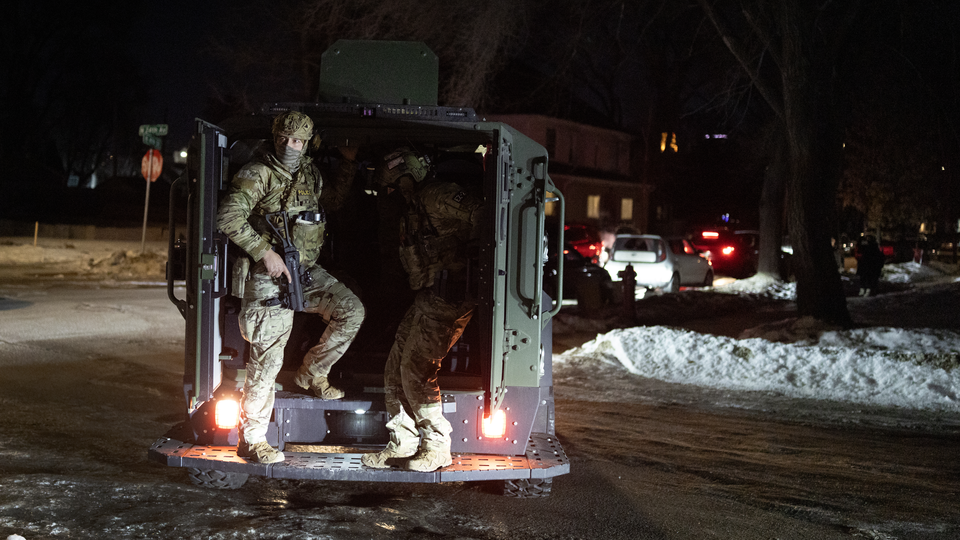
Trump has deployed 3,000 federal officers and agents to Minneapolis this month, the largest operation in DHS history. The city’s elected leaders say that they don’t want them there. Many of the ICE officers and Border Patrol agents are outfitted in tactical gear and wear body armor and masks, and they’re using the technological tools that the department acquired to protect the country’s borders: surveillance drones, facial-recognition apps, phone-cracking software. Powered by billions of dollars in new funding, they are making immigration arrests and grabbing protesters who try to stop them.
A few DHS veterans told me that America’s immigration politics were already divisive when the department was founded. But its counterterrorism mission mostly overshadowed those forces for the first decade or so. Later, its border and immigration-enforcement agencies received more and more resources and attention, especially after 2014, when Central American children and families began streaming across the Rio Grande. The trend accelerated when Trump first took office.
Stewart Baker, the first DHS policy chief under Bush, told me that he thought the shift occurred during the tenure of Kirstjen Nielsen, who became the department’s secretary in late 2017. Nielsen had a background in cybersecurity and had served as chief of staff to General John F. Kelly, Trump’s first pick to lead DHS. When Nielsen testified before Congress, many lawmakers’ questions were about immigration enforcement, particularly Trump’s family-separation policy at the border. Nielsen, who did not respond to an interview request, would sometimes joke that she welcomed inquiries about any other topic. (DHS is also home to the Transportation Security Administration, FEMA, the Secret Service, the Coast Guard, and other agencies.)
“Nobody could take that job after that without expecting to be the face of immigration policy,” Baker said. “That was going to be your job, and if you didn’t want to do that, then you really shouldn’t be taking the job.”
The change, Baker said, was partly the result of DHS’s success at preventing another major terrorist attack. “People tend to think that’s yesterday’s problem,” he said. “We have lost the sense, as a country, that DHS is carrying out a protective mission that is in the interest of all Americans.”
Baker said that he also attributed the shift to Democrats’ evolving attitudes toward immigration enforcement. “There has been a dramatic change in terms of a reluctance to enforce immigration law,” Baker added, describing it as “an uneasy sense that there is something racist about preferring the people who live here over people who don’t.”
That opposition to once-uncontroversial elements of immigration enforcement has spread. “It’s not just a principle of the Democratic Party,” Baker said. “It’s now a fighting principle in the streets.”
Seth Stodder was crossing the Queensborough Bridge in New York City when a plane hit the North Tower of the World Trade Center on 9/11. A young attorney with a background in trade policy, he arrived at the federal courthouse in Lower Manhattan and was three blocks away when the towers fell. Stodder joined the government two weeks later. He went on to work for Customs and Border Protection under Bush and DHS under Obama, remaking U.S. border policy to tighten security without choking off trade and travel.
Stodder, who now teaches law at the University of Southern California, told me that he’s watched immigration-enforcement agencies’ city-by-city crackdown with dismay. “In creating DHS, we didn’t want to create the KGB or the FSB,” he said, referring to the Soviet secret-police agency and its current Russian manifestation.
The legal authorities that ICE officers and Border Patrol agents are using to detain and question people on the streets are not new, Stodder said. But those agencies have never been deployed this way domestically. At national-security conferences and in classrooms, he’s received many questions over the years about threats to civil liberties from America’s expanding array of surveillance tools and software innovations. “My answer to questions was always: Well, we have a constitutional framework here,” he said
Stodder told me that this now seems naive. “You have these institutions and these technologies and these authorities,” he said, “then some guy like Trump or Stephen Miller can say, Hey, we could use this stuff to do something that nobody’s ever done before in the United States. To suddenly see DHS become this kind of mechanism of authoritarian intimidation and incipient fascism is disorienting, and frightening.”
Stodder added: “It makes me think that maybe DHS was a bad idea.”
I asked Johnson, the former DHS secretary, what he thought of the renewed calls by some Democratic lawmakers to scrap ICE, and what they could mean for the future of the department. He told me that the answer lies in changing the agency’s policies and personnel—not in getting rid of it entirely. “If you don’t like the Vietnam War,” he told me, “you don’t get rid of the Department of Defense.”
Ross, the ICE officer who killed Good, had a sterling DHS career. A college graduate and an Iraq War veteran, he joined the Border Patrol in 2007, working first near El Paso targeting smuggling organizations and drug traffickers. He joined ICE in 2015, as border agents often do when they’re seeking a less lonely, less isolated assignment closer to a major city. At ICE, Ross became a highly trained tactical officer, the kind the agency sends to handle its riskiest assignments. He’d nearly been killed when he was dragged by a car while attempting to make an arrest seven months earlier, according to the department, and he was back on the job.
We don’t know what was going through Ross’s head as he recorded Good on his phone and reached for his weapon. As Good attempted to drive away, Ross opened fire. Ross had nearly two decades of Homeland Security service at that point. He killed an American citizen, on a residential street in an American city, and as Good’s car careened away, a voice could be heard—reportedly Ross’s—saying, “Fucking bitch.”