Donald Trump has adopted a reckless version of neoconservative regime-change policies without the democratic idealism, echoing past U.S. failures in Iraq. His call for Iranians to overthrow their government lacks a real plan, risking chaos and betrayal.
Key Takeaways
•Trump's call for regime change in Iran mirrors past U.S. failures, like in Iraq, where quick interventions led to prolonged chaos.
•His approach lacks the neoconservatives' democratic ideals, focusing instead on American power and self-interest.
•Regime change without nation-building or support for democracy often results in destruction rather than renewal.
•Trump has dismantled U.S. agencies that promote democracy, undermining any real commitment to Iranian freedom.
•His vague hopes for Iranian uprising ignore the risks of civil war and further repression, with no accountability for consequences.
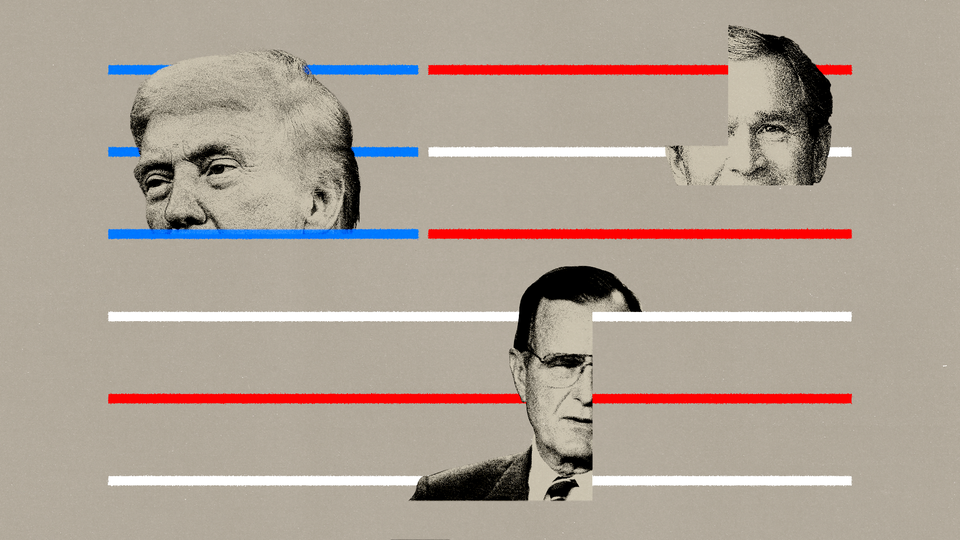
Donald Trump has embraced a warped version of the neoconservatism he once derided. Illustration by Paul Spella / The Atlantic. Sources: Howard L. Sachs / CNP / Getty; Kenny Holston / Getty; United States Department of Defense. During the Gulf War, in February 1991, George H. W. Bush called on the Iraqi people to “take matters into their own hands to force Saddam Hussein, the dictator, to step aside.” Coalition aircraft dropped leaflets urging Iraqi civilians and troops to rise up. But when the country’s oppressed Shia and Kurdish populations followed that exhortation, Hussein’s surviving forces crushed them, killing tens of thousands of people, while the United States military stood by and did nothing.
In the early hours of Saturday morning, as U.S. and Israeli warplanes started to bomb Iran and target its leadership, Donald Trump recorded an eight-minute video message that echoed Bush. “When we are finished, take over your government,” he urged the Iranian people. “It will be yours to take.” Like Bush, he provided no further instructions.
Regime change on the cheap—by covert action, military coup, airpower, or short ground war—has tempted almost every American president since World War II. No wonder: It offers to solve a difficult foreign problem with little cost to Americans. We remember the wars in Afghanistan and Iraq as prolonged, bloody, ultimately futile attempts to remake recalcitrant foreign countries as democracies. But President George W. Bush intended both wars to be brief and low-cost—regime change with a small footprint.
The original plan in Iraq called for a rapid transfer of power to a group of exiles in the spring of 2003, followed by early elections and the withdrawal of all but 30,000 American troops by summer’s end. This would be regime change without nation building, the best of both worlds, and it was really no plan at all, for it depended on magical thinking: Iraqis would be so hungry for democracy that they would build it for themselves. When looting broke out in Baghdad, and undermanned American forces without orders to provide security failed to intervene, Defense Secretary Donald Rumsfeld sniffed, “Freedom’s untidy.”
In early June 2003, a few weeks after the fall of Baghdad, a retired general named Jay Garner, the first American proconsul of newly liberated Iraq, was recalled to Washington and met Bush in the Oval Office. Though Iraq was already descending into chaos, for 45 minutes they exchanged congratulations on a mission accomplished. Garner later told me that as the meeting ended, Bush asked, “You want to do Iran for the next one?” To which Garner replied, “No, sir, me and the boys are holding out for Cuba.”
The forever war that followed amounted to a belated attempt to assume responsibility for the disaster that an ill-conceived invasion had created. It was a tragic sign of getting serious. The Iraq War’s neoconservative architects suffered from a hubristic faith in American power and their own righteousness. But if their ideological commitments hadn’t included democracy, the war would have lasted just a few months.
The war had my reluctant support because I couldn’t imagine anything worse than Hussein’s totalitarian regime. But within a few years of the invasion, many Iraqis who had welcomed it began to look back with nostalgia. Today, it’s impossible not to feel happy for Iranians inside the country and overseas as they celebrate the deaths of their oppressors, above all that of Supreme Leader Ali Khamenei, whose rule destroyed the lives of so many people, especially young ones. But the surest way for worse to follow is to fail to believe that it can.
Iran, with its deep history, its educated and relatively homogeneous population, and its unbreakable freedom movement, has always seemed a better bet for political transformation than Afghanistan or Iraq. But if recent decades have taught anything, it’s that the absence of tyranny is not freedom but chaos; that war is a likelier agent of disintegration than of renewal; that America knows how to destroy regimes but not remake societies. Democracy can’t be installed—it has to grow from within, over time, under delicate conditions. The U.S. can help support it, but last year Trump shut down every U.S. agency and bureau that promoted democracy and human rights, and defunded government media, such as Voice of America and Radio Farda, that could have communicated with the Iranian people during this crisis. Having done more than any president in our lifetime to destroy democracy at home, Trump has no interest in making it flourish abroad. His hubris resembles that of the neocons—like them, he believes in American supremacy and is fascinated by the overwhelming power of the U.S. military—but he shares none of their idealism. His only commitment is to himself.
Trump came to office as a strident critic of the post-9/11 wars—“America First” meant no more U.S. troops killed in stupid interventions to change regimes in far-off countries. But Trump prizes his own untrammeled power more than consistency or peace. He’s become the latest advocate for regime change on the cheap—beguiled by the vision of “doing Iran for the next one” and resolving the 47-year conflict between the United States and the Islamic Republic, imagining a final end to the regime’s nuclear ambitions, terrorism, regional wars, and savage repression of its people. “This is the single greatest chance for the Iranian people to take back their Country,” Trump wrote on Truth Social on Saturday. “Hopefully, the IRGC and Police will peacefully merge with the Iranian Patriots, and work together as a unit to bring back the Country to the Greatness it deserves.”
In January, the IRGC—the Islamic Revolutionary Guard Corps, along with the paramilitary Basij militia—killed as many as 30,000 Iranian protesters during the most brutal crackdown in the history of this violent regime. Most Iranians regard these forces with fear and hatred. No one can guarantee them the “complete immunity” that Trump offered over the weekend if they lay down their arms, and they won’t easily relinquish their power and corrupt wealth. His notion of spontaneous democratic combustion in a country of 90 million people, with its heavily armed military establishment still very much in control, shows sheer wishful thinking. Hopefully is the language of a leader without a plan.
And if “Greatness” fails to arrive—if the regime changes the name at the top but not its basic character, and its security forces slaughter thousands more Iranians who follow Trump’s videotaped advice to “take over” their country, and civil war breaks out in ethnic-minority regions, and the entire Middle East is in flames—who can believe that Trump will take any responsibility? Rather, he’ll claim the glory of war without owning the tragedy of all that it brings and move on to something else, while the Iranian people are betrayed again, this time by us.