Elon Musk's Starlink has played a pivotal role in the Ukraine war, with his recent decision to restrict Russian access via a whitelist system giving Ukrainian forces a battlefield advantage. This shift highlights both Ukraine's dependence on Musk's technology and broader concerns about his unilateral power to influence the conflict's outcome.
Key Takeaways
•Elon Musk's Starlink satellite internet service has become a critical battlefield tool for both Ukraine and Russia, with Musk's decisions directly impacting military operations.
•In early 2026, Musk implemented a whitelist system that blocked Russian access to Starlink, giving Ukrainian forces a significant communications advantage that led to territorial gains.
•Ukraine's dependence on Starlink creates strategic vulnerability, as Musk has previously intervened to limit Ukrainian operations when he feared escalation, including blocking a 2022 naval drone attack on Russian ships in Crimea.
•European allies recognize the risk of relying on Musk's technology and are developing alternatives, with Germany's Rheinmetall planning to build a Starlink replacement for its military.
•The whitelist implementation created temporary disruptions for Ukrainian forces but ultimately strengthened their position, while Russian attempts to circumvent the ban through bribery and other means were largely unsuccessful.
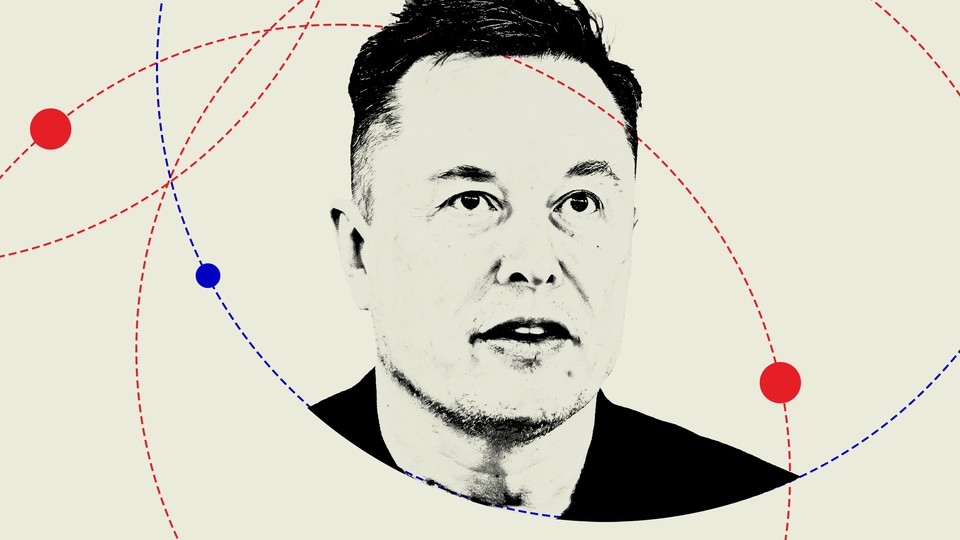
Russian forces falter as the world’s richest man intervenes in the war once again. Illustration by The Atlantic. Source: Fabrice Coffrini / AFP. On a frigid day late last month, a Russian attack drone slipped through Ukraine’s air-defense systems and glided into Kyiv’s government district, heading in the direction of President Volodymyr Zelensky’s office. The drone flew so low that officials inside the Cabinet of Ministers building could see it passing beneath them from their windows on the seventh floor. “A bunch of people saw it and were running around, like, ‘What the fuck was that?’” one government official recalled.
The drone, later identified as a Russian BM-35, caused minor damage when it crashed into a nearby building, injuring no one, the official said on the condition of anonymity. But the incident, which has not been previously reported, set in motion a chain of events that would allow Ukraine to seize the momentum at the front with the help of an unlikely ally: Elon Musk.
Since the start of the Russian invasion four years ago, Musk has played an outsize role in determining the course of the war. His high-speed internet service, Starlink, uses portable satellite dishes to create a Wi-Fi connection anywhere in the world, and it has allowed both the Russian and Ukrainian militaries to stay online in the war zone, coordinate troop movements, and navigate drones. No other system can match the reach and reliability of Starlink, which runs on the world’s largest constellation of satellites. Musk has occasionally used that system in ways that have helped one side of the war or the other.
In the fall of 2022, Musk intervened to limit the use of Starlink in Ukraine in a way that senior officers in Kyiv perceived as a service to Russian President Vladimir Putin. He argued that he wanted only to avoid an escalation that would provoke the Kremlin to use nuclear weapons. This time, his actions have worked in Ukraine’s favor, helping its troops break through Russia’s defensive lines in one small but significant section of the front. The reasoning behind Musk’s recent decision to limit Russian access to his technology remains unclear, and he did not respond to numerous requests for comment. The move to back Ukraine seems out of character for Musk, who has tended to follow his ally Donald Trump in advocating for a swift end to the war even if it forces Ukraine to grant painful concessions to the Russians. Whatever caused Musk’s apparent change of heart, the authorities in Kyiv are grateful for it.
Soon after the drone incursion in central Kyiv last month, Ukrainian officials appealed directly to Musk for help. The newly appointed minister of defense, Mykhailo Fedorov, presented Musk with evidence of Russian forces using Starlink to operate their long-range drones, including the one that breached Ukraine’s most sensitive airspace. Fedorov wrote on X (which Musk also owns) on January 29: “Western technologies must continue to support the democratic world and protect civilians—not be used for terror and the destruction of peaceful cities.”
In a series of talks with Musk and his team, the Ukrainians offered a plan to block the Russians from using Starlink. According to several government and military sources familiar with the plan’s implementation, its first phase took effect in the last days of January, severely curtailing the ability of both warring sides to use Starlink for their attack drones. SpaceX, the company that operates the Starlink network, then developed a whitelist of Ukrainian users—and shut off access for the Russians. (The company did not respond to requests for comment.)
“The whitelist was created, software-wise, in, like, one day,” a person familiar with the implementation of the plan told me. The SpaceX team behind it received clear instructions from its bosses: “‘No limits. Take off the gloves; use Starlink for anything to help Ukraine.’” Even inside the company, there was confusion as to what exactly motivated Musk. “But there was a political decision from Elon for sure,” the person said.
By the first days of this month, Russian forces began to suffer severe problems with their battlefield communications. “Starlink is our Achilles’ heel,” Alexander Kots, one of Moscow’s most experienced war correspondents, who spends much of his time embedded with Russian troops in Ukraine, said. “Unfortunately, we will not get a proper replacement for this system anytime soon,” he told the host of a Russian podcast. “I can’t even imagine in principle how we can catch up with Musk’s creation.”
Without the ability to operate drones or communicate through Starlink, the Russians have struggled to hold their defensive lines, and the Ukrainians have advanced. In the first three weeks of February, they seized more than 300 square kilometers of land from the Russians, Zelensky said in an interview with the French news agency AFP. “Without a doubt, our forces are exploiting the problems that the Russians are having with Starlink,” he said. A few days later, the commander of Ukraine’s armed forces, General Oleksandr Syrsky, said in a social-media post that the Ukrainians had liberated eight villages and more than 400 square kilometers during the past month, a rate of advance that Ukraine has not achieved in well over a year of grinding, attritional combat.
This turn of fortune will not be enough to defeat the Russians, who still possess a much larger army with a far superior arsenal of weapons, including nuclear missiles. But any sign of Russian weakness on the battlefield can help strengthen Ukraine’s position at the negotiating table, Zelensky told me earlier this month during an interview in his office in Kyiv. “Ukraine is not losing,” he said. “We have it rough. But to say that in these last six months they are winning somewhere? No.”
The assistance from Musk has helped Zelensky drive home this argument, both to his own people and to the Russians. It has also reminded Ukraine’s allies in Europe of the power that Musk wields over the course of this war. Through his satellite network, he can shift the balance in one direction or the other, all from the comfort of the SpaceX headquarters in Boca Chica, Texas.
“Do we want to be dependent on Elon Musk? No,” Armin Papperger, the head of Germany’s biggest defense company, Rheinmetall, which plans to build an alternative to Starlink for the German military, told me in an interview last week. “If he closes his satellites, if he closes communications, we have a problem,” Papperger said. This time around, Musk assisted Ukraine and its allies in the war. But their dependence on his good graces still worries the Europeans. “We need to be independent from Musk,” Papperger said. “That is a strategic necessity.”
Ukraine and its allies first realized the depth of their dependence on Starlink in the fall of 2022, when Musk used the system to stop a Ukrainian attack against the Russians. That September, Ukraine’s main intelligence service, the SBU, developed a plan to sink Russian warships stationed in Crimea, the Black Sea peninsula that Russia seized from Ukraine in 2014. Working in concert with the U.S. military, the SBU planned to use a flotilla of naval drones to sneak into the port of Sevastopol, the home of the Russian Black Sea fleet.
The operation involved a small group of Ukrainian-made drone boats, each one packed with more than 100 kilograms of C-4 explosives and remotely controlled with a Starlink terminal. Ivan Lukashevych, the SBU general who led the mission, told me that he went to great lengths to make sure that the Starlink units would work around the shores of Crimea. As part of the preparations, two undercover SBU agents boarded a commercial vessel traveling from Constanta, Romania, past the shores of Crimea and into the port of Poti, Georgia. “They had a Starlink with them, and they were checking if it worked along that route,” Lukashevych, who goes by the call sign “Hunter,” said. “It worked perfectly.” (Details of the SBU’s preparations for the mission have not been previously reported.)
From the agency’s command post five stories beneath a high-rise in Kyiv, the general and several of his comrades, including Fedorov, monitored the launch of the naval drones on a bank of screens. The vessels traveled for about seven hours until they came within about 40 nautical miles of their target. But as the boat at the front of the flotilla rounded the western tip of Crimea, its satellite link to the command center cut off, Lukashevych said.
“The entire operation hinged on these communications,” Lukashevych said. “At first I thought it may be a problem with the first boat. So we sent two more of them to the same spot, and as soon as they crossed a certain line, they also went dark. That’s when we understood they had been turned off.”
Fedorov, who was then serving as the minister in charge of Ukraine’s drone program, began calling his contacts at SpaceX to find the source of the breakdown. But he could not get any clear answers. After months of planning, the SBU was forced to abort the mission and bring its drones back to shore. Lukashevych was furious. “Musk decided to do a bit of work for Putin,” the general said.“He saved the Russian fleet.”
Musk later released a statement to clarify his reasoning. He confirmed that he had received an “emergency request” from the government in Kyiv to “activate Starlink all the way to Sevastopol,” and he had refused to grant it. “If I had agreed to their request, then SpaceX would be explicitly complicit in a major act of war and conflict escalation,” Musk wrote.
Before that intervention, the Ukrainians had seen Musk as a steadfast partner in the war. He had provided them with hundreds of Starlink terminals free of charge at the start of the invasion, joining an initial chorus of support for Ukraine in Silicon Valley, where tech billionaires gave generous donations to help push back the Russian assault. But the mood among Musk and his associates changed as Russia intensified its threats to use nuclear weapons against Ukraine and its Western allies. Musk wanted nothing to do with that kind of escalation.
“How am I in this war?” he asked his biographer, Walter Isaacson, in 2022. “Starlink was not meant to be involved in wars. It was so people can watch Netflix and chill and get online for school and do good peaceful things, not drone strikes.”
Musk soon demanded payment from the Pentagon for the Starlink services provided to Ukraine’s armed forces, and he grew vocal in calling for an end to the war. The Ukrainians responded by trying to break their dependence on Starlink, and Lukashevych told me that they had some success. By the start of 2023, the SBU learned to make its communication systems more resistant to outside interference. “We hacked the positioning system on the Starlinks,” Lukashevych said. “So Musk will not be able to shut them off whenever he wants.”
The Ukrainians also experimented with other communications systems for their drones, including wireless mesh networks, which use radio nodes to relay frequencies across a broad segment of the war zone. But nothing came close to the effectiveness of Starlink, which remained a central pillar of Ukraine’s defenses and a source of deep concern for its leadership. Throughout the war, military and political leaders have consistently told me that they could never be sure whether Musk would intervene again to block one of their riskier operations, and what his motives might be.
These concerns grew acute in August 2024, when Ukraine launched its first offensive across the border into Russia, seizing a large chunk of territory in the region of Kursk. Military commanders found that their Starlink terminals stopped working as soon as they entered that region. “Starlink set the limit at the border of Ukraine,” Colonel Pavlo Yelizarov, the commander of one of Ukraine’s most effective drone units, Lasar’s Group, whose bombers are controlled through Starlink, told me. “So we had to find some other solutions.”
The issue came up again a year ago, when Trump returned to the White House. His initial attempts to force a swift end to the war led to tensions with Zelensky, who refused to accept a peace deal with terms that favored the Russians. Last February, Reuters reported that one of Trump’s envoys had tried to pressure the Ukrainians by threatening to cut off their access to Starlink. The tensions culminated the following week, during a televised clash between Trump and Zelensky in the Oval Office.
After that, the United States paused all aid to Ukraine for about a week. Without access to intelligence from U.S. spy agencies, Ukraine’s offensive in the Kursk region faltered, and its troops were soon forced to pull back. Zelensky did not blame the Americans for that reversal. In an interview last March, a couple of weeks after the U.S. resumed sharing intelligence and supplying other military aid, he declined to say whether Trump’s envoys had threatened to block Starlink access.
“There were these reports that Starlink could be turned off, but I don’t know how true that was,” Zelensky told me. Even the possibility of such a threat, he added, “has certainly pushed us to look for alternatives, and we have been doing that.” But Ukraine has not yet found a system that works nearly as well as Starlink. Any attempt to shut it off, Zelensky said, “would be very sensitive for us.” I asked him to be more specific: How sensitive exactly? The president stared at me for a long moment and drew out his words for emphasis. “I think it would be very sensitive.”
The sensitivity came into focus this month, when Musk intervened in the war once again. As part of Fedorov’s plan to create a whitelist of Starlink users, SpaceX had restricted access to the system in Ukraine. By coincidence, I was due to embed that week on a mission with a Ukrainian drone unit, whose commander contacted me at the last minute with some worrying news: The unit’s Starlink terminals had stopped working as normal. Whenever its drones flew faster than 80 kilometers per hour, their Starlink connection would cut off.
The disruption had forced his unit—and many others throughout the war zone—to ground its drones until their Starlink terminals could be registered with SpaceX. “We’ve already submitted everything, and we expect the limitation to be lifted tomorrow,” he wrote to me on February 1. Within a few days, the whitelist system was up and running, and the Starlinks approved for flight were back in operation across Ukraine.
Meanwhile, Russian drone units were scrambling to find a way around the ban. Their agents tried to bribe Ukrainians to register their Starlink terminals to comply with the whitelist. Earlier this month, a Ukrainian couple living in the region of Odesa was arrested for agreeing to register a Starlink for the Russians in exchange for $30, according to the SBU, which said in a statement that the couple face life imprisonment if convicted.
In a separate case, Ukrainian cyberoperatives created a fake Starlink registration system and invited Russian soldiers to use it for a fee. The scam reportedly tricked Russian drone operators into giving away the location of their Starlink terminals, allowing Ukrainian artillery and drones to target them. In a week of work, “we received data on 2420 enemy Starlinks and the exact positions of the enemy,” the hackers, known as the 256th Cyber Assault Division, said in a statement on social media. (Their claim could not be independently verified.)
For the moment, Ukraine seems to have the upper hand against the Russians, at least when it comes to battlefield communications. Fedorov, the defense minister, has publicly expressed his gratitude to Musk for giving Ukraine that advantage, and Musk has pledged to continue his support. “Looks like the steps we took to stop the unauthorized use of Starlink by Russia have worked,” Musk wrote on X. “Let us know if more needs to be done.”