Conservative influencers are advocating for a revival of McCarthyism, arguing that Senator Joseph McCarthy was unfairly maligned and should be celebrated for his anti-Communist tactics. Figures like Steve Bannon and Jack Posobiec call for intensified political targeting, including blacklists and shaming of perceived enemies, with a broader scope than the original McCarthy era. This movement is part of a larger right-wing effort to revise history and legitimize authoritarian approaches in modern politics.
Key Takeaways
•Conservative figures like Steve Bannon and Jack Posobiec are pushing to rehabilitate Joseph McCarthy, claiming he was right and advocating for a more aggressive modern version of McCarthyism.
•The proposed new McCarthyism involves tactics such as 'naming and shaming' leftists, using blacklists, and targeting a wide range of enemies, including progressives, globalists, and political opponents.
•This revival is part of a broader right-wing revisionist strategy to recast historical figures and events, aiming to shift political norms and justify authoritarian measures in contemporary American politics.
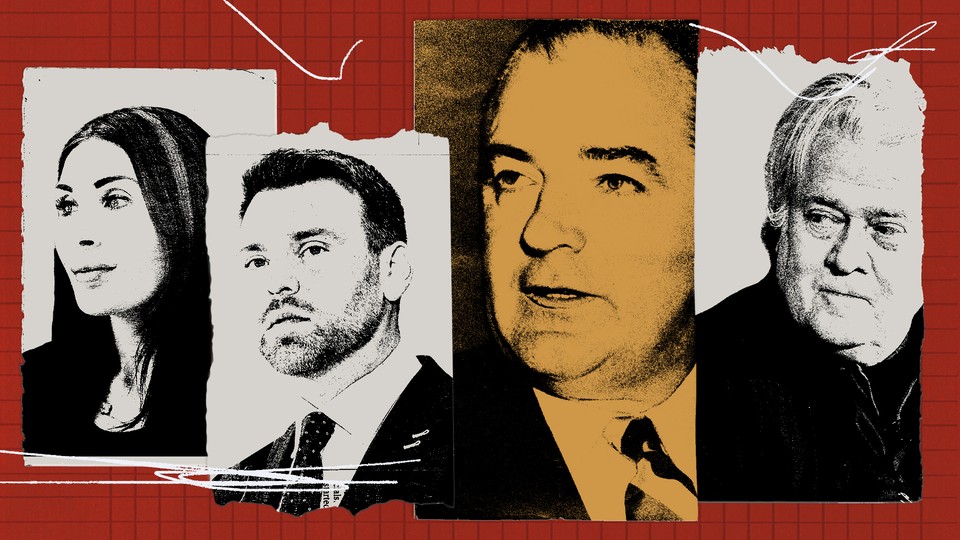
Conservative influencers are pushing for a return to the dark days of 1950s inquisitions. Illustration by Akshita Chandra / The Atlantic* For decades, Senator Joseph R. McCarthy’s name has been used as shorthand for the opposite of the aspirational ideal of civilized American politics. In the way that Kleenex has become interchangeable with tissue, McCarthyism, for many, is an eponym for the unjust, reprehensible use of political power. Indicating that anything resembled the tactics and smears of the late senator from Wisconsin has been enough to suggest that such behavior was out of bounds, with no rightful place in our modern politics. But now comes a small, influential group of hard-line right-wingers who believe that, in the words of one popular meme in such circles, McCarthy was right.
McCarthyite revivalism has flitted around the edges of American conservatism since the senator fell from grace during his conspiratorial anti-Communist campaign in the 1950s. In 1954, the conservative patron saint William F. Buckley Jr. and his friend and fellow conservative thinker L. Brent Bozell Jr. defended the senator in their book, McCarthy and His Enemies, as a sometimes-misguided figure unfairly maligned for his justified quest to root out Communist influence in government. Buckley called himself a “critic friendly to McCarthy” in 1959 and continued to defend the senator for decades.
The conservative media personality Ann Coulter, in her 2003 book, Treason, made the case that McCarthy had been right that the government was crawling with Communists, and that the greater problem was that Democrats “didn’t give a damn” about Soviet infiltration. Steve Bannon, a former senior adviser to Donald Trump and a MAGA-world podcaster, has been making the case for McCarthy’s rehabilitation since at least 2013 and remains fixated on the cause. When I recently raised the matter with him, he told me that “McCarthy is a hero to me” and explained that he had tried to buy the North Carolina home of McCarthy’s most famous target, General George C. Marshall. (Bannon said he ended up buying a home nearby.) More recently, the idea that “McCarthy was right” has been embraced by other influential voices around Trump—who learned some of his own hardball tactics from McCarthy’s chief counsel, Roy Cohn—though not, apparently, by the president himself. Some of his only searchable public utterances about the senator have been negative: In separate posts on X in 2018 and 2019, he cited a “Joseph McCarthy style Witch Hunt” and “modern day McCarthyism” in decrying the special-counsel investigation into Russian interference in the 2016 election.
The case for McCarthy’s rehabilitation centers on the contention that the senator has been unfairly maligned and was correct in his choices of both his enemies and his tactics—and that, if anything, he didn’t go far enough, limited as he was by the relative decorum of the times. (The tide of public opinion turned against McCarthy when he was challenged by the U.S. Army’s chief counsel Joseph Welch with the famous question “Have you no sense of decency, sir?”—a rocket at the time that by today’s standards of political discourse could be considered something of a softball.)
Laura Loomer, the gadfly and a Trump favorite, told my colleague Michael Scherer in an interview last year that “we need to make McCarthy great again.” And she told TheNew Yorker that McCarthy is “one of the most underrated and underappreciated political figures in history.” Jack Posobiec, a prominent far-right influencer and conspiracy theorist, also has posted that “McCarthy didn’t go far enough.” Bannon, in a recent phone conversation with me, put it even more starkly: “We need to do McCarthyism to the tenth power.”
In the early 1950s, McCarthy destroyed reputations and careers, mostly through congressional hearings and public accusations, fostering a climate in which individuals were fired over even the faintest suspicions of Communist sympathies. He delivered his opening salvo before a local Republican women’s club in Wheeling, West Virginia, in 1950, predicting that democracy would be destroyed “because of enemies from within” (another phrase often repeated in Trump circles). “I have here in my hand a list of 205—a list of names that were made known to the secretary of state as being members of the Communist Party and who nevertheless are still working and shaping policy in the State Department,” he said that day. The number of names shifted over time—first to 57, then to 81—and McCarthy never publicly produced the list. But it didn’t matter. His Wheeling speech came one year after the leaders of the Communist Party of the United States were put on trial. McCarthy tapped into, and then stoked, a national concern that at times verged on paranoia about the Soviet threat.
McCarthy used congressional hearings to expose the extent of alleged Communist infiltration. Before long, he and his allies were finding Communists everywhere. In addition to the State Department, he targeted journalists, academics, members of the Army, and others, ruining lives both through direct accusations and by fostering “Reds under the bed” anxiety. The House Un-American Activities Committee was spurred to conduct its own hearings and investigations, adding to the overblown fears of Communist encroachment. Hollywood studios circulated a blacklist of more than 250 people suspected of having Communist Party ties, leading to their industry exile. Documents released decades later revealed that there was indeed some Soviet infiltration of the U.S. government, but not on the scale that McCarthy had insisted. One 1950 investigation led by Senate Democrats found that McCarthy’s accusations that specific individuals in the State Department had Communist ties were baseless, and it described them as “a fraud and a hoax.” Since then, McCarthyism has been added to the list of 20th-century blights on the U.S. consciousness and the Constitution.
What exactly McCarthyism for our times looks like is still in flux. Loomer declined to elaborate when I asked. In my conversations with Bannon, he was enthusiastic about bringing McCarthy into the modern political moment, but vague about the details. Posobiec, though he declined to talk, has been a little more precise. In the 2024 book, Unhumans, he and his co-author, Joshua Lisec, wrote that renewing McCarthyism would mean employing the “humiliation tactic” of “naming and shaming” leftists, and a return to the blacklists of the Red Scare.
They devote a chapter of the book (which is dedicated to “the memory of those who have fought communism”) to the late Chilean dictator Augusto Pinochet and his anti-communist purges, which included killing dissidents by throwing them out of helicopters. The authors also praise conservative activists such as Chaya Raichik, the creator of Libs of TikTok (a conspiracy-mongering TikTok account that targets the left, particularly transgender and gay people); Christopher Rufo (a conservative activist and writer who has condemned DEI hiring practices); and James O’Keefe (a right-wing activist who has made a career of trying to expose perceived liberal bias) as early pioneers of a revitalized McCarthyism.
Posobiec and Lisec added one caveat: Campaigns must be done through “legal weapons of mass persuasion,” and they added that “nothing here in this section or in this book advocates illegal violence.”
In January, Posobiec wrote on X, “arrest ALL communists,” and he later said that he very much supports “the policy of black-bagging communists and sending them to Gitmo. In fact, I have a list of names that are ready to go.” Both arresting individuals on ideological grounds and “black-bagging” them—the warrantless surveillance in intelligence-gathering that can include breaking and entering—are illegal. (Gitmo refers to the U.S. military base at Guantánamo Bay, Cuba, where foreign combatants have been held without the legal support and process offered to those under arrest in the U.S.)
Some of the tactics that the McCarthy revivalists propose are more aggressive than anything McCarthy pursued. “McCarthy, for all of his obvious flaws, was still predicated on the use of the judicial system,” David Austin Walsh, a historian at the University of Virginia, told me. Should this new McCarthyism veer into proposing or doing anything violent, Walsh added, it “isn’t even really McCarthyism anymore—it’s just fascism.”
The new McCarthyites also want to define their targets more broadly than McCarthy did. The senator went after people who he claimed (however unfairly) were treasonously undermining the U.S. to help its chief adversary, the Soviet Union, in the years after World War II, when the parameters of a new global order were just coming into view. McCarthy’s rampage was about rooting out traitors. The new McCarthyites want to destroy their political adversaries. Unhumans uses the term communists interchangeably with progressives and Cultural Marxists (the modern right’s term for anyone who believes in left-of-center ideas about race, gender, and sexuality).
During a call in January, Bannon told me that the marks for his version of McCarthyism are “the globalists” who “don’t believe in the nation-state, they don’t believe in the sovereignty of this country, they particularly don’t believe in the citizens of this country.” Bannon has used the term globalists to refer to Silicon Valley elites, media executives, neoconservative foreign-policy hawks, proponents of lightly regulated global markets, and Jared Kushner. While we were on the phone, Bannon expanded this to include “all the deep-state-apparatus guys,” naming former FBI Director James Comey—whom the administration has targeted with dubious charges—as well as Andrew McCabe, a former FBI deputy director; John Brennan, a former CIA director and a vocal Trump critic; and Andrew Weissmann, a key member of Special Counsel Robert Mueller’s team that investigated 2016 Russian election interference. Bannon also mentioned the governors of Illinois, California, and Minnesota as targets for the new McCarthyism because of their defiance of ICE; he framed the governors as defending the sovereignty of their states and thereby “working against the sovereignty of the country.” To Bannon, “McCarthyism was the same thing: The sovereignty of the country was under attack.” But if the culprit then was a foreign power, now it’s duly elected American officials standing up for the constitutional divide between federal and state government.
Bannon doesn’t see this as a departure from the original McCarthyism. “There will be shifting targets, yeah,” he said, before adding that “Islamists” are also in “our gun sights.” Presumably, that’s a figurative turn of phrase, but none of the advocates of a new McCarthyism spell out exactly how they intend to go about prosecuting their many enemies. When I asked Bannon about the problems of the original McCarthyism—such as, for instance, the lack of due process for those he pursued—Bannon responded, “Fuck you” (I interpreted this as being directed at his ideological opponents, not me). “What do you mean ‘due process’? These were spies and infiltrators. They don’t get due process.”
The right’s interest in rehabilitating McCarthy is part of a broader playbook: recasting history—concepts, figures, legislation, turning points—to change the future of politics. In October, I wrote about the push to redefine what it means to be an American moving from the dark fringes of the right-wing internet to the White House, as influential conservatives promote a blood-and-soil vision that puts “heritage Americans”—those with generational lineage on these shores—ahead of more recent arrivals.
Other recent examples of right-wing revisionism include painting Martin Luther King Jr. as a negative force and seeking to undermine 1960s legislation that supported civil rights and expanded immigration. Some sections of the right have looked further back, targeting the Enlightenment. Only by recasting the tenets of the past, the thinking goes, can America move forward.
Ditto for the new embrace of McCarthyism. “In some ways, it’s trying to build a history that excuses that or that legitimates authoritarianism and impunity,” Nicole Hemmer, a historian at Vanderbilt University, told me. The term McCarthyism has been so frequently and so vaguely used, by both supporters and detractors, that those seeking its rehabilitation can contort McCarthy’s legacy however they deem convenient for their goals. This allows them to frame their actions not as a radical shift in national direction after 250 years of independence but as a bid to help the country return to its true path.
“You’re going to have a tremendous historical revisionism, particularly by the far right, to put McCarthy forward as a role model,” Bannon said. “The age of McCarthy is upon us.” If you consider the events of the past year—the Trump administration’s attempt to get Jimmy Kimmel kicked off the air; the arrest of the journalist Don Lemon; the prosecution of Trump’s political enemies; and the president’s civil suits against media outlets, universities, and law firms—you could be forgiven for thinking it’s already been here for a while.
*Illustration sources: ullstein bild / Getty; Shannon Finney / Getty; Dominic Gwinn / Middle East Images / AFP / Getty; Jacob M. Langston / The Washington Post / Getty.