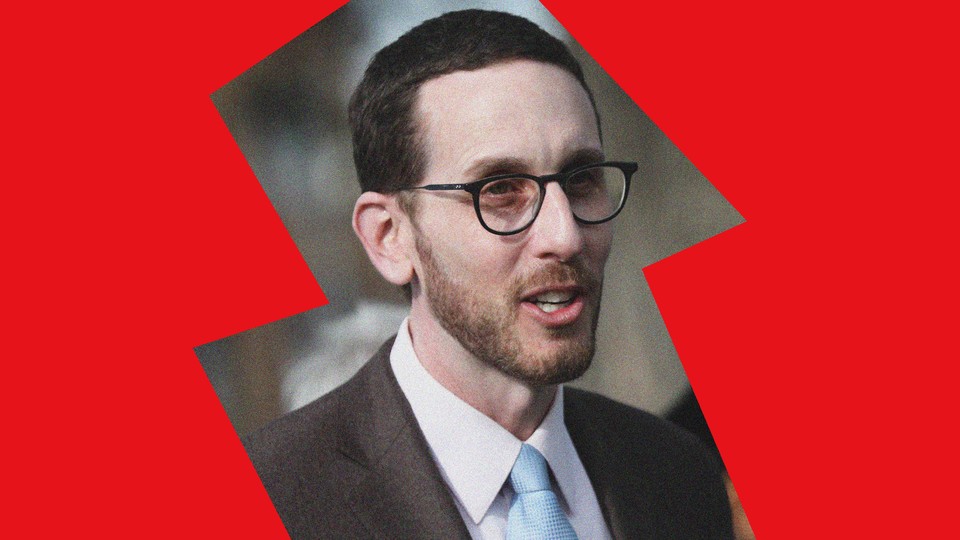
California state senator Scott Wiener faces intense criticism from all sides for his stances on housing, transgender rights, and Israel. His willingness to engage with pushback and champion controversial policies makes him one of America's most effective—and shouted-at—politicians.
Key Takeaways
•Scott Wiener's positions on housing (YIMBYism), transgender inclusion, and Israel draw criticism from both left and right, making him a unique political figure.
•His extreme tolerance for public confrontation and commitment to thorny issues has led to legislative successes, particularly in California housing policy.
•Wiener's identity as a gay Jewish politician creates complex tensions within progressive circles, especially regarding Israel and LGBTQ+ advocacy.
•The race for Nancy Pelosi's congressional seat has become a proxy war over California's housing policies and ideological divides within the Democratic Party.
•Despite facing constant criticism, Wiener maintains strong convictions and continues to advocate for his beliefs, even when unpopular.
Scott Wiener—a pro-trans Zionist who wants California to allow more homes—has an extreme tolerance for pushback. Illustration by The Atlantic. Source: Lea Suzuki / The San Francisco Chronicle / GettyScott Wiener has an unusual distinction in American politics: He upsets almost everybody. In the months before I met the California state senator—who is now running for Nancy Pelosi’s congressional seat—he had been harangued at one public meeting after another. In October, pro-Palestinian protesters disrupted his campaign’s pumpkin-carving event to shout: “Wiener, Wiener, you can’t hide; we charge you with genocide.” (This was not anisolatedincident.) His usual response in these situations is to wait calmly and then carry on as normal.
At another event a few days later, the singer Tish Hyman, who identified herself as “the only Black lesbian here,” confronted Wiener about his far-reaching support for transgender inclusion. “What would you say to women who are seeking assurance that their safety will be protected from men who by California law can self-ID as women in women-only spaces?” asked Hyman. Wiener replied that he was committed to the safety of all women—trans women included. Video of the confrontation went viral.
In an era when many politicians try to make only the most cautious public statements, or the ones most palatable to their side of the political spectrum, Wiener is an outlier. As a gay, Jewish politician, he defends Israel in ways that get him in trouble with the left. His LGBTQ advocacy not only has made him a target of the right but also goes too far for people such as Hyman, who voted for Kamala Harris. And as a YIMBY—an acronym that stands for “Yes in My Backyard”—he’s faced down San Francisco’s powerful homeowner class, who wrap their aversion to new housing in the language of environmentalism and social justice. His successful housing legislation has attracted national attention—to get homes built in San Francisco, you have to be something close to a magician. He “works on thorny issues of policy and politics with a wonk’s focus and a jock’s tenacity,” a recent Mother Jones article declared. The New York Times’ Ezra Klein credited him for being, “for a very long time, this lonely voice trying to radically expand housing supply.”
Wiener stands athwart some of the touchiest fault lines in today’s politics, and his extreme tolerance for pushback has made him one of the most effective legislators in the country. He also might be the most shouted-at politician in America. “I have supporters in San Francisco who don’t love my housing work,” Wiener told me, “but they either don’t love it, but they understand why I’m doing it—or they don’t love it, but they tolerate it and they like me because of other issues, right?”
Although in other ways you couldn’t imagine two more dissimilar men, Wiener’s ferociously active spirit resembles the Bolshevik antsiness of Donald Trump. The current president is attractive to some voters who might not agree with his values, or his language, or even his policies, but who like that the president is, well, presidenting. Last year, Trump bulldozed the East Wing of the White House, one of the most recognizable historic sites in the United States. In Democratic cities, people demand 38 meetings and three dozen environmental assessments before tearing down a crack den to build a nursery for sad orphans. Voters, Wiener argues, want politicians who are “willing to break glass to get those things done.”
In any shot of the California legislature, Wiener is instantly recognizable—a 6-foot-7 figure in a crisp suit and tie. He studied law at Harvard, where Ketanji Brown Jackson, now a Supreme Court justice, was a classmate. He moved to San Francisco in the 1990s to take a job with a law firm, where he worked on LGBTQ issues and housing policy. “As a young attorney in the late 1990s, I represented a long-term HIV survivor facing eviction,” he wrote last year. “He told me he could either return to the South for housing and lose access to quality HIV care, or stay in San Francisco for the care he needed but become homeless.”
Wiener has competition for Pelosi’s seat, and the composition of his rivals tells an interesting story about the various currents of the modern Democratic Party. One of his opponents is Saikat Chakrabarti, a 39-year-old start-up centimillionaire who previously served as chief of staff to Representative Alexandria Ocasio-Cortez. Pelosi has not formally endorsed a candidate, but she has appeared at events with another contender, Connie Chan, a progressive member of the city’s Board of Supervisors who is popular with labor unions. Wiener says Chan caters to NIMBYs; her supporters call Wiener a pro-developer capitalist.
The race has now become a proxy for the California housing wars, which pit younger renters against established homeowners in neighborhoods zoned for single-family units. This summer, Wiener finally got so-called infill legislation passed, which permits denser construction near public transportation. Senate Bill 79 was the third version of the bill—the first, S.B. 827, died in committee all the way back in 2018. “When we did S.B. 827, it was like a brand-new thing, like no bill like that, even in the same universe had ever been introduced before,” Wiener told me.
After its failure, Wiener looked for compromises and championed other bills aimed at increasing housing supply. At the same time, pressure groups worked hard to get younger, more YIMBY legislators elected. “Term limits have their downsides,” he told me. “One of the upsides is you have new, fresh thinking on different issues, and this is one of them.” Less high-mindedly, when S.B. 79 ran into resistance in Sacramento, he made a deal—pledging that housing more than 85 feet tall, or on land owned by transit authorities, would use unionized labor. After making such concessions, the bill finally squeaked through.
In the wild seas of California politics, his YIMBYism has drawn attacks from the left. “There are some people in San Francisco, if you believe in making it easier to build things, then that somehow makes you a moderate,” he said. Wiener is often attacked for not being left-wing enough. As a member of the city’s Board of Supervisors, he fought to ban public nudity from the Castro neighborhood outside of Pride parades and other special events. As a result, he was sharply criticized by radical nudists. “The San Francisco labels are stupid,” he told me. He considers himself “very progressive” and is more overtly sex-positive than even the typical Bay Area politician. He has posed shirtless in a leather necktie at the Folsom Street Fair, and spoken publicly about taking Truvada, a pill that dramatically reduces the chances of contracting HIV.
Since October 7, Weiner has clearly found it hard to reconcile his commitment to Israel with the mood among leftists who endorse his support for LGBTQ rights. He is the son of Conservative Jewish parents who founded a congregation near their home in rural Turnersville, New Jersey; he says he was called a “kike” and a “Christ-hater” at school. Both of his nephews were Bar Mitzvah–ed in Israel, and he still has relatives there. “It’s the home of half of all Jews on the planet,” he notes.
Wiener has described Israel’s actions in Gaza as “indefensible,” condemned the violence of West Bank settlers, and called for an end to arms sales to Prime Minister Benjamin Netanyahu’s government. But he has also argued that Israel has a right to defend itself, and a right to exist as a Jewish state, and he does not characterize the bombing of Gaza as a genocide—a description that the San Francisco left insists upon. Both Chakrabarti and Chan had an easier time with the crowd at the candidates’ first joint appearance, on January 7, because they held up signs saying yes when the moderator asked whether Israel was committing genocide. Wiener declined to answer the question in either direction.
He links these purity tests to medieval tropes that defined “good Jews” as those who quietly obeyed the authorities and “bad Jews” as those who were too open about their identity. Today, he sees Jews being pushed out of progressive circles based on similar judgments. “If part of your Jewishness is, you know, that you support the homeland of the Jews and the home of one-half of all Jews on the planet, then that makes you a bad Jew,” he said. “If you’re not willing to use the exact language that we want you to use, then you’re a bad Jew.”
Wiener told me that since October 7, he has personally—“as a state senator who has no role in foreign policy”—experienced an increase in anti-Semitism. So have other Jewish leaders and businesspeople in San Francisco. “It’s not just about Israel,” he said. “It’s straight-up anti-Semitism.” On December 7, for example, he posted on X about California students who formed a human swastika on school football field, uploading their photo alongside a Hitler quotation about how “international financial Jews” would plunge the world into war, leading to the “annihilation of the Jewish race.”
He is regularly confronted in public by provocateurs with cameras, filming clips for social media. Wiener says he wants to stay open to those who want a genuine conversation, such as a non-Zionist Jewish friend who brought over eight people for a two-hour meeting on the subject. “We had a wonderful dialogue,” he maintains.
Talking with Wiener was my way of stepping outside my own tribe on one set of issues. His transgender-rights advocacy, in my view, ignores serious gaps in the evidence base for youth gender medicine and brushes aside women’s concerns about biological males in their sports and single-sex spaces.
The story of the woman who confronted Wiener, Tish Hyman, is that she felt unsafe changing in front of a transgender woman, Alexis Black, in a gym. Hyman confronted the gym staff, who threw her and Black out; under California law, people can use whichever locker room aligns with their gender identity. After the incident went viral, it emerged that Black, under the name Grant Freeman, had previously pleaded guilty to assault, after breaking her then-wife’s jaw. (Upon transitioning after the attack, Black took the ex-wife’s first name.) Wiener argues that transgender women face violence, too, and should not be treated as an inherent threat. “I think anyone who is harassing anyone or engaging in weird, creepy, inappropriate behavior in a locker room, in a group bathroom, something should be done about that,” Wiener tells me, “whether that is a cis man, cis woman, trans man. That should not be tolerated.” Transgender people who want to get on with their lives without harassment and abuse should not suffer because of the actions of the occasional creep, he says.
The argument isn’t about what policies he supports, he says, because he has never proposed a bill about restrooms or locker rooms specifically. “The triggering thing I said on that stage,” he said, referring to the event where Hyman and others criticized him, “is trans women are women, and they fundamentally dispute that.”
If California Governor Gavin Newsom runs for president, he will have to answer for the state’s many gender-related policies championed by Wiener, such as adding a nonbinary option to driver’s licenses. Wiener also proposed S.B. 357, which repealed California’s law criminalizing loitering with intent to commit prostitution. He has argued that this prevents young people, in many cases members of sexual or racial minorities, from being hassled by police; the Times recently reported that the new approach hampered police attempts to find underage girls working on the streets.
Legislation like this has made Wiener a frequent target of MAGA influencers such as Libs of TikTok. In 2024, an account called “End Wokeness” posted a description of his voting record over the Folsom Street Fair photo, alongside another with Kamala Harris. Elon Musk, the owner of X, reposted it with the comment: “Wiener is an utter scumbag.”
Perhaps because of the nastiness of the attacks, Wiener tends toward a knee-jerk dismissal of people who disagree with him on these issues. He told me that the MAGA information universe that amplified Tish Hyman hates him as “the gay Jew from San Francisco who thinks trans kids are, like, full human beings.” I objected that there is also a liberal criticism that gender-questioning teens who might need talk therapy are being put on a medical pathway. We went back and forth. He said that all the American medical associations support puberty blockers; I noted that systematic evidence reviews, such as those commissioned for Britain’s exhaustive Cass Report, do not. He said that the Cass Report was “debunked.” I replied that one critical paper on the Yale Law School website—not peer-reviewed, and written in part by doctors who prescribe these treatments themselves—is not a debunking. He argued that gender surgeries on minors are rare (true) and that regret rates are low (we don’t know, because the institutions that made experimental gender treatments mainstream did not pause to collect systematic data).
In general, Wiener seems more patient with those who criticize him over Gaza than with people who part with him on gender. I asked him about that difference: Just as the abusive, disruptive pro-Palestinian activists might nonetheless have a fair point about Netanyahu’s policies, aren’t some of the concerns about single-sex spaces and puberty blockers worth hearing out, even if Libs of TikTok is awful to him? He didn’t bite.
Still, you don’t have to agree with him on everything to realize that he’s making a fundamentally different calculation from applause-driven careerists. One of the reasons that you can argue with Wiener—or shout at him, if your politics dictate that approach—is that he has strong beliefs and argues them bravely, even when they are unpopular. He fights, he loses, and he fights again until he wins.