Tesla Just Killed the Most Important Car of the 21st Century
AI Summary6 min read
TL;DR
Tesla is discontinuing the Model S, the groundbreaking electric sedan that revolutionized the EV industry by proving electric cars could be desirable and high-performance. This move reflects Tesla's strategic shift from car manufacturing toward AI and robotics, despite the Model S's legacy as the most important car of the 21st century.
Key Takeaways
•Tesla announced it will stop manufacturing the Model S, the pioneering electric sedan that transformed EVs from impractical vehicles to desirable, high-performance alternatives to gasoline cars.
•The Model S's legacy includes proving EVs could work for ordinary people, turning cars into updatable gadgets via software, and inspiring global competition in the EV market.
•Tesla's discontinuation of the Model S is part of a broader retreat from car manufacturing to focus on AI, robotics, and autonomous vehicles, such as the humanoid robot Optimus.
•Despite its impact, the Model S became less relevant as Tesla's sales shifted to more affordable models like the Model 3 and Model Y, and it faced increasing competition from companies like BYD.
•Tesla's move toward unproven technologies like humanoid robots and fully autonomous cars represents a risky pivot, as the company abandons the car business it helped create.
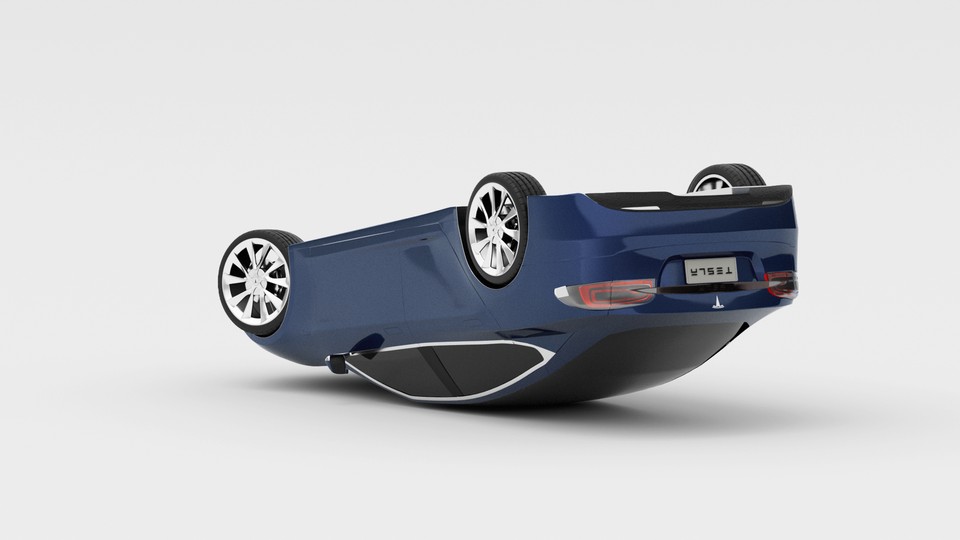
The Model S deserved better than this. Illustration by Matteo Giuseppe Pani / The Atlantic Before Elon Musk, most electric vehicles seemed less like an alternative to gasoline than an argument in its favor. The sad state of affairs for EVs for many years was that they were slow, impractical, and largely enticing only if you lived with copious guilt over your carbon emissions.
Then Tesla came out with the Tesla Model S. The speedy, high-tech sedan didn’t just leave other EVs in the dust; it could compete with the likes of BMW and Mercedes-Benz. “EVs went from ‘eating your vegetables’ to getting you super-car performance in a vehicle that’s luxurious and quiet,” Jake Fisher, the senior director of auto testing at Consumer Reports, told me. The Model S proved something that’s now easy to take for granted: EVs can work, and ordinary people might actually want one. A year after the Model S’s 2012 debut, Musk personally drove one coast-to-coast to prove that it was just as capable as a gas car.
Now the Model S is going away. During Tesla’s earnings call yesterday, Musk announced that his company will soon stop manufacturing the car that launched his empire. “That is slightly sad,” he acknowledged on the call. In a sense, it was inevitable. Tech products get killed off all the time to make way for something better; Apple no longer sells the iPhone 4. Indeed, the Tesla Model S has become irrelevant and overpriced compared with the company’s newer cars. (As a Road & Track headline put it in 2023, “The Tesla Model S Has Lived Long Enough to See Itself Become a Villain.”) Nearly all of Tesla’s global sales come from the more affordable Model Y and Model 3, leaving the original Model S unceremoniously lumped in with “Other Models” in the company’s financial reports.
But Tesla is not phasing out the Model S to focus on making even better cars. The move is part of a retreat from the car business. Tesla will stop producing the Model S and another one of its less popular cars, the gull-winged Model X SUV, in order to free up space at its California factory to build the human robot Optimus. “It is time to bring the S and X programs to an end and shift to an autonomous future,” Musk said yesterday. He’s made very clear that he wants to reposition Tesla as an AI company. The promise of robotaxis that can take you to work and robots that water your plants is why Tesla’s investors recently offered Musk a $1 trillion pay package even as the company’s car sales are slumping and slumping. If cars like the Model S changed the world, the investors would argue, then there’s no reason to believe that Musk’s vision for robots can’t do something even grander. (Tesla did not respond to a request for comment.)
This plan had better work. Now that Tesla seems largely done with making new car models, the company is throwing away a lot in order to go all in on autonomy. The irony is that in canceling the Model S, Tesla is effectively walking away from a business that it helped create. Even at its apex, the Model S never sold as well as something like the Toyota Camry. (The Tesla’s initial starting price of about $100,000 immediately put it out of reach for most car buyers.) But it is undoubtedly the most important car of the 21st century. The global EV industry would not be what it is today without it.
Perhaps the biggest legacy of the Model S is that it turned cars into gadgets. From the get-go, Tesla owners enjoyed a parade of new features rolled out via software downloads. Until the Model S, whatever features your car had at purchase were essentially all you ever got, unless you modified it yourself or paid a shop to do it. Tesla pioneered the idea of a car that could, like a smartphone, get better over time with digital upgrades. At times, software updates can be a nuisance for drivers: Some features are now locked behind a subscription paywall. This kind of approach has made Tesla a tech company, with a stock price more reminiscent of Silicon Valley than of Detroit. Tesla is now worth more than most other car companies combined.
Naturally, other automakers were eager to replicate the Tesla playbook. By the late 2010s, the rest of the industry was scrambling to chase Tesla’s progress and innovation (and that stock price). Other companies have since sunk billions of dollars into EVs, batteries, and software, all to varying degrees of success. Software updates are something the sector is still struggling with. Even last year, when Tesla’s profits and sales sank, most Americans who bought an EV were opting for Teslas. And when Tesla set up its factory in China, it kicked that country’s auto industry into high gear. Now electric cars from companies such as Geely and Xiaomi handily outclass many of Tesla’s cars; the auto giant BYD just eclipsed Tesla to become the world’s biggest seller of EVs. Perhaps that’s why Tesla is moving away from making cars; it’s now up against dozens of other Teslas that have government support and considerable financial resources.
The Model S may have another enduring legacy: In addition to turning Tesla into an EV juggernaut, it also laid the groundwork for Musk’s eventual obsession with robots and robotaxis. Tesla’s “Autopilot” feature, which allows drivers to take their hands off the wheel on the highway and while parallel parking, debuted as a software upgrade on the Model S. Over time, this evolved into “Full Self-Driving,” for hands-free driving in cities. It’s the basis for Tesla’s AI-powered autonomous-car dreams and its hopes for robotics: A humanoid robot like Optimus should theoretically “see” and operate in the world much the same way.
Even so, Tesla is racing toward a totally unproven concept. The technology behind humanoid robots remains in its infancy, and there’s no guarantee that fully autonomous cars can be deployed safely at scale. Musk’s company proved that people could want electric cars. It might be a much taller order to prove that they’d want humanlike robots and cars without steering wheels.