SIRT7 regulates dosage compensation and safeguards the female X chromosome
Abstract
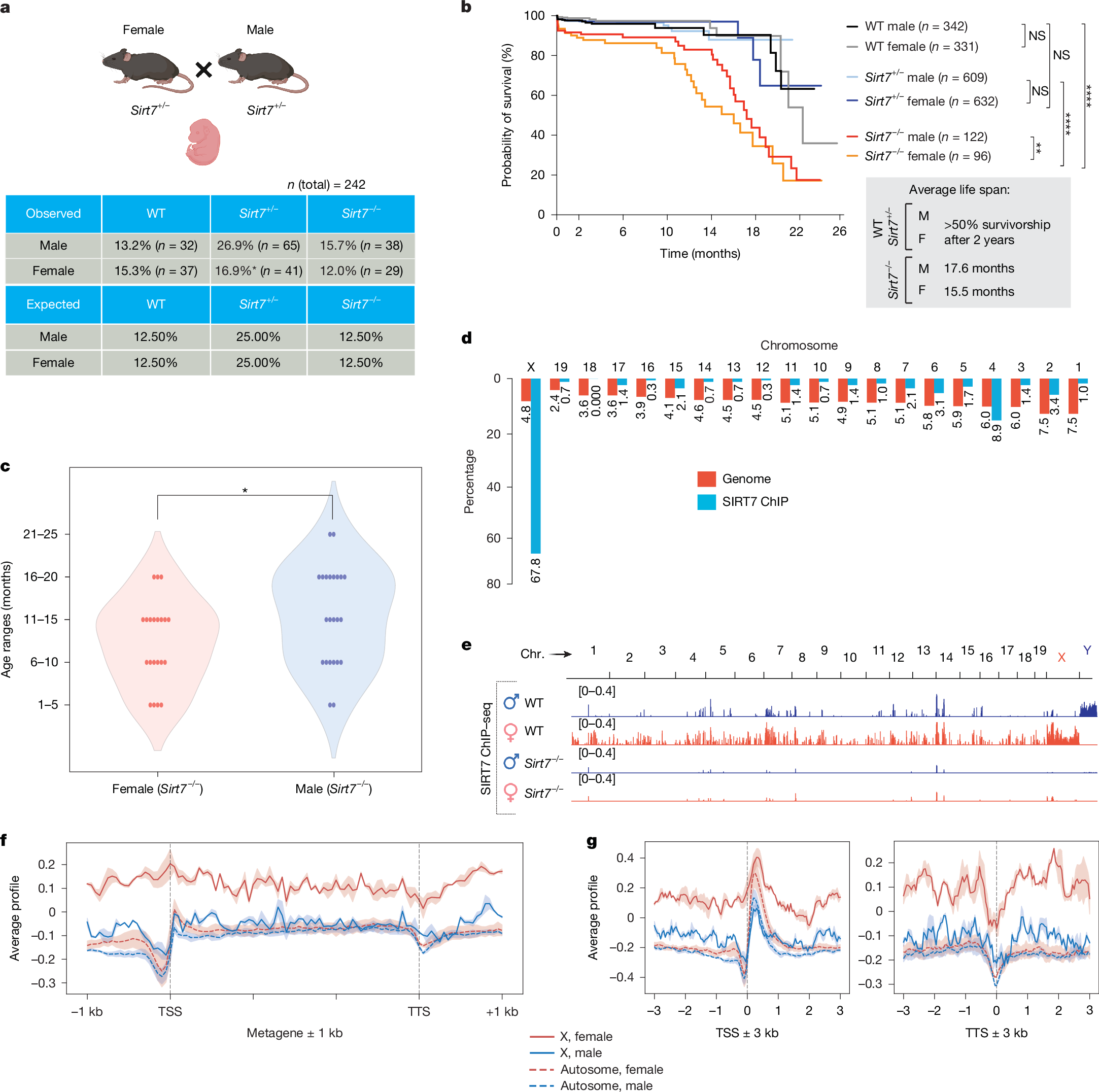
Sirtuins are deacetylases implicated in stress responses and longevity in mammals1,2. Although their differential impact on disease for the two sexes has been noted3,4,5,6,7, the underlying reasons are unclear. Here, using Sirt7 as a model in mice, we examine the mechanisms leading to sex differences and find that Sirt7−/− female mice have decreased fitness throughout their lifespan. Notably, SIRT7 preferentially localizes to the sex chromosomes. In female individuals, SIRT7 loss affects X-chromosome inactivation, the first arm of dosage compensation that equalizes X-linked gene expression between males and females8,9,10. Xist is overexpressed and gene silencing becomes more efficient. However, SIRT7 loss has greatest impact on the active X (Xa) chromosome. The Xa chromosome becomes hyperacetylated at Lys36 of histone H3, structurally disorganized, prone to DNA damage and overexpressed. Increased Xa-chromosome expression leads to genome imbalance and augmented X-chromosome upregulation—the second arm of dosage compensation that balances X-chromosome versus autosomal gene expression. These data reveal an essential crosstalk between sirtuins and the sex chromosomes, with SIRT7 safeguarding X-chromosome integrity and dosage balance with autosomes. We propose that the sex bias in SIRT7 biology can be explained in part by unequal effects on the sex chromosomes.
Access Nature and 54 other Nature Portfolio journals
Get Nature+, our best-value online-access subscription
$32.99 / 30 days
cancel any time
Subscribe to this journal
Receive 52 print issues and online access
$199.00 per year
only $3.83 per issue
Buy this article
- Purchase on SpringerLink
- Instant access to the full article PDF.
USD 39.95
Prices may be subject to local taxes which are calculated during checkout
 The alternative text for this image may have been generated using AI.
 The alternative text for this image may have been generated using AI.
 The alternative text for this image may have been generated using AI.
 The alternative text for this image may have been generated using AI.
 The alternative text for this image may have been generated using AI.
Similar content being viewed by others

SIRT7 links H3K36ac epigenetic regulation with genome maintenance in the mouse testis
Dynamic dosage changes in X-linked transposable elements during mammalian dosage compensation
Elastic dosage compensation by X-chromosome upregulation
Data availability
All new datasets generated from this work have been deposited in GEO under accession GSE256287. The MS proteomics data have been deposited to the ProteomeXchange Consortium via the PRIDE partner repository under dataset identifier PXD057198. Source data are provided with this paper.
Code availability
The custom code for RNA-seq and related ChIP–seq presented in this study is archived at Zenodo96 (https://doi.org/10.5281/zenodo.19464181).