Limitations of probing field-induced response with STM
TL;DR
A study challenges reported magnetic-field-induced changes in kagome superconductors, arguing that apparent lattice and charge density wave modifications observed with scanning tunneling microscopy are likely experimental artifacts from tip changes and instrument drift, not intrinsic sample properties.
Key Takeaways
- •Reported magnetic-field-induced changes in kagome superconductor RbV₃Sb₅'s lattice and CDW may be experimental artifacts.
- •Two main artifacts identified: STM tip apex reconfiguration affecting CDW modulation amplitudes, and piezo creep/hysteresis/thermal drift distorting topographs.
- •The study suggests previously reported piezomagnetism in these materials could be attributed to measurement limitations rather than intrinsic physical phenomena.
Tags
arising from: Y. Xing et al. Nature https://doi.org/10.1038/s41586-024-07519-5 (2024).
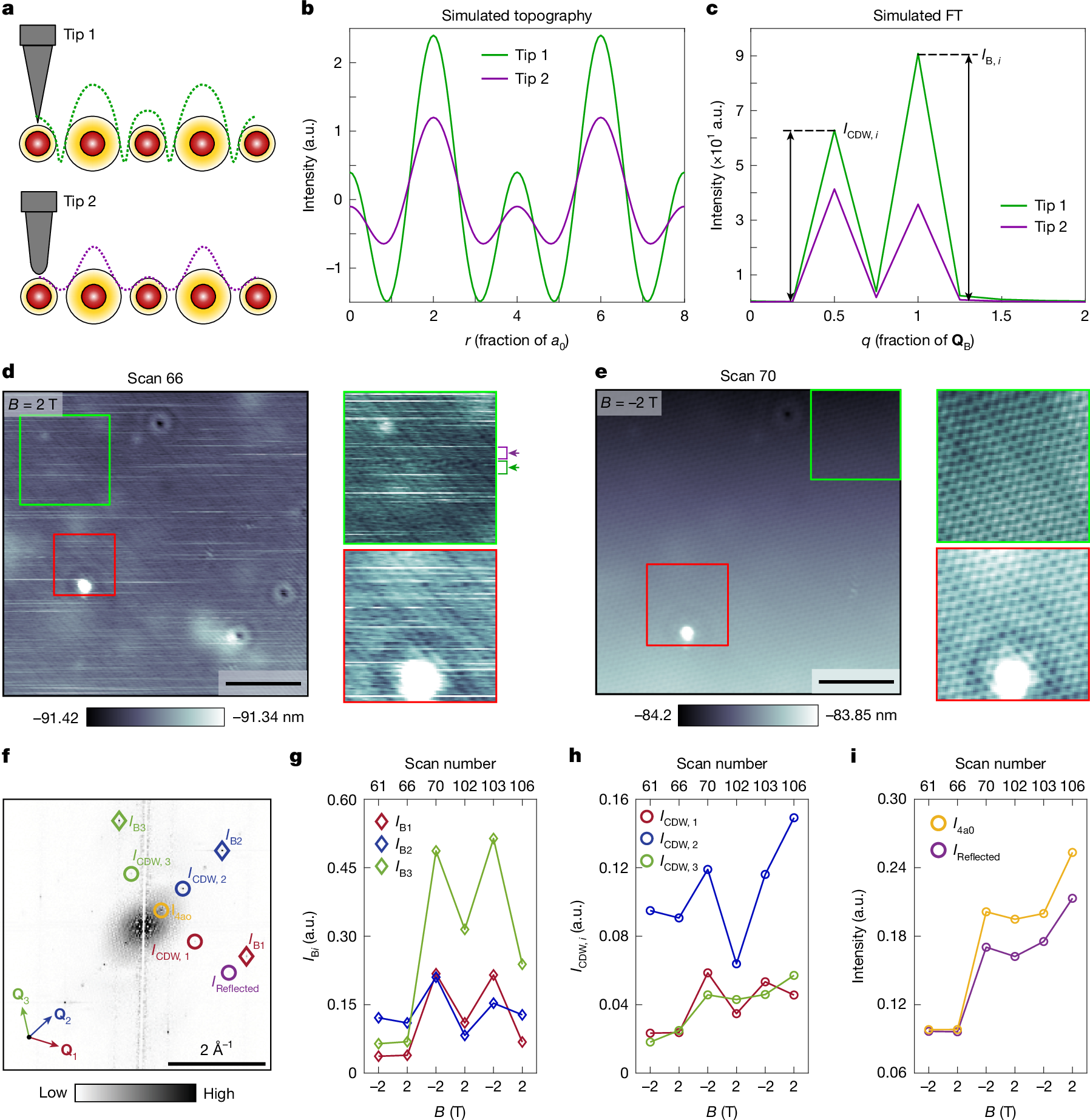
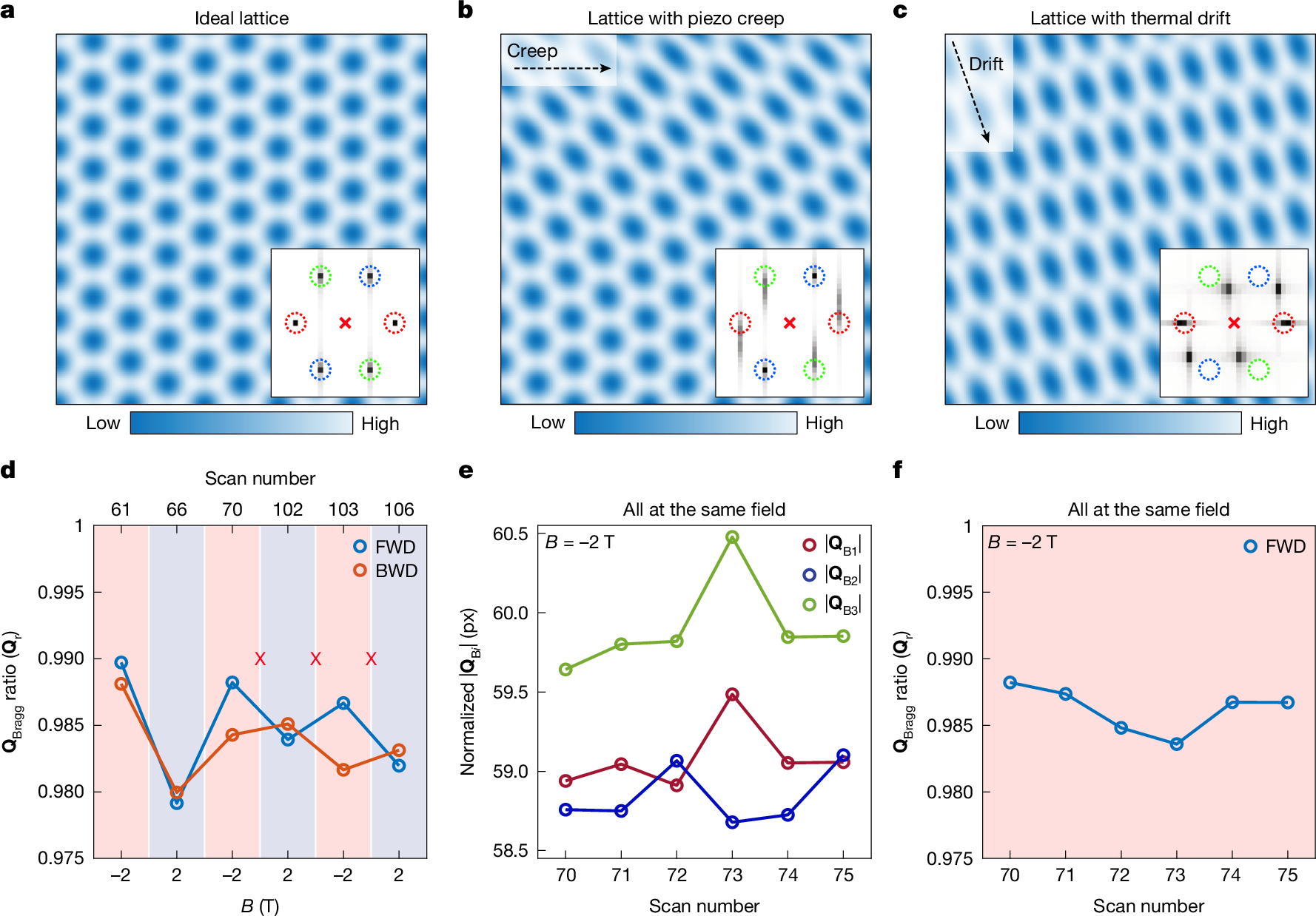
The kagome superconductors AV3Sb5 (where A = K, Cs, Rb) exhibit intertwined density waves, unconventional superconductivity and time-reversal symmetry breaking without spin magnetism1,2, with scanning tunnelling microscopy (STM) studies reporting3,4, albeit not universally5,6, magnetic-field-dependent changes in the apparent chirality of the 2 × 2 charge density wave (CDW). Related to this, Xing et al.7 investigated the effects of magnetic and electric fields on the 2 × 2 CDW state and the lattice structure of kagome superconductor RbV3Sb5, reporting a field-induced ~1% change in the in-plane lattice constants, concomitant with the CDW intensity modification, controlled by the field direction. Here we demonstrate how the apparent magnetic field induced lattice and CDW intensity change can be explained as a consequence of two independent experimental artifacts: a reconfiguration of atoms at the STM tip apex that alters the amplitudes of CDW modulations, and piezo creep, hysteresis and thermal drift, which artificially distort STM topographs. We argue that the reported piezomagnetism could be attributed to experimental artifacts rather than an intrinsic magnetic-field-induced change of the sample.
Access Nature and 54 other Nature Portfolio journals
Get Nature+, our best-value online-access subscription
$32.99 / 30 days
cancel any time
Subscribe to this journal
Receive 51 print issues and online access
$199.00 per year
only $3.90 per issue
Buy this article
- Purchase on SpringerLink
- Instant access to the full article PDF.
USD 39.95
Prices may be subject to local taxes which are calculated during checkout
References
Wilson, S. D. & Ortiz, B. R. AV3Sb5 kagome superconductors. Nat. Rev. Mater. 9, 420–432 (2024).
Yin, J.-X., Lian, B. & Hasan, M. Z. Topological kagome magnets and superconductors. Nature 612, 647–657 (2022).
Jiang, Y.-X. et al. Unconventional chiral charge order in kagome superconductor KV3Sb5. Nat. Mater. 20, 1353–1357 (2021).
Shumiya, N. et al. Intrinsic nature of chiral charge order in the kagome superconductor RbV3Sb5. Phys. Rev. B 104, 035131 (2021).
Li, H. et al. Rotation symmetry breaking in the normal state of a kagome superconductor KV3Sb5. Nat. Phys. 18, 265–270 (2022).
Li, H. et al. No observation of chiral flux current in the topological kagome metal CsV3Sb5. Phys. Rev. B 105, 045102 (2022).
Xing, Y. et al. Optical manipulation of the charge-density-wave state in RbV3Sb5. Nature 631, 60–66 (2024).
Candelora, C. et al. Quantifying magnetic field driven lattice distortions in kagome metals at the femtometer scale using scanning tunneling microscopy. Phys. Rev. B 109, 155121 (2024).