Pivoting colloidal assemblies exhibit mechanical metamaterial behaviour
TL;DR
Researchers use DNA-based sliding contacts to create colloidal pivots, assembling them into Brownian metamaterials that exhibit auxetic deformations driven by thermal fluctuations. They demonstrate rotating diamond and triangle geometries and integrate magnetic particles for external control, enabling precise shape changes.
Tags
Abstract
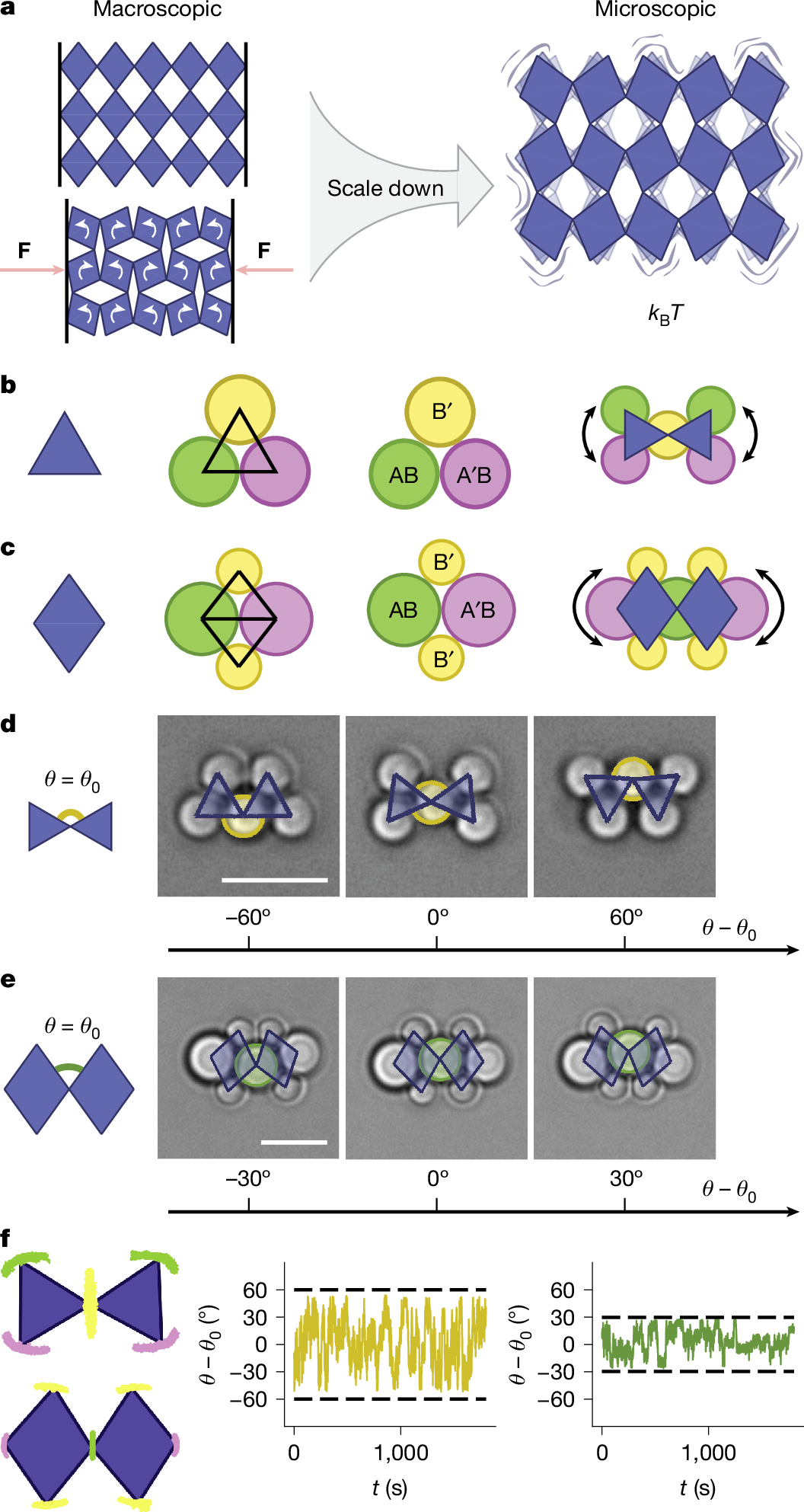
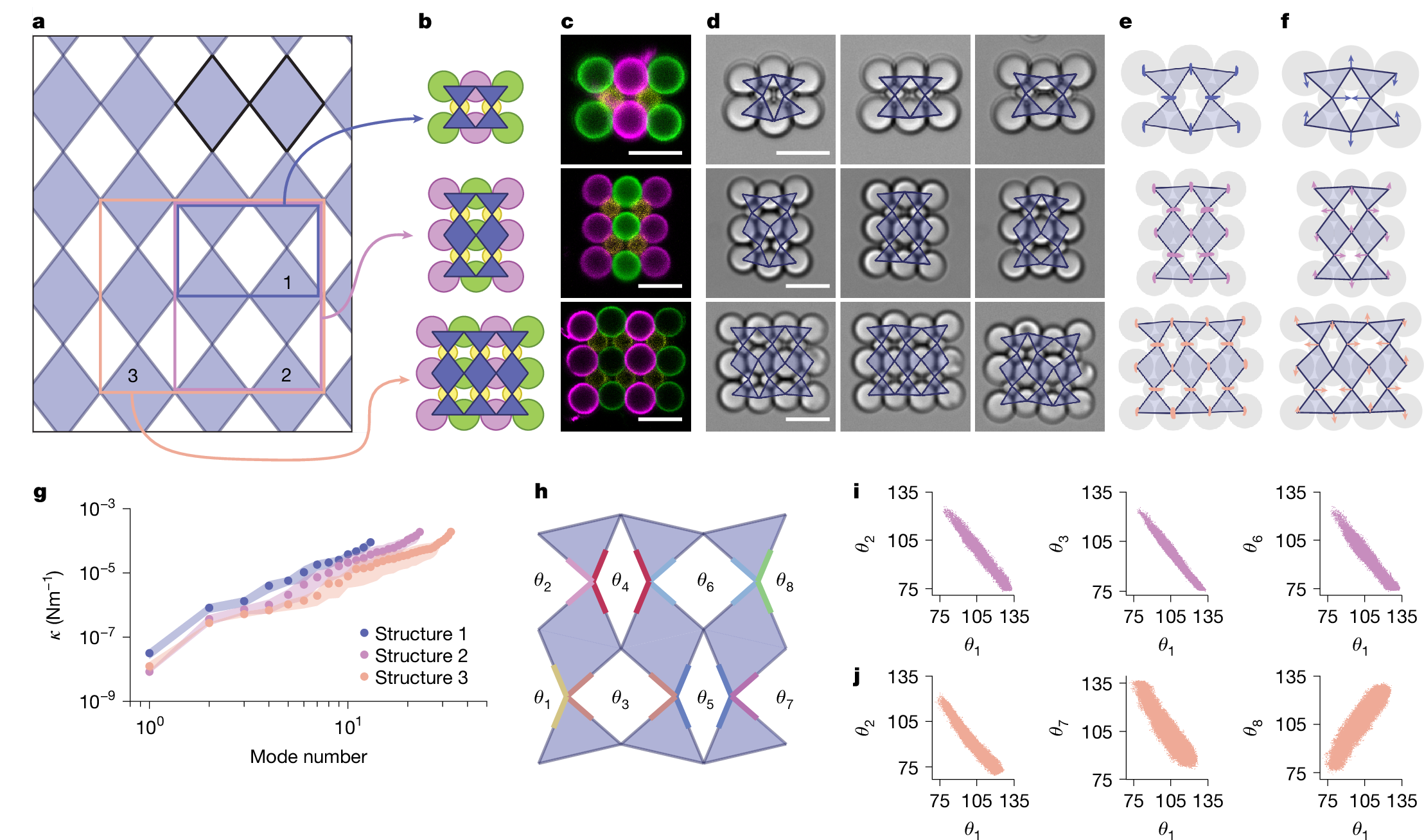
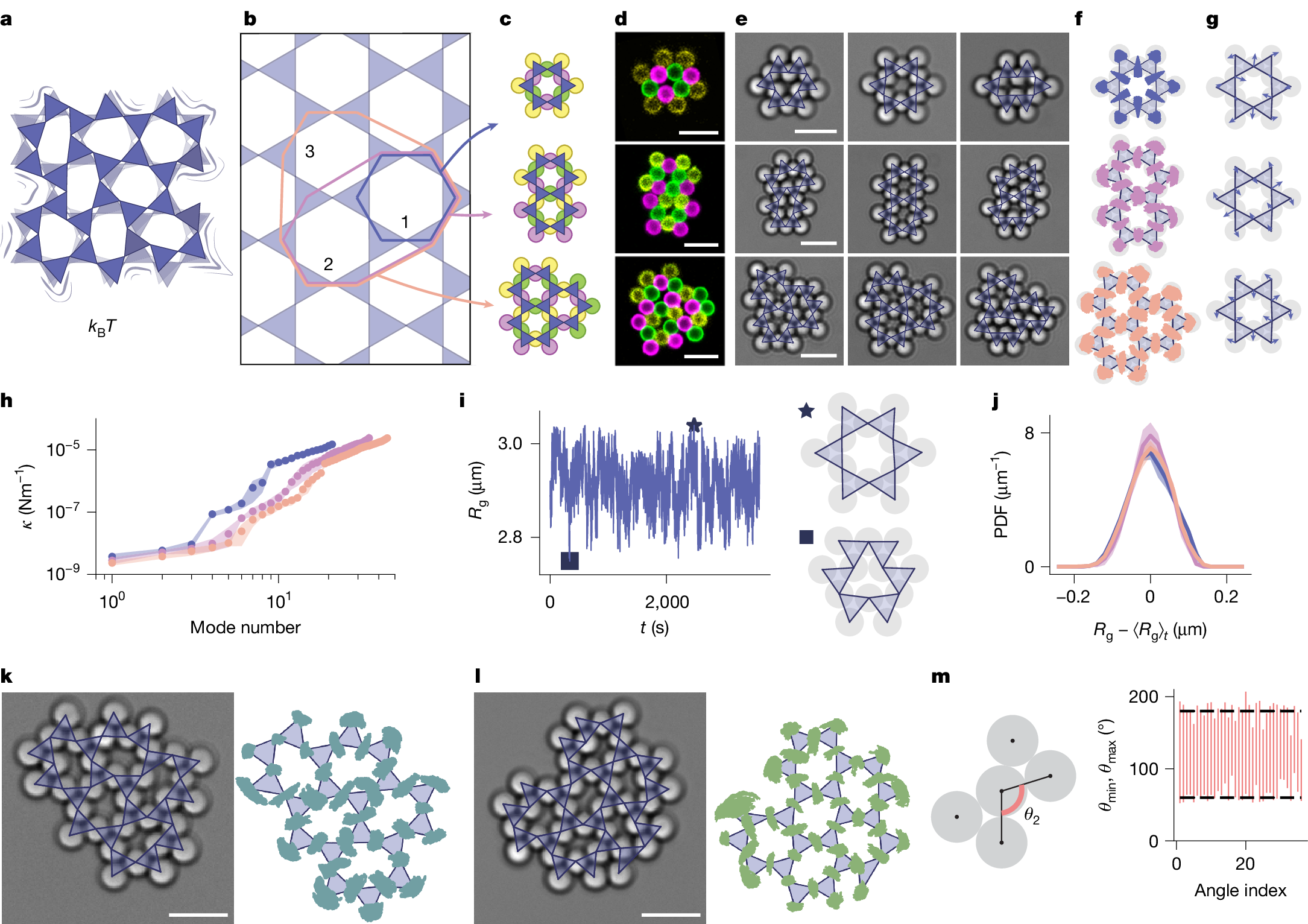
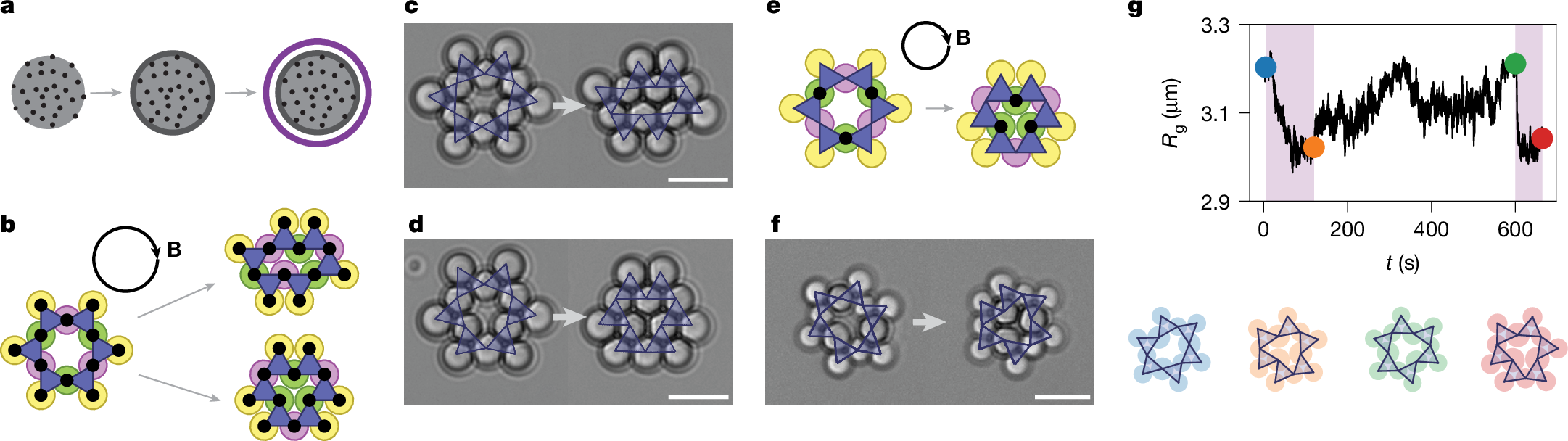
Biological machines use targeted deformations that can be actuated by Brownian fluctuations. However, although synthetic micromachines can similarly make use of targeted deformations, they are too stiff to be driven by thermal fluctuations and require strong forcing1,2,3. Furthermore, systems that are able to change their conformation by thermal fluctuations do so uncontrollably4,5 or require external control6. Here we use DNA-based sliding contacts7,8,9 to create colloidal pivots, rigid anisotropic objects that freely fluctuate around their pivot point and use a hierarchical strategy to assemble these into Brownian metamaterials with targeted deformation modes. We realize the archetypical rotating diamond and rotating triangle, or kagome, geometries and quantitatively show how thermal fluctuations drive their predicted auxetic deformations10,11,12,13,14,15. Finally, we implement magnetic particles into the colloidal pivots to achieve colloidal metamaterials that can be controlled externally as well as use Brownian fluctuations for precisely controlled shape changes. Together, our work introduces a strategy for creating Brownian mechanical metamaterials with easily actuatable deformation modes.
Access Nature and 54 other Nature Portfolio journals
Get Nature+, our best-value online-access subscription
$32.99 / 30 days
cancel any time
Subscribe to this journal
Receive 51 print issues and online access
$199.00 per year
only $3.90 per issue
Buy this article
- Purchase on SpringerLink
- Instant access to the full article PDF.
USD 39.95
Prices may be subject to local taxes which are calculated during checkout
Selective hinge removal strategy for architecting hierarchical auxetic metamaterials

Programming scheduled self-assembly of circadian materials
Data availability
The data that support the plots in this paper are available from Zenodo at https://doi.org/10.5281/zenodo.14886689 (ref. 45).
Code availability
The models supporting the findings of this study are described in the paper and its Supplementary Information. The code that supports the findings of this study is available from Zenodo at https://doi.org/10.5281/zenodo.14886689 (ref. 45).
References
Hu, X. et al. Magnetic soft micromachines made of linked microactuator networks. Sci. Adv. 7, eabe8436 (2021).
Smart, C. L. et al. Magnetically programmed diffractive robotics. Science 386, 1031–1037 (2024).