Reply to: Limitations of probing field-induced response with STM
TL;DR
This reply defends findings that electric fields from laser light can control charge-density-wave (CDW) peak intensities in RbV3Sb5, and that magnetic fields also affect the CDW state. It counters claims that such effects are measurement artifacts, highlighting key evidence that cannot be dismissed.
Key Takeaways
- •The authors demonstrate that laser-induced electric fields can control CDW peak intensities in RbV3Sb5, with accompanying changes in Bragg vector ratios.
- •They replicate previous findings showing magnetic field effects on the CDW state, supporting the reality of field-induced responses.
- •The reply argues against claims that CDW intensity changes are solely due to measurement artifacts like drift or noise.
- •Key experimental evidence is presented that cannot be explained by artifacts, maintaining the validity of the original findings.
Tags
replying to: C. Candelora & I. Zeljkovic Nature https://doi.org/10.1038/s41586-026-10126-1 (2026).
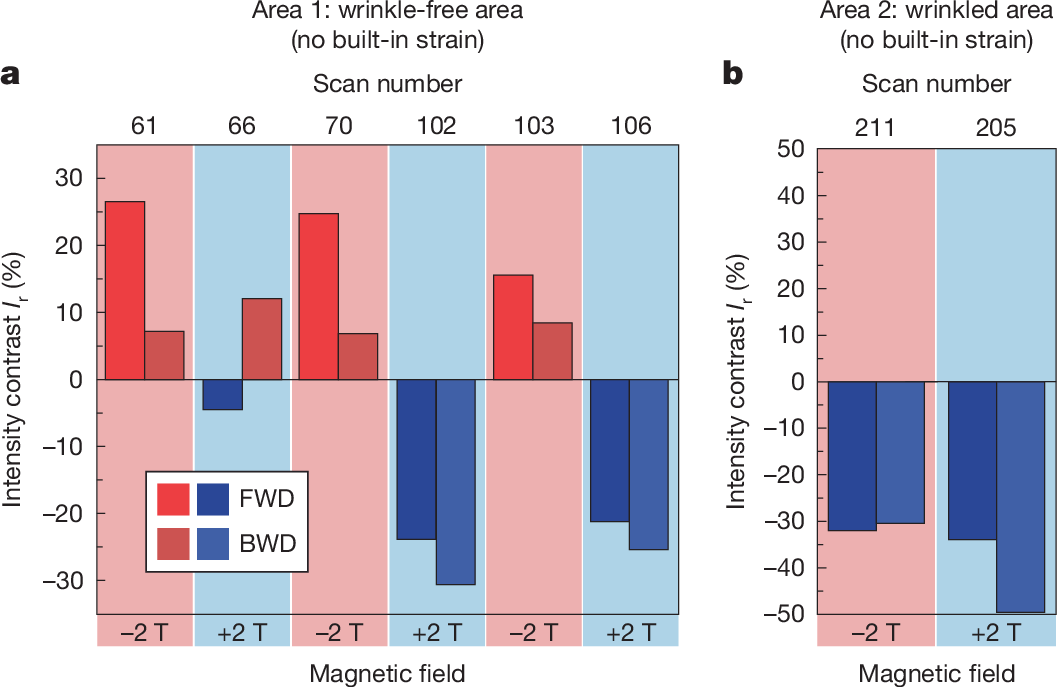
In our paper1, we demonstrate that the relative intensities of charge-density-wave (CDW) peaks in the Fourier transform of STM topographies of RbV3Sb5 can be controlled by an electric field induced by laser light. Moreover, we show that this change in the intensities is accompanied by changes in the ratio of Bragg vectors; we also replicate previous findings on the changes in the CDW state induced by a magnetic field. In their comment, Candelora and Zeljkovic2 assert that, in the absence of artifacts like drift, noise and tip changes, the CDW intensity in the 135 compounds would remain unaffected by light and magnetic fields, consistent with a previous publication from their group3. Before addressing their comments in detail below, we highlight a few key points that cannot be dismissed on the basis of measurement artifacts.
Access Nature and 54 other Nature Portfolio journals
Get Nature+, our best-value online-access subscription
$32.99 / 30 days
cancel any time
Subscribe to this journal
Receive 51 print issues and online access
$199.00 per year
only $3.90 per issue
Buy this article
- Purchase on SpringerLink
- Instant access to the full article PDF.
USD 39.95
Prices may be subject to local taxes which are calculated during checkout
References
Xing, Y. et al. Optical manipulation of the charge-density-wave state in RbV3Sb5. Nature 631, 60–66 (2024).
Candelora, C & Zeljkovic, I. Limitations of probing field-induced response with STM. Nature https://doi.org/10.1038/s41586-026-10126-1 (2026).
Li, H. et al. Rotation symmetry breaking in the normal state of a kagome superconductor KV3Sb5. Nat. Phys. 18, 265–270 (2022).
Jiang, Y.-X. et al. Unconventional chiral charge order in kagome superconductor KV3Sb5. Nat. Mater. 20, 1353–1357 (2021).
Shumiya, N. et al. Intrinsic nature of chiral charge order in the kagome superconductor Rb × V3 × Sb5. Phys. Rev. B 104, 035131 (2021).
Deng, H. et al. Chiral kagome superconductivity modulations with residual Fermi arcs. Nature 632, 775–781 (2024).
Guo, C. et al. Correlated order at the tipping point in the kagome metal CsV3Sb5. Nat. Phys. 20, 579–584 (2024).
Author information
These authors contributed equally: Yuqing Xing, Seokjin Bae
Authors and Affiliations
Department of Physics and Materials Research Laboratory, Grainger College of Engineering, University of Illinois at Urbana-Champaign, Urbana, IL, USA
Yuqing Xing, Seokjin Bae, Rafael M. Fernandes & Vidya Madhavan
Materials Department, University of California Santa Barbara, Santa Barbara, CA, USA
Stephen D. Wilson
Department of Physics, Boston College, Chestnut Hill, MA, USA
Ziqiang Wang
Anthony J. Leggett Institute for Condensed Matter Theory, The Grainger College of Engineering, University of Illinois at Urbana-Champaign, Urbana, IL, USA
Rafael M. Fernandes
- Yuqing Xing
Search author on:PubMed Google Scholar
- Seokjin Bae
Search author on:PubMed Google Scholar
- Stephen D. Wilson
Search author on: