Structural basis for chaperone-guided assembly of RNA-induced silencing complex
Abstract
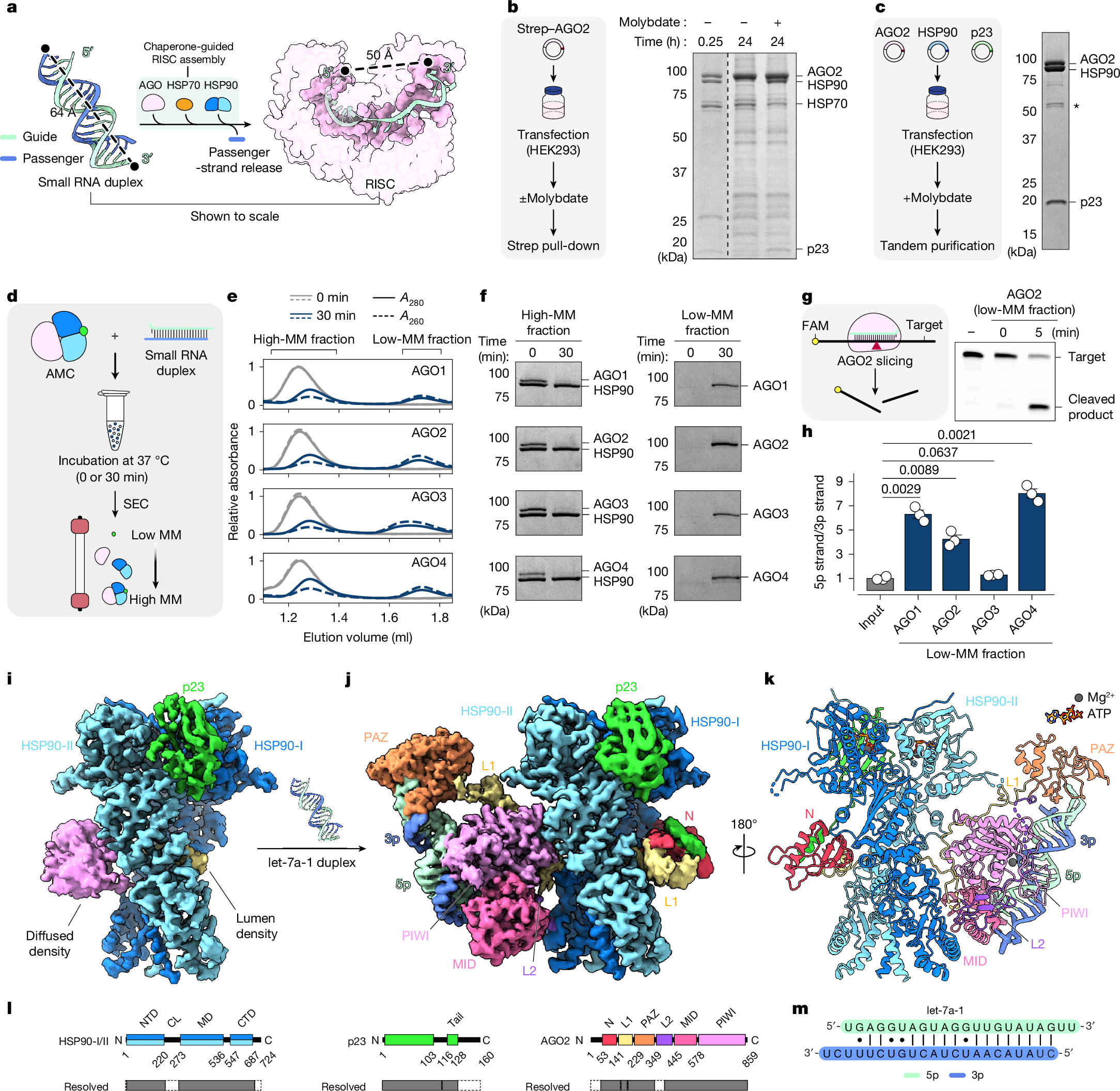
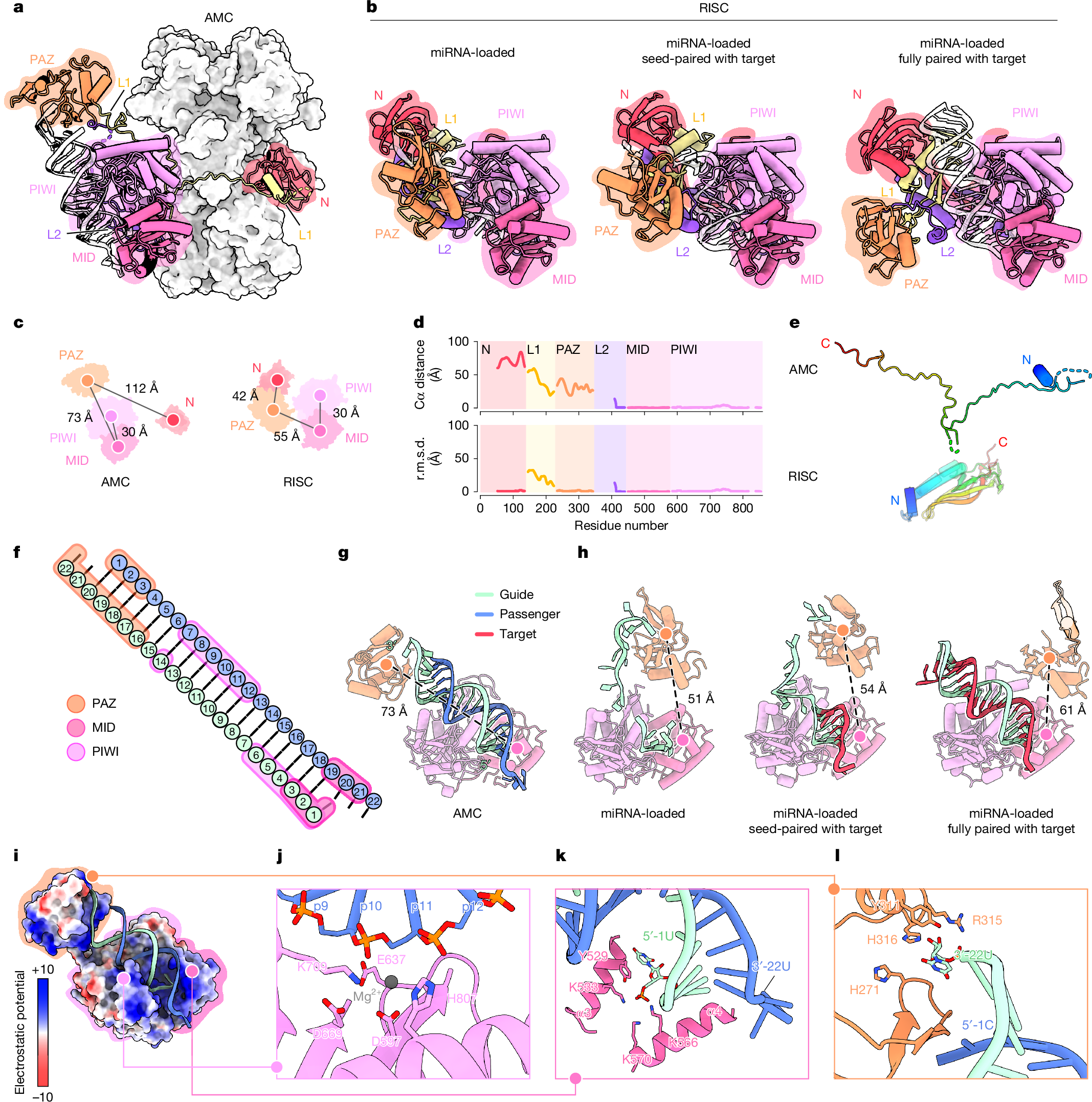
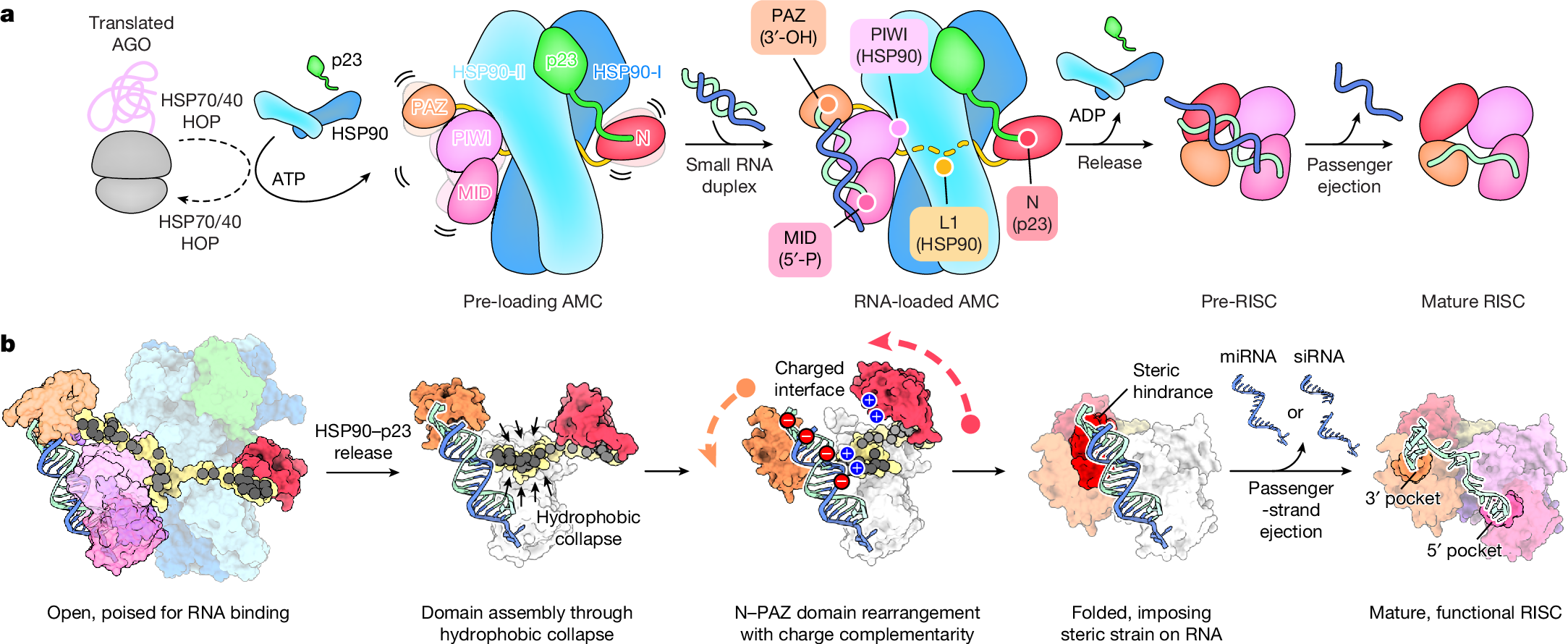
The RNA-induced silencing complex (RISC), comprising an Argonaute (AGO) protein and a small RNA, is the central effector in RNA silencing. Small RNAs are loaded onto AGO as bulky duplexes in an HSP70- and HSP90-dependent process1,2,3, but the molecular mechanism remains poorly understood. Here we identify the human AGO–HSP90–p23 complex, which captures AGO in an RNA-free state, termed the AGO maturation complex (AMC). The purified AMC enables RNA loading and AGO folding, faithfully recapitulating de novo RISC assembly. Using cryogenic electron microscopy, we determined the structure of AMC bound to a microRNA duplex. In contrast to its conformation in the RISC, AGO adopts a highly open conformation in the AMC: the N domain and the RNA-binding module (PAZ–MID–PIWI) are fully detached and anchored to opposite sides of the HSP90 dimer, connected solely by the unfolded L1 linker. This arrangement exposes a positively charged cleft that accommodates an RNA duplex. AGO folding is facilitated by a small RNA duplex containing a 5′-terminal phosphate—but not by single-stranded RNAs—revealing a role for the RNA duplex as a chaperone-like cofactor that directs AGO domain assembly. These findings elucidate the RISC assembly mechanism and establish the AMC as a molecular tool for probing optimal RNA features and chemical modifications for the rational design of small interfering RNA therapeutics. Our study also sheds light on how chaperones, together with ligands, can guide the folding of client proteins.
Access Nature and 54 other Nature Portfolio journals
Get Nature+, our best-value online-access subscription
$32.99 / 30 days
cancel any time
Subscribe to this journal
Receive 52 print issues and online access
$199.00 per year
only $3.83 per issue
Buy this article
- Purchase on SpringerLink
- Instant access to the full article PDF.
USD 39.95
Prices may be subject to local taxes which are calculated during checkout
 The alternative text for this image may have been generated using AI.
 The alternative text for this image may have been generated using AI.
 The alternative text for this image may have been generated using AI.
 The alternative text for this image may have been generated using AI.
 The alternative text for this image may have been generated using AI.
Similar content being viewed by others
Mechanistic insights into RNA cleavage by human Argonaute2–siRNA complex
Analysis of chimeric reads characterises the diverse targetome of AGO2-mediated regulation
Structure of the Dicer-2–R2D2 heterodimer bound to a small RNA duplex
Data availability
The cryo-EM structure of AMC–let-7a-1 has been deposited in the PDB under accession code 9W5I. The composite map and consensus map of AMC–let-7a-1 have been deposited in the EMDB under accession codes EMD-65663 and EMD-65662, respectively. The partial maps of local refinement focused on MID/PIWI, N-domain and HSP90–p23 have been deposited in the EMDB under accession codes EMD-65661, EMD-65660 and EMD-65659, respectively. The consensus map and AGO2-focused map of AMC have been deposited in the EMDB under accession codes EMD-69544 and EMD-65658, respectively. There are no restrictions on data availability. For material requests, please contact the corresponding authors. Other structural models cited in this study for analysis (4W5N, 4W5O, 7KRJ, 7XW2, 8EOB, 9CMP, 7V6C, 7ZUB, 8FFW, 5FWK, 5FWL, 7Z37 and 8GFT) are also available at the PDB.
References
Iwasaki, S. et al. Hsc70/Hsp90 chaperone machinery mediates ATP-dependent RISC loading of small RNA duplexes. Mol. Cell 39, 292–299 (2010).
Miyoshi, T., Takeuchi, A., Siomi, H. & Siomi, M. C. A direct role for Hsp90 in pre-RISC formation in Drosophila. Nat. Struct. Mol. Biol. 17, 1024–1026 (2010).
Iki, T. et al. In vitro assembly of plant RNA-induced silencing complexes facilitated by molecular chaperone HSP90. Mol. Cell 39, 282–291 (2010).