A 5.3-million-year-old deep-sea whale necropolis in the Diamantina Zone
Abstract
Whale falls are biodiversity oases at seabeds1,2,3,4,5,6, yet their record from the oceans has remained sparse and fragmentary6,7. Here we report the discovery of a vast whale necropolis in the Diamantina Zone (4,616- to 7,001-m depth), extending about 1,200 km along the sea floor of the southeastern Indian Ocean. This area has a deep and extensive accumulation comprising five modern natural whale-fall communities and 476 fossil cetaceans recorded. We show that carcasses host specialized communities dominated by brittle stars, bone-boring worms and chemosynthesis-based bivalves and that the fossil record in this area comprises both extant and extinct deep-diving beaked whales. Isotopic dating shows that whale falls in this region have occurred since at least 5.3 million years ago. These findings reshape the understanding of the limits and biogeography of whale-fall ecosystems and establish some deep sea floors as a fossil archive for tracing cetacean evolution over geological time.
Molecular and zooarchaeological identification of 5000 year old whale-bone harpoons in coastal Brazil
Late Paleolithic whale bone tools reveal human and whale ecology in the Bay of Biscay
Description of a collaborative sperm whale birth and shifts in coda vocal styles during key events
Main
The deep sea is home to myriad life forms that have adapted to extreme environmental conditions. One of the most fascinating phenomena of the deep sea are whale-fall communities, whereby a whale carcass that sinks to the ocean floor1,2,3 initiates a highly idiosyncratic ecosystem in association with a variety of physiologically diverse organisms, thus providing crucial insights into the interplay of life and death in the ocean’s depths4,5,6,7. Although whale falls are abundant, with more than 70 sites documented across diverse ocean basins and depths6, their distribution remains patchy and only sporadically documented7.
The species composition and diversity of whale-fall communities are strongly influenced by water depth and related environmental factors, such as temperature and hydrodynamic regime6,8,9. In contrast to deep-sea sites, shallow-water shelf whale falls generally yield different sets of taxa, indicating that highly specialized and species-rich whale-fall communities develop primarily in the food-limited setting of the deep ocean7,10,11,12,13. So far, however, most whale falls are found between some tens of metres to around 4,000 m water depth6,7, with the deepest example reaching 4,204 m in the southwest Atlantic Ocean14. The biogeography, evolutionary novelty and connectivity of deep-sea whale-fall communities remain poorly understood, first and foremost because of the paucity of data from abyssal and hadal depths7.
The Diamantina Fracture Zone lies to the south of the Broken Ridge and Perth Abyssal Plain in the Indian Ocean, stretching about 1,200 km parallel to the Southeast Indian Ridge (Fig. 1). It formed as the Australian and Antarctic continents separated between 60 million and 50 million years ago15. The rough sea floor topology is the result of block faulting16. The deepest regions of the Diamantina Zone cluster in its northwestern section, most notably at the Dordrecht Deep, which reaches a maximum depth of 7,079 m as measured by the conductivity–temperature–depth sensor aboard the human-occupied vehicle (HOV) Fendouzhe in 2023. The Diamantina Zone has not been previously documented to be associated with any whale falls.
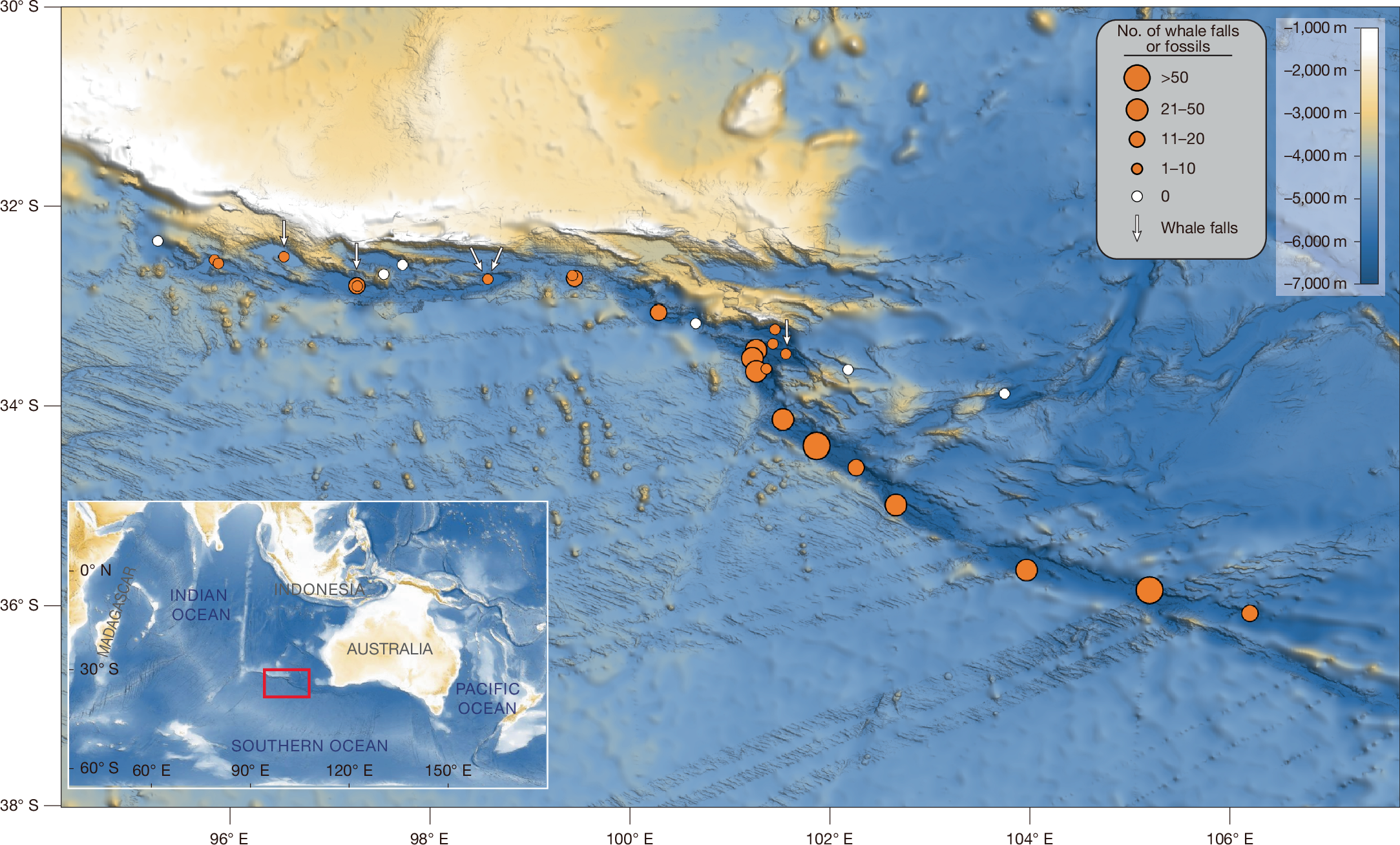
Orange circles indicate dive locations where whale fossils or whale falls were observed; circle size corresponds to the number of whale remains recorded per dive. Whale falls in the sulfophilic stage are marked with white arrows. White circles denote dives with no observed whale fossil or whale fall. Notably, the distribution of both whale falls and whale fossils is restricted to the Diamantina Zone sea floor; none were detected outside this region. Figure adapted from ref. 51, Wiley, under a Creative Commons licence CC BY 4.0.
Whale-fall biota
From 8 February to 17 March 2023, using the Fendouzhe submersible capable of reaching depths of up to 11,000 m on board the R/V Tansuoyihao, we discovered extensive whale falls and fossils in the Diamantina Zone (Fig. 1 and Supplementary Video 1). During dive FDZ159, we first encountered whale fossils at a depth of 7,002 m, near the deepest point of the Dordrecht Deep. These fossils were found partially buried in soft surface sediments and lightly coated with black Fe–Mn oxides. Following the initial discovery, we conducted 32 dives to the sea floor, aiming at mapping the spatial distribution and extent of the whale falls and fossils, as well as identifying any associated whale-fall ecosystems. By doing this, we documented and collected samples from 485 whale-fossil sites and active whale falls (Fig. 2, Extended Data Tables 1 and 2 and Supplementary Table 1) from 1,200 km along the sea floor, representing an ecological landmark in the Diamantina Zone.
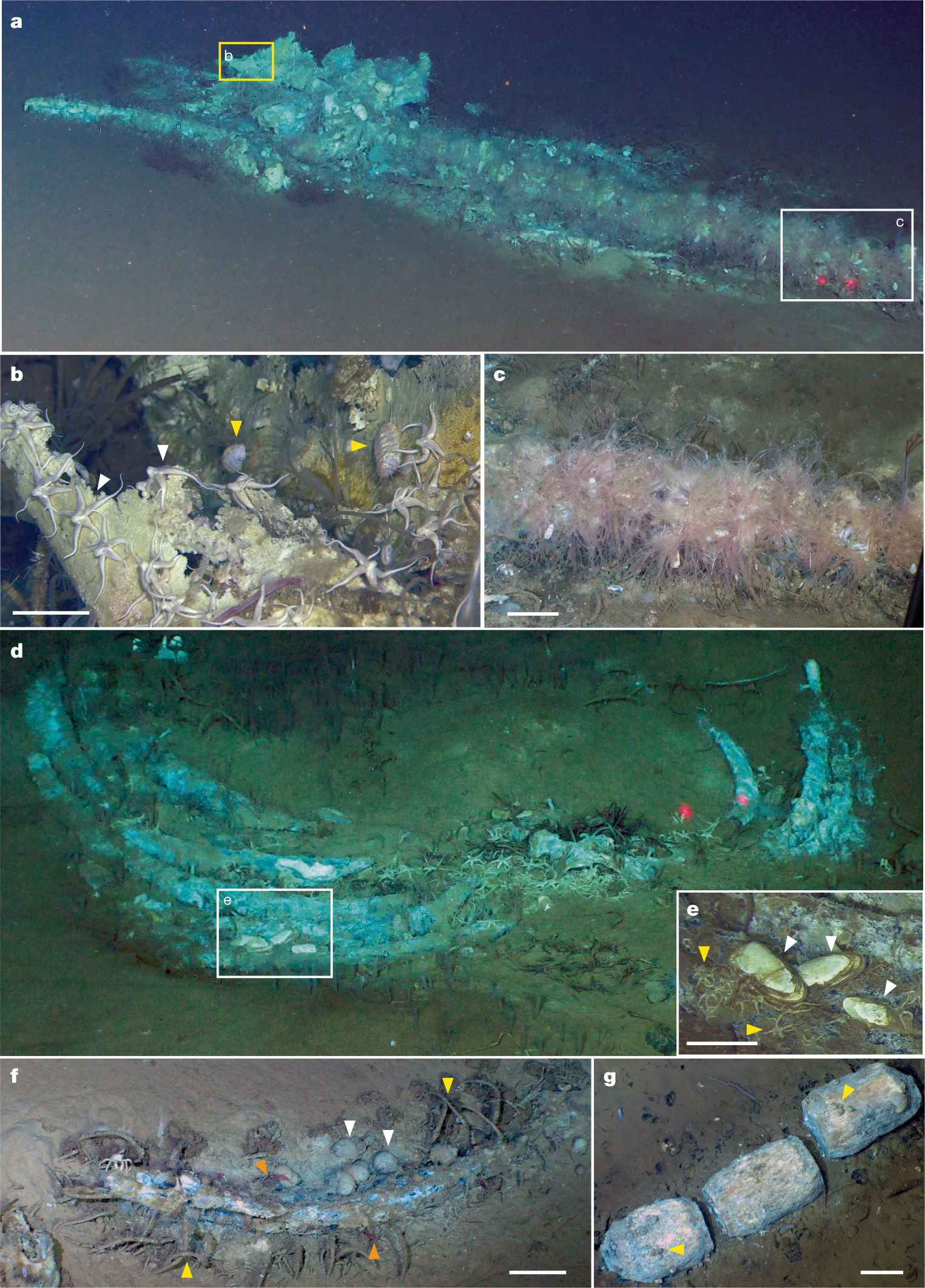
a, A 3-m-long minke whale fall recorded during dives FDZ174/FDZ177 at 5,610 m depth. b, Close-up view of yellow box in a showing brittle stars Ophiambix sp. (white arrows) and scale worms polynoid (yellow arrows) on the cranium. c, Close-up view of white box in a showing numerous transparent tubes of the bone-eating worm Osedax sp. emergent from whale bone. d, A beaked-whale fall consisting of eight ribs and several thoracic vertebrae observed during dive FDZ178 at 5,609 m depth. Brittle stars Ophioscolecidae sp. and Silax sp. and chemosymbiotic vesicomyid bivalves Abyssogena southwardae are associated with these bones. Tubeworm Nicomache sp. occurs in the surrounding sediments. e, Close-up view of the white box in d showing three vesicomyid bivalves (white arrows) and brittle stars (yellow arrows). f, A whale bone recorded during dive FDZ173 at 4,625.2 m depth, dominated by gastropods Phymorhynchus sp. 1 (white arrows), polychaetes Nicomache sp. (yellow arrows) and Osedax sp. (orange arrows). g, The deepest whale fall, consisting of three elongated vertebrae of a beaked whale, with small gastropods (yellow arrows) on their surface, observed during dive FDZ163 at 6,788.7 m depth. The two red laser points are spaced 10 cm apart. Scale bars, 5 cm.
The five active whale falls are in the sulfophilic stage (Fig. 2). Bones are covered with dense, whitish microbial mats and bone-boring worms Osedax, indicating prolonged residence on the sea floor. At 6,789 m water depth, the Dordrecht Deep beaked-whale carcass WF1, consisting of three elongated vertebrae, has the deepest active whale-fall community. The largest carcass encountered, the 5-m-long skeleton WF3, was identified as the Antarctic minke whale Balaenoptera bonaerensis through the highly diagnostic earbone morphology17 and a nearly complete mitochondrial genome (GenBank: PX519993).
Across the five whale falls in the sulfophilic stage, the associated fauna are taxonomically broad, comprising 35 recognized macrofaunal taxa (more than 0.5 mm in size) documented from in situ imagery and collected specimens (Extended Data Table 1 and Extended Data Figs. 1 and 2). The macrofauna are dominated by annelids, crustaceans and molluscs, with further cnidarians and nematodes. Bone-eating worms, gastropods, vesicomyid bivalves and brittle stars dominate the megafauna (more than several centimetres in size), reaching local densities up to 2,840 individuals per square metre (Supplementary Table 2).
Most recovered taxa may be new to science. Molecular data were obtained for 21 species, but only the vesicomyid bivalve Abyssogena southwardae could be confidently assigned to species level through barcoding comparison with GenBank records; all remaining species were identified at genus or family rank, integrating morphological data. Three chemosymbiotic bivalves (Adipicola sp., Abyssogena southwardae and Thyasiridae sp.) hosting different sulfur-oxidizing microbial symbionts (Extended Data Fig. 2) and two bone-eating worms (Osedax sp. 1 and Osedax sp. 2) form the core of these communities18,19. The observations at water depths of 5,609 m and 5,634 m of sea daisies (Asteroidea: Xyloplax sp.) provide, to our knowledge, the deepest evidence of this genus, as well as the first record on whale falls, expanding the habitat of Xyloplax beyond wood falls and hydrothermal vents20. Three brittle-star species (Ophiambix sp., Ophioscolecidae gen. et sp. and Silax sp.) recovered from the whale skeletons differ notably from the dominant trench-floor ophiuroid genera Ophiosphalma and Ophiuroglypha. The absence of whale-fall species in the background sediments indicates that these brittle-star assemblages are highly specialized and confined to organic-rich whale substrates. In addition, some whale falls, for instance, at depths of 5,115 m, 6,470 m, 6,570 m and 6,772 m, are in the final reef stage (Extended Data Fig. 3). The exterior of these skeletons is primarily inhabited by common hard-substrate megafauna, such as the stalked sea anemone Galatheanthemum profundale, the pedunculate sponge Caulophacus sp. and the sea star Freyastera sp. The different faunal composition of the studied whale falls may be attributable to their sites, successional stages or carcass sizes.
Fossil whale fauna
The palaeontological analysis of 43 recovered fossils from the Diamantina Zone led to the identification of five beaked-whale species and one baleen-whale species. Most of the beaked-whale specimens, primarily consisting of isolated rostra, were attributed to two living ziphiid species: the Andrews’ beaked whale, Mesoplodon bowdoini (Fig. 3a,b), and the strap-toothed whale, Mesoplodon layardii (Fig. 3c,d), both of which are known to inhabit the present-day southeastern Indian Ocean21. Diagnostic traits of M. layardii preserved in 14 specimens include a narrow, elongated, transversely compressed rostrum and a strongly pachyosteosclerotic vomer forming a prominent posterior bulge, a secondary anterior bulge and a midrostral dorsal depression in between (Fig. 3c,d and Extended Data Fig. 4a–g). Further matching traits, such as the shape of the prominential notch and maxillary tubercle and the size and position of the infraorbital and premaxillary foramina, further support this identification22. The seven rostra assigned to M. bowdoini are robust, moderately elongated and laterally compressed and provided with a single anterior vomeral bulge and a ventrally deflected apex, consistent with previous descriptions22 (Fig. 3a,b and Extended Data Fig. 4e–h).

a,b, Mesoplodon bowdoini, FDZ180-R1a dorsal (a) and lateral (b) views. c,d, Mesoplodon layardii, FDZ184-R1a dorsal (c) and lateral (d) views. e–g, Pterocetus diamantinae sp. nov., FDZ182-R1a, holotype dorsal (e), lateral (f) and anterior (g) views. h, Pterocetus benguelae, FDZ186-R3a. i. Izikoziphius rossi, FDZ163-R7a. Dotted lines indicate uncertain sutures. Oblique lines indicate principal break surfaces. Scale bar, 20 cm.
Three exceptionally well-preserved skulls were identified as belonging to the extinct genera Pterocetus and Izikoziphius, which were first described from fossils trawled from the sea floor off South Africa23. As for Pterocetus, this extinct relative of the modern Mesoplodon spp. and bottlenose beaked whales is characterized by distinctive wing-like expansions of the preorbital processes23. One Pterocetus specimen from the Diamantina Zone is referred to P. benguelae (Fig. 3h); the other represents a new species, Pterocetus diamantinae sp. nov. (Supplementary Note, Fig. 3e–g, Extended Data Figs. 5a,b and 6 and Extended Data Table 3). The single Izikoziphius cranium closely resembles the type species I. rossi (Fig. 3i and Extended Data Fig. 5e,f). Izikoziphius is a close relative of the extant Cuvier’s beaked whale but is recognized as a separate genus owing to the observation of a unique fossa on the premaxilla, a dome-shaped maxillary crest and a proportionally longer rostrum23. Baleen-whale fossils include a fairly well-preserved tympanic bulla of the sei whale, Balaenoptera borealis (Extended Data Fig. 5g–j) and several dilapidated, largely indeterminate cranial and postcranial remains of mostly balaenopterid mysticetes (Extended Data Fig. 5k–l).
Dating of whale fossils
To determine the ages of the fossils, we analysed 33 fossil bone specimens for their strontium isotope composition (87Sr/86Sr) (Fig. 4 and Extended Data Table 4). This method relies on comparing the isotopic signature preserved in the biominerals to the known historical record of seawater isotopes. Although this method is typically performed on compact dental tissues, the hyperdense bones of ziphiid rostra probably preserves a pristine Sr-isotope ratio24. Eight samples exhibited Sr-isotope ratios identical to modern seawater, indicating complete geochemical exchange after death. The remaining 25 samples, however, yielded 87Sr/86Sr ratios ranging from 0.709173 to 0.709029. When calibrated against the seawater 87Sr/86Sr curve25, these values correspond to ages between 0.12 Ma and 5.26 Ma. The fossil species Pterocetus bengulae and Izikoziphius rossi were found to be the oldest, with Sr-isotope aver