Rock weathering can counteract river CO2 emissions induced by permafrost thaw
Abstract
Climate-induced permafrost thaw unlocks large stores of organic carbon that are mineralized and emitted as carbon dioxide (CO2) from rivers to the atmosphere1. Concurrently, warming and permafrost thaw can increase mineral weathering rates, thus affecting the release and sequestration of inorganic carbon2,3,4. Yet how these biological and geological carbon cycles interact and jointly affect CO2 dynamics (emission compared with drawdown) in permafrost rivers remains unknown5. Here we combine CO2 emissions, organic and inorganic solute concentrations, dual carbon isotopes (δ13C–Δ14C) and geochemical modelling to infer how permafrost thaw may affect river biogeochemistry over decades to centuries across the Qinghai–Tibet Plateau. Leveraging a gradient of thermal permafrost degradation, we find that river CO2 emissions decline, whereas solute fluxes from rock weathering increase with decreasing permafrost cover. Across this region, net CO2 drawdown fluxes from rock weathering are about 35% of river CO2 emissions, varying from around 15% in catchments with continuous permafrost to more than 100% in catchments with discontinuous or isolated permafrost. Thus, carbon fluxes from chemical weathering may become increasingly important with ongoing permafrost thaw, potentially even outpacing river CO2 emissions. Our findings disentangle the interplay between biological and geological carbon fluxes that are important for the cryosphere and the global carbon cycle.
Main
River networks perfuse and integrate landscapes6, receiving organic carbon (OC) from terrestrial primary production and dissolved inorganic carbon (DIC) \(({\rm{D}}{\rm{I}}{\rm{C}}=\sum {{\rm{C}}{\rm{O}}}_{2({\rm{a}}{\rm{q}})}+{{{\rm{HCO}}}_{3}}^{-}+{{{\rm{CO}}}_{3}}^{2-})\) from soil respiration and chemical rock weathering. This OC is metabolized in rivers and returned to the atmosphere as carbon dioxide (CO2) or methane (CH4), buried in sediments, or transported to coastal oceans. Similarly, DIC can precipitate, outgas or travel downstream7,8. Global carbon inputs to rivers (about 3.2 petagrams of carbon (PgC) yr−1), the resulting riverine carbon emissions (around 2.3 PgC yr−1) and carbon export to the ocean (approximately 0.8 PgC yr−1)8 are on par with the net terrestrial carbon sink (that is, the net primary productivity minus respiration without considering land-use changes; about 3.2 PgC yr−1)9. Consequently, rivers forge important connections between terrestrial, marine and atmospheric carbon pools that modulate the global carbon cycle8. Despite major advances in understanding the role of rivers in the carbon cycle, key knowledge gaps persist regarding the interaction between biological and geological carbon sources and sinks5, as well as their responses to climate change.
Of primary concern is the impact of climate warming on the vast OC stocks (approximately 1,014 PgC) stored in the Northern Hemisphere permafrost soils10. Permafrost thaw is mobilizing a portion of this large, near-surface OC reservoir on Earth11. The subsequent breakdown of this ancient, biolabile OC in rivers fuels in situ respiration and methanogenesis, thus amplifying emissions of aged CO2 and CH4, and potentially perturbing the contemporary carbon cycle12,13,14,15,16,17,18. However, permafrost thaw has effects beyond mobilizing ancient OC. In particular, recent studies have demonstrated that multi-decadal increases in DIC fluxes and associated dissolved solutes in permafrost rivers could reflect intensified chemical weathering2,3,4,19,20. Given that landscape-scale weathering fluxes are controlled by a combination of lithology21, hydrology22,23,24, temperature25,26 and exposure of reactive surfaces27,28, climate warming and permafrost thaw could have multifaceted impacts on these fluxes2,3,4. Whereas climate warming can directly increase dissolution kinetics26, the associated permafrost thaw may alter weathering reactions by exposing minerals or by modulating the hydrology and promoting acidic redox conditions in sub-surface environments4. Importantly, weathering reactions in the critical zone affect biogeochemistry through the hydrosphere because groundwater transports weathering products—including carbon—to fluvial ecosystems.
The role of weathering reactions for the carbon cycle depends on the nature of the exposed minerals21,29. Weathering of silicate and carbonate minerals by carbonic acid produces alkalinity and draws down CO2 (refs. 30,31). By contrast, weathering of sulfide minerals—such as pyrite—produces sulfuric acid and releases CO2, either by interacting with the alkalinity pool or by dissolving carbonate minerals32,33. In reality, biological and geological CO2 fluxes are intertwined and co-vary across permafrost rivers. For example, acidity produced by respiration of OC could be buffered by alkalinity production from chemical weathering28. These interactions may be particularly important in mountainous landscapes with widespread permafrost coverage that are strongly exposed to climate change and characterized by rapid weathering rates34,35. Efforts to isolate the impact of permafrost thaw on chemical weathering are rare, and no studies have quantified the balance between biological and geological CO2 sources and sinks in rivers draining permafrost landscapes subject to climate warming. These knowledge gaps introduce substantial uncertainties in understanding the contemporary and future role of permafrost landscapes and their rivers within the global carbon cycle8.
Here, we examine the balance of riverine CO2 fluxes resulting from OC mineralization and chemical weathering spanning a permafrost gradient on the Qinghai–Tibet Plateau (QTP; Fig. 1a). The QTP is the largest contiguous cryosphere outside the Arctic and Antarctic36, with an estimated OC storage of 50.4 Pg in its permafrost soils37, partly dating back to the late Pleistocene38. The permafrost on the QTP is, on average, warmer and has a higher mean active-layer thickness (about 0.21 m) compared with Arctic permafrost (about 0.10 m), with 44% of permafrost at a mean ground temperature above −0.5 °C, which makes it particularly vulnerable to climate warming39. From the cold plateau in the north and west of the study area, air temperatures increase eastward and southward, and permafrost extent decreases from continuous to discontinuous, sporadic and isolated (Fig. 1a and Extended Data Fig. 1a). By substituting space for time40, this landscape and its rivers potentially hold information about the sensitivity of biogeochemical cycles to climate warming and permafrost thaw over decadal to centennial timescales, timescales of permafrost landscape changes that are impossible to observe with long-term monitoring approaches.
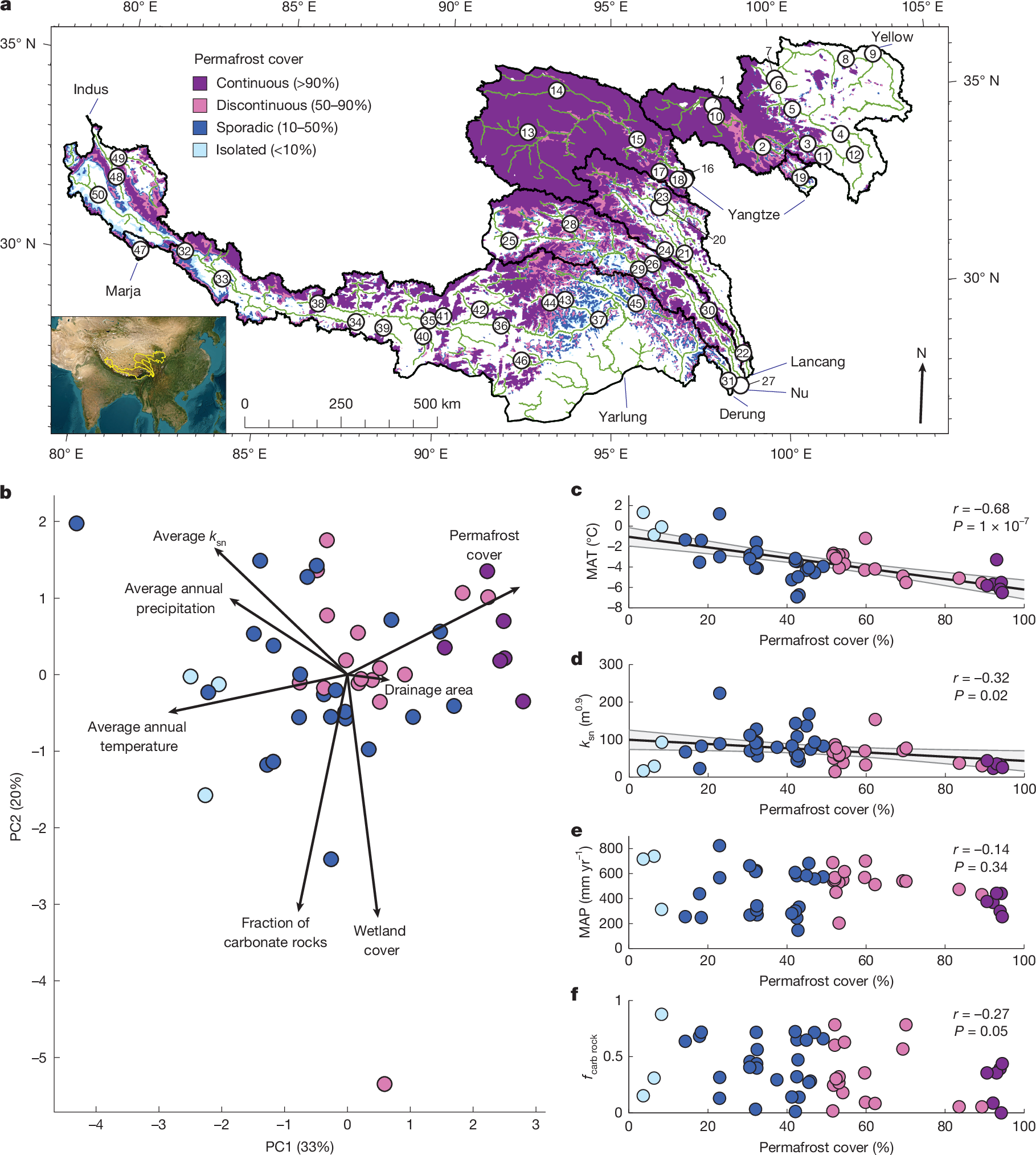
a, Map of the QTP shown in an Asia North Lambert Conformal Conic projection, showing permafrost cover and sampling locations (open dots). The green lines indicate rivers with catchment areas >1,000 km2. The black outlines mark the main catchments drawn on to the border of China and to the edge of the QTP. The names of the main rivers in each catchment are shown. Numbers in sample points are the sample ID (Supplementary Table 5). b, PCA of the main environmental boundary conditions in the study area, highlighting a permafrost-climate gradient (PC1) and a lithology gradient (PC2). More than 75% of the variance in PC1 was explained by permafrost extent (30%), mean annual air temperature (33%) and mean annual precipitation (14%). The remaining variance was mainly explained by changes in normalized river steepness index (ksn; 18%). The relationship between permafrost extent and ksn was attributable to high permafrost extent on the flat plateau in the northern and eastern parts of the QTP. Lithology (40%), wetland extent (38%) and ksn (11%) contributed most to the variance explained by PC2. The points are coloured by permafrost category. c–f, Environmental variables across the permafrost gradient: mean annual air temperatures (MAT; °C) (c), catchment-averaged steepness index (m0.9) (d), mean annual precipitation (MAP; mm yr−1) (e) and fraction of carbonate rock in the catchment (fcarb rock) (f). The points are coloured by permafrost category. Pearson’s correlation coefficients and P values are shown. The black lines are linear regressions with grey shading showing the 95% confidence interval of the regression. These are plotted only if r ≥ 0.3.
A permafrost gradient on the QTP
We repeatedly sampled 50 rivers in the headwaters of the largest river systems of Asia (Yellow, Yangtze, Lancang, Nu, Derung, Yarlung Tsangpo, Marja Tsangpo and Indus Rivers; Fig. 1a) during the ice-free season between April and October over more than 3 years. The sampled headwaters cover a total area of approximately 780,000 km2, span elevations from 1,650 m to 4,820 m above sea level, and drain all major lithologies of the QTP, including a variety of sedimentary, igneous and metamorphic rocks (Extended Data Fig. 1b and Supplementary Tables 1 and 2). We include basins on the cold plateau underlain by continuous permafrost and catchments draining warmer landscapes with discontinuous, sporadic or isolated permafrost cover.
Across these landscape-scale environmental gradients, we found that permafrost extent is inversely related to average annual air temperature (principal component 1, PC1; Fig. 1b,c and Extended Data Fig. 1a), consistent with thermal permafrost degradation in response to climate change41. Because permafrost extent tends to be the highest on the flat plateau in the northern and eastern parts of the study area, we also found that permafrost extent declines moderately with the catchment-averaged steepness index (ksn), a proxy for landscape-scale erosion rates42,43 (Fig. 1b,d and Extended Data Fig. 1c). The permafrost gradient does not substantially co-vary with factors that may affect chemical rock weathering (for example, lithology and average annual precipitation; Fig. 1b,e,f and Extended Data Fig. 1b,d). Furthermore, permafrost does not co-vary with wetland coverage, which can affect dissolved organic carbon (DOC) export to rivers44 (Fig. 1b). Thus, our sampled catchments allow us to relate changes in permafrost extent and temperature to river biogeochemistry, mostly independently from other environmental variables that also affect weathering and carbon fluxes.
Solute and carbon sources in QTP rivers
To assess the concentrations and sources of carbon and inorganic constituents in QTP rivers, we measured CO2 partial pressure (\({p}_{{\mathrm{CO}}_{2}}\)) and emission rates, concentrations of DOC, DIC, major dissolved cations and anions, and isotopes of carbon (δ13C–Δ14C), sulfur (δ34S) and oxygen (δ18O). We found all 50 rivers to be supersaturated in CO2 with respect to atmospheric equilibrium, with a median saturation of 230% (interquartile range 200–270%), and \({p}_{{\mathrm{CO}}_{2}}\) of 650 (580–750) μatm and a median riverine CO2 emission rate of 95 (81–120) mmol m−2 day−1 (Extended Data Fig. 2). These emissions are bracketed by previous observations from QTP rivers (Supplementary Table 3), but remain below the median estimate (594 mmol m−2 day−1) for global rivers8. Concentrations of DOC and DIC are 380 (320–440) μmol l−1 and 1,800 (1,400–2,600) μmol l−1 (Extended Data Fig. 2 and Supplementary Table 2), respectively, whereas total dissolved ion concentrations (4,600 (2,900–5,900) μmol l−1) are dominated by Ca2+ (750 (580–1,000) μmol l−1), Mg2+ (480 (230–840) μmol l−1), Na+ (410 (250–830) μmol l−1), SO42− (430 (260–730) μmol l−1) and HCO3− (2,000 (1,300–2,600) μmol l−1; Extended Data Fig. 2 and Supplementary Table 2). No substantial seasonal trends in either CO2 or dissolved chemistry were apparent over the study period (Extended Data Fig. 3), although water temperatures increased from April to August and runoff increased slightly through summer and into fall (Extended Data Fig. 4).
We found that the dissolution of carbonates contributed the most cations (78% (70–86%) of the total cation charge), whereas silicates and evaporites contributed a smaller fraction (6.0% (3.6–9.5%) and 6.3% (1.6–14%), respectively; Extended Data Fig. 5a and Supplementary Table 2). With one exception, samples with more than 25% and up to 78% cation contribution by evaporites occurred exclusively in eight sites of the westernmost Yellow River, Yangtze River and Lancang River, and are probably controlled by evaporitic units within the metasediments45. Coupled isotopic compositions of δ34S-SO42− and δ18O-(SO42−–H2O) identify a mixing trend between riverine sulfate (SO42−) derived from pyrite and evaporite sources (Extended Data Fig. 5b). We infer that sulfate from sulfide oxidation balances 23% (11–36%) of the total cation charges (Extended Data Fig. 5a).
Interactions of organic and inorganic carbon pools
Based on dual carbon isotopes (δ13C–Δ14C) and a three-endmember mixing model46, we found that old permafrost- and rock-derived carbon substantially contributes to DOC, DIC and CO2 pools in QTP rivers. DOC is a mix of modern (67 ± 11%) and old permafrost (21 ± 13%) as well as rock (carbonate and petrogenic OC; 12 ± 6%) carbon sources, with an average age of 2,232 14C years (Fig. 2a,b). DIC can be modelled as a mixture of modern (49 ± 19%) and old permafrost (34 ± 19%) and rock (19 ± 8%) sources, with an average age of 3,512 14C years (Fig. 2a,b). Riverine CO2 falls between DOC and DIC in both its δ13C and Δ14C signatures and has an average age of 1,655 14C years, consistent with a mix of modern permafrost (66 ± 11%), old permafrost (22 ± 13%) and rock (12 ± 7%) carbon sources (Fig. 2a,b).
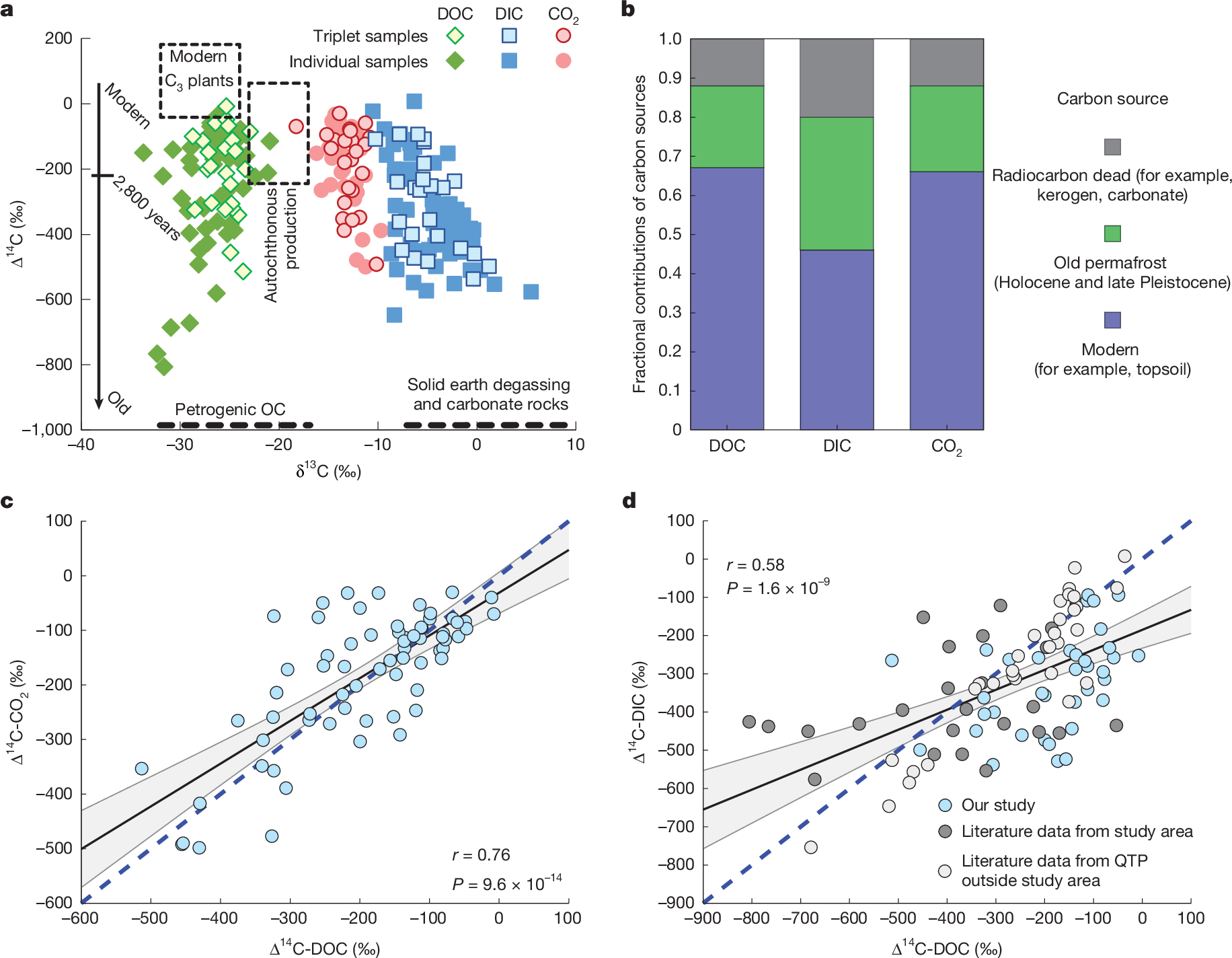
a, Δ14C compared with δ13C for measured samples (bordered points) and literature data (unbordered points). Expected carbon isotope ranges for select endmembers are marked with black-dashed lines and boxes (Methods). The threshold of Δ14C age for the Northern Hemisphere permafrost soils is about 2,800 14C years (ref. 50). b, Results from a three-endmember mixing model of Δ14C data. c,d, Δ14C isotopes for paired samples collected at the same ti