Probing picometre-scale interlayer deformations via hyperbolic polaritons
Abstract
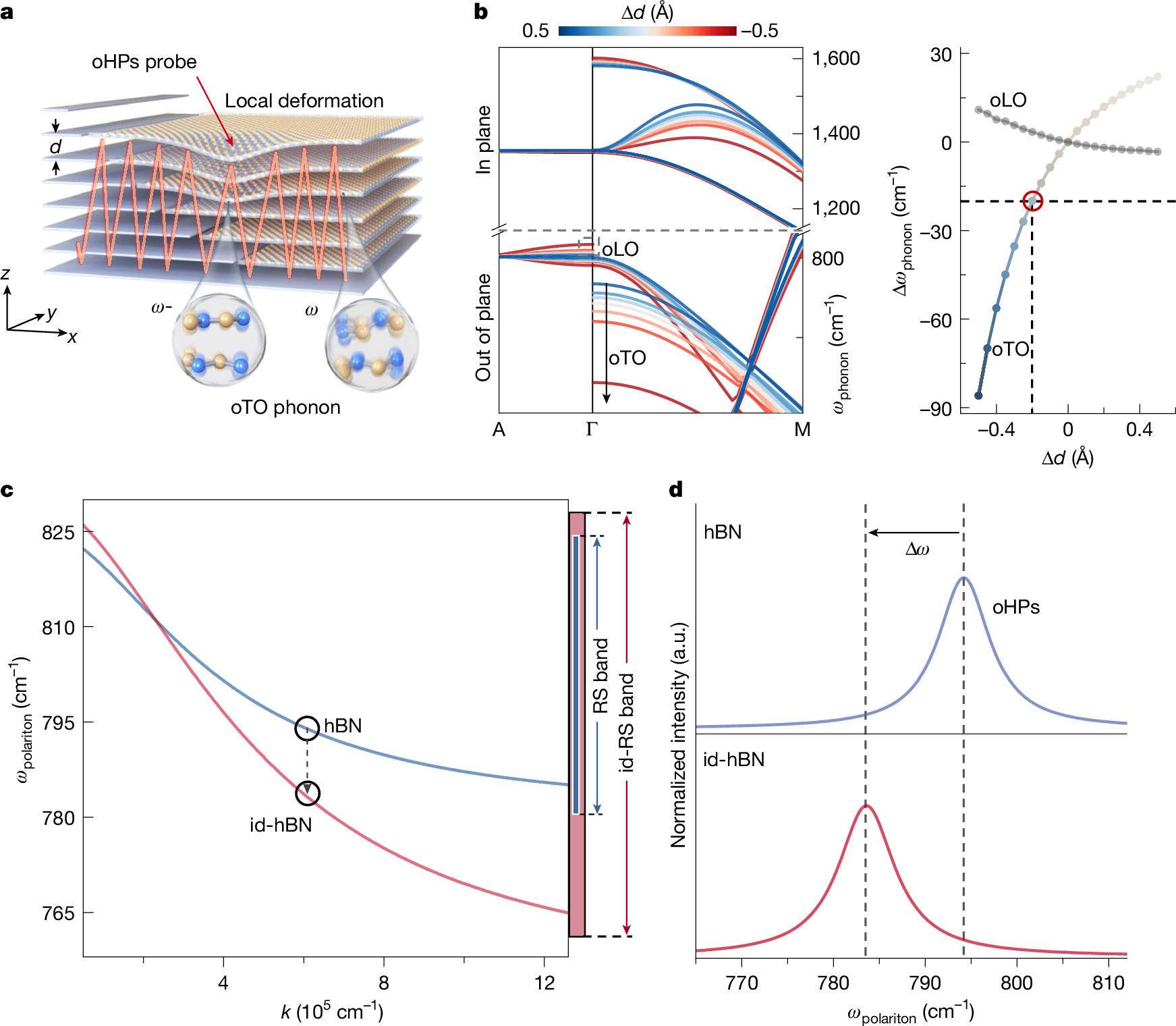
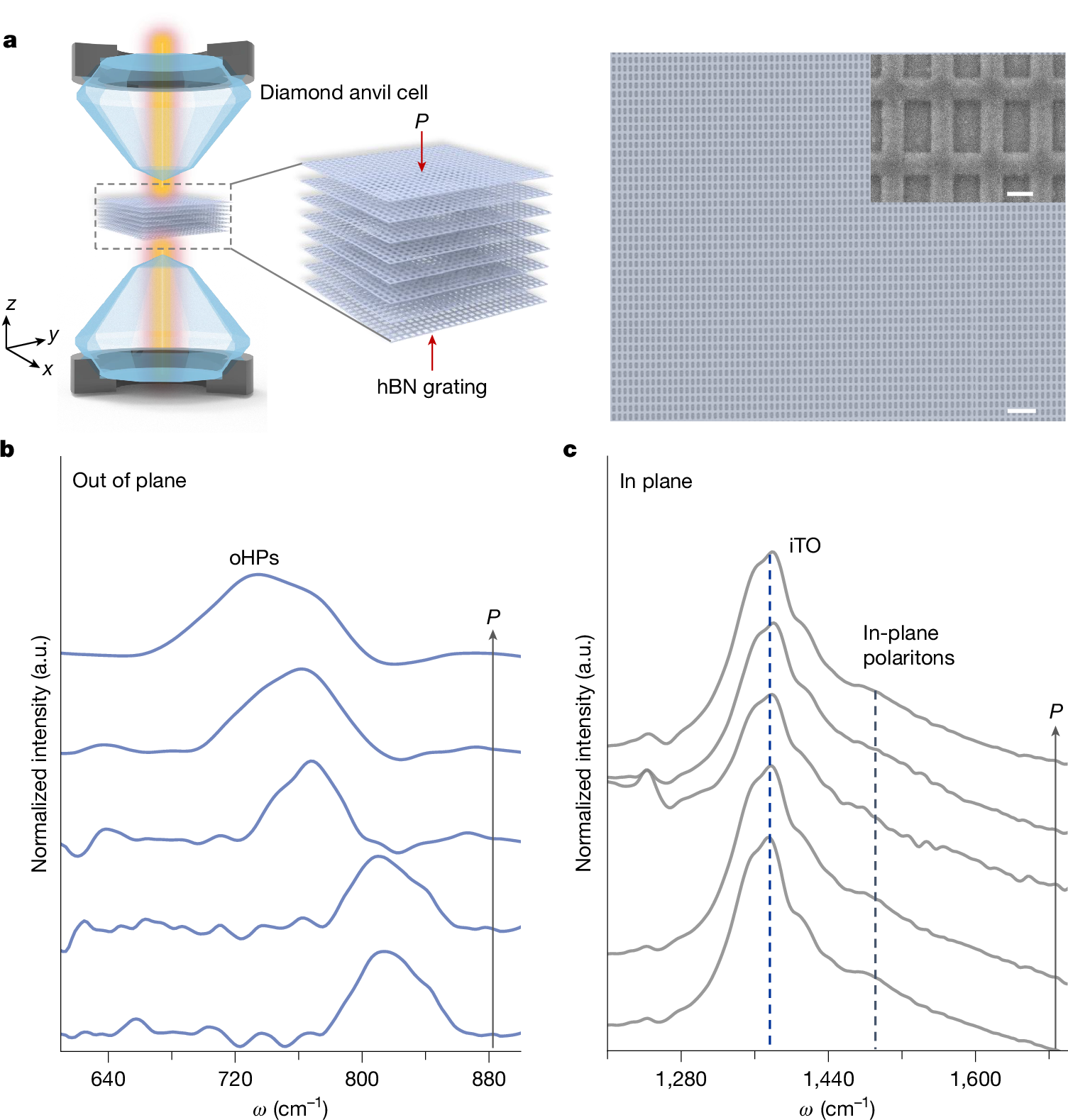
The resilience of van der Waals (vdW) materials to large strain fields makes them an ideal platform for tuning electronic, optical and magnetic properties1,2,3,4. Although in-plane strain is readily mapped, non-invasive and quantitative characterization of out-of-plane strain remains a formidable challenge, particularly for picometre-scale deformations buried at interfaces. Here we demonstrate a polaritonic optical method that uses the mid-infrared out-of-plane hyperbolic polaritons (oHPs) mode to detect interlayer deformations in prototypical vdW polar insulator–hexagonal boron nitride (hBN). This method uses the softening mechanism of out-of-plane transverse optical (oTO) phonons induced by interlayer strain, enabling highly sensitive detection of picometre-scale deformations. Although these oTO phonon modes are typically spectroscopically ‘dark’, their strain response is activated through the oHPs, achieving an atomic displacement sensitivity of about 10 pm (about 8 × 10⁻⁷ times the probing wavelength), enabling ultradeep-subwavelength mechanical interlayer deformation detection. This is experimentally validated in both planar hBN and at the buried interface of quantum dot–hBN nanotube heterostructures. This polariton-based picometrology bridges nanomechanics and photonics, providing a non-destructive lens to visualize hidden stress landscapes with atomic precision.
Access Nature and 54 other Nature Portfolio journals
Get Nature+, our best-value online-access subscription
$32.99 / 30 days
cancel any time
Subscribe to this journal
Receive 52 print issues and online access
$199.00 per year
only $3.83 per issue
Buy this article
- Purchase on SpringerLink
- Instant access to the full article PDF.
USD 39.95
Prices may be subject to local taxes which are calculated during checkout
 The alternative text for this image may have been generated using AI.
 The alternative text for this image may have been generated using AI.
 The alternative text for this image may have been generated using AI.
 The alternative text for this image may have been generated using AI.
Data availability
The data that support the findings of this study are available from the corresponding author on request. Source data are provided with this paper.
References
Kim, H., Uddin, S. Z., Higashitarumizu, N., Rabani, E. & Javey, A. Inhibited nonradiative decay at all exciton densities in monolayer semiconductors. Science 373, 448–452 (2021).
Song, Z. et al. Flaw-size-dependent mechanical interlayer coupling and edge-reconstruction embrittlement in van der Waals materials. Nat. Mater. 24, 1554–1560 (2025).
Pimenta Martins, L. G. et al. Pressure tuning of minibands in MoS2/WSe2 heterostructures revealed by moiré phonons. Nat. Nanotechnol. 18, 1147–1153 (2023).
Yankowitz, M. et al. Dynamic band-structure tuning of graphene moiré superlattices with pressure. Nature 557, 404–408 (2018).
Li, J., Shan, Z. & Ma, E. Elastic strain engineering for unprecedented materials properties. MRS. Bull. 39, 108–114 (2014).
Yeo, Y. et al. Polytype switching by super-lubricant van der Waals cavity arrays. Nature 638, 389–393 (2025).
Van Winkle, M. et al. Engineering interfacial polarization switching in van der Waals multilayers. Nat. Nanotechnol. 19, 751–757 (2024).
Barré, E. et al. Engineering interlayer hybridization in van der Waals bilayers. Nat. Rev. Mater. 9, 499–508 (2024).