A distant brown dwarf coplanar to a warm Jupiter and a hot super-Earth
Abstract
In transiting planetary systems, in which planetary sizes are accurately determined from transit observations, the presence of transit-timing variations1 (TTVs), especially when combined with radial velocity (RV) data, provides powerful constraints on masses and orbital eccentricities. Together, these measurements offer crucial insights into system architecture, formation mechanisms and dynamical evolution. We present long-term RV and transit/TTV monitoring of the relatively young star (age approximately 1 Gyr) TOI-201, revealing an exceptional multi-planet system composed of a hot super-Earth (SE) size planet transiting every 5.8 days, a warm Jupiter (WJ) on a 53-day orbit and an eccentric (e = 0.62) low-mass brown dwarf (BD) on an approximately 8-year orbit, with an estimated mass MBD of about 16 Jupiter masses. The BD is the longest-period transiting substellar object ever characterized by means of RVs and the only one known to be coplanar with inner planets. The architecture of this system suggests that the SE was formed isolated and in the innermost region of the gaseous disk. On the other hand, the orbital configuration of the outer companions suggests a nearly in situ formation of both objects, with the WJ forming in a dense inner disk. Alternatively, the BD might have formed farther out and migrated inward, while increasing its eccentricity owing to interactions with the disk.
Access Nature and 54 other Nature Portfolio journals
Get Nature+, our best-value online-access subscription
$32.99 / 30 days
cancel any time
Subscribe to this journal
Receive 52 print issues and online access
$199.00 per year
only $3.83 per issue
Buy this article
- Purchase on SpringerLink
- Instant access to the full article PDF.
USD 39.95
Prices may be subject to local taxes which are calculated during checkout
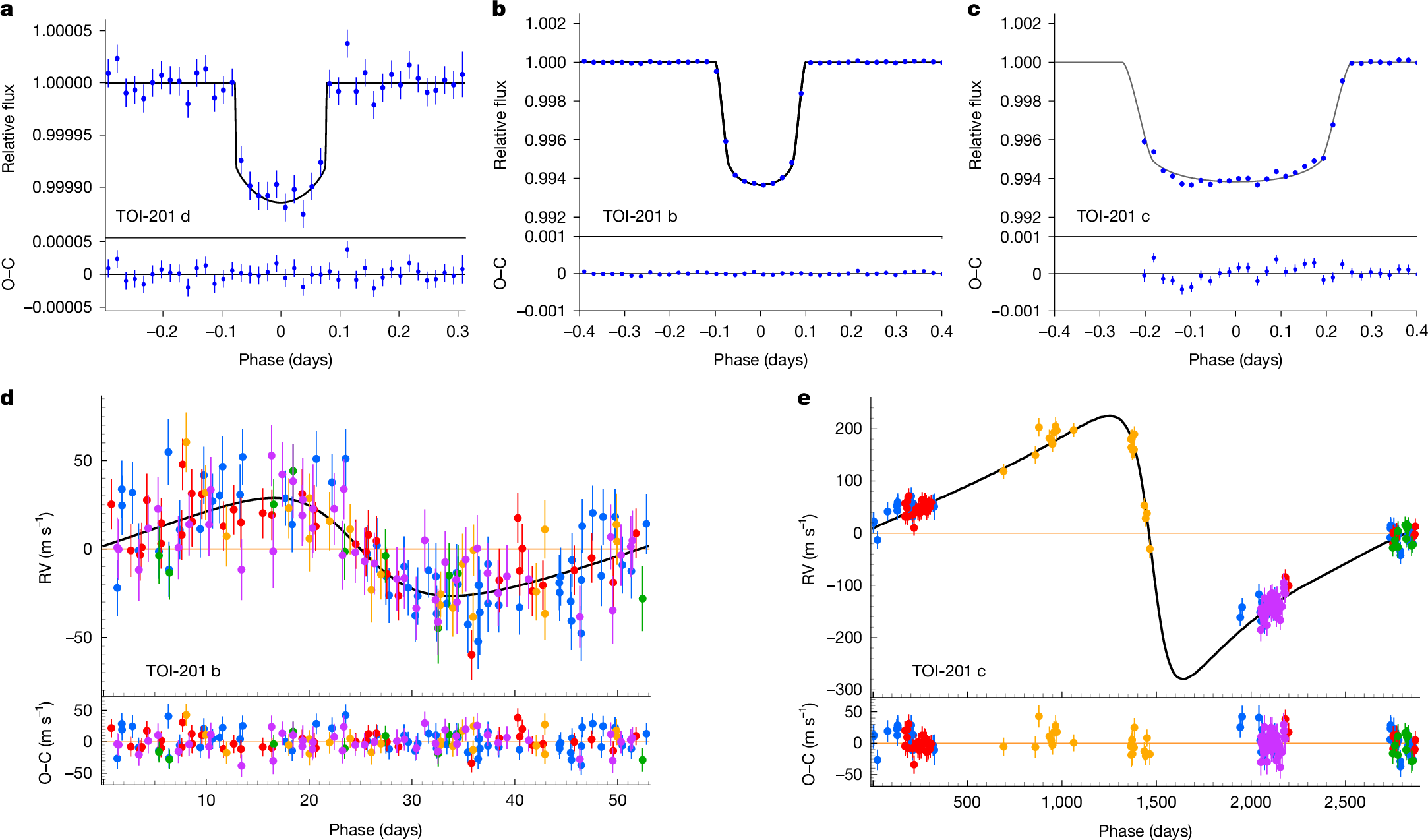 The alternative text for this image may have been generated using AI.
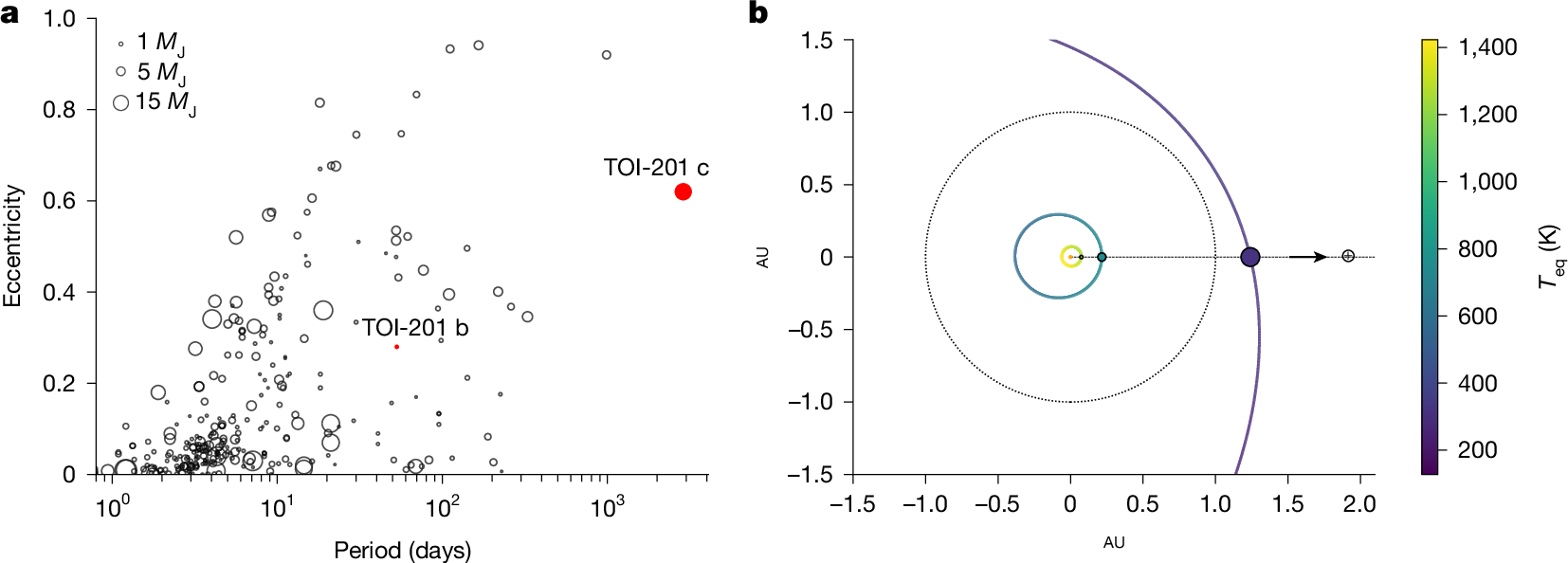 The alternative text for this image may have been generated using AI.
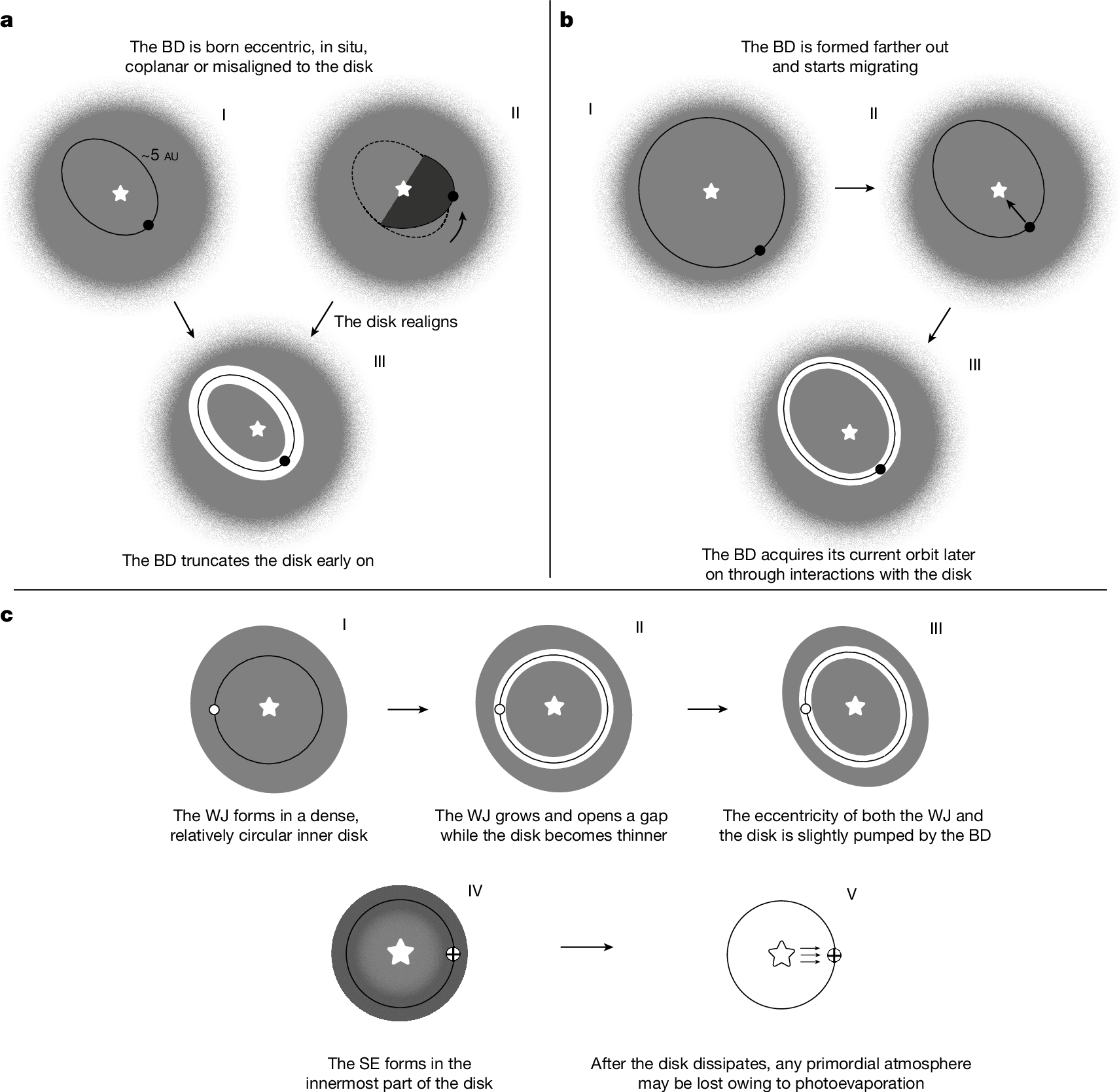 The alternative text for this image may have been generated using AI.
Data availability
The TESS photometric data can be downloaded from the Mikulski Archive for Space Telescopes (MAST) archive at https://mast.stsci.edu/portal/Mashup/Clients/Mast/Portal.html?searchQuery=TOI201. The RV data are presented in the Supplementary Information.
Code availability
The Exo-Striker tool can be downloaded from https://github.com/3fon3fonov/exostriker. The CERES pipeline is available at https://github.com/rabrahm/ceres. The juliet tool can be downloaded from https://github.com/nespinoza/juliet. The Gastli python package can be found at https://gastli.readthedocs.io/en/latest/. The EXOFASTv2 code can be downloaded from https://github.com/jdeast/EXOFASTv2.
References
Dobrovolskis, A. R. & Borucki, W. J. Influence of Jovian extrasolar planets on transits of inner planets. Bull. Am. Astron. Soc. 28, 1112 (1996).
Ricker, G. R. et al. Transiting Exoplanet Survey Satellite (TESS). J. Astron. Telesc. Instrum. Syst. 1, 014003 (2015).
Hobson, M. J. et al. A transiting warm giant planet around the young active star TOI-201. Astron. J. 161, 235 (2021).
Brahm, R. et al. HD 1397b: a transiting warm giant planet orbiting a V = 7.8 mag subgiant star discovered by TESS. Astron. J. 158, 45 (2019).
Rogers, L. A. Most 1.6 Earth-radius planets are not rocky. Astrophys. J. 801, 41 (2015).
Paxton, B. et al. Modules for Experiments in Stellar Astrophysics (MESA). Astrophys. J. Suppl. Ser. 192, 3 (2011).
Acuña, L., Kreidberg, L., Zhai, M. & Mollière, P. GASTLI. An open-source coupled interior–atmosphere model to unveil gas-giant composition. Astron. Astrophys. 688, A60 (2024).
Spiegel, D. S., Burrows, A. & Milsom, J. A. The deuterium-burning mass limit for brown dwarfs and giant planets. Astrophys. J. 727, 57 (2011).
Maciejewski, G. & Łoboda, W. A transiting giant on a 7.7 yr orbit revealed by transit timing variations in the TOI-201 system. Astrophys. J. Lett. 988, L63 (2025).
Murray, C. D. & Dermott, S. F. Solar System Dynamics (Cambridge Univ. Press, 1999).
Chatterjee, S., Ford, E. B., Matsumura, S. & Rasio, F. A. Dynamical outcomes of planet-planet scattering. Astrophys. J. 686, 580–602 (2008).