Trapping of single atoms in metasurface optical tweezer arrays
TL;DR
Researchers trapped single strontium atoms in optical tweezer arrays using holographic metasurfaces, achieving arrays with over 100 atoms and scaling to 360,000 traps. This method overcomes limitations of traditional techniques, enabling scalable quantum technologies with high uniformity.
Key Takeaways
- •Metasurfaces enable trapping of single atoms in optical tweezer arrays with high uniformity and arbitrary geometries.
- •Arrays with over 100 atoms and trap spacings as small as 1.5 μm were demonstrated, surpassing previous size constraints.
- •Scalability to 360,000 traps was achieved, overcoming critical barriers for neutral-atom quantum technologies.
Tags
Abstract
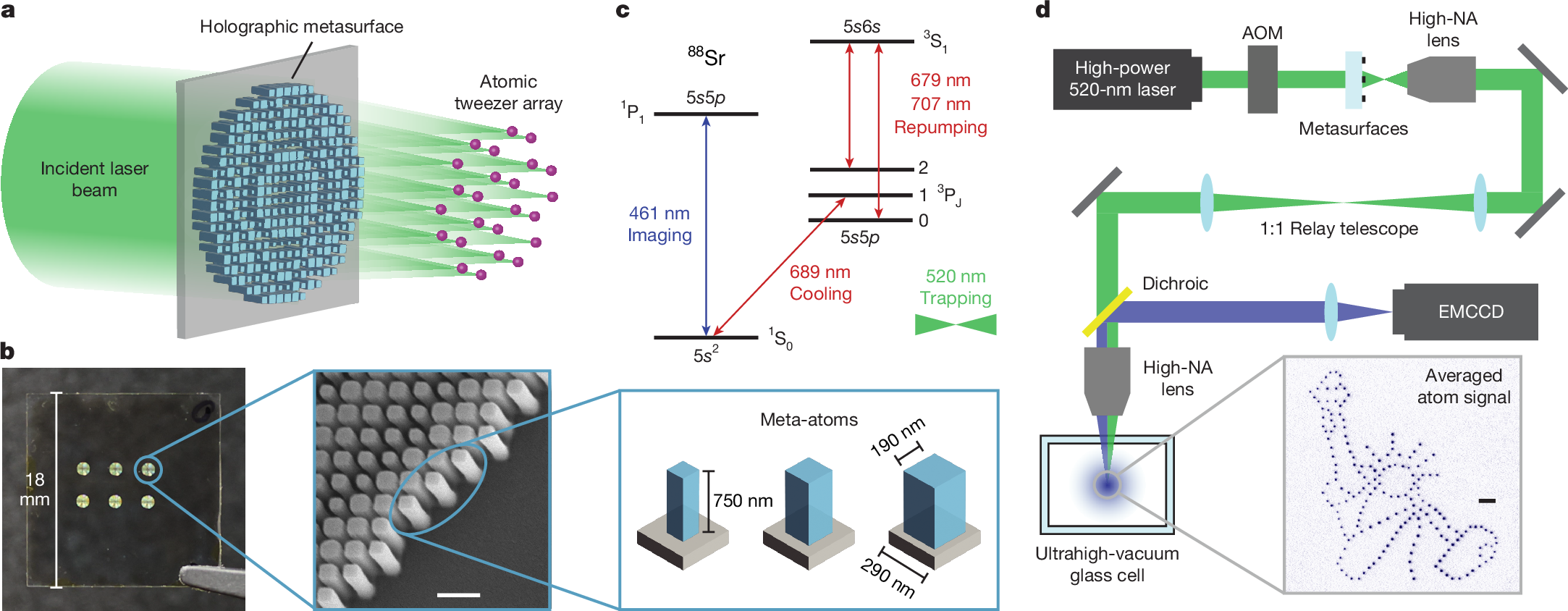
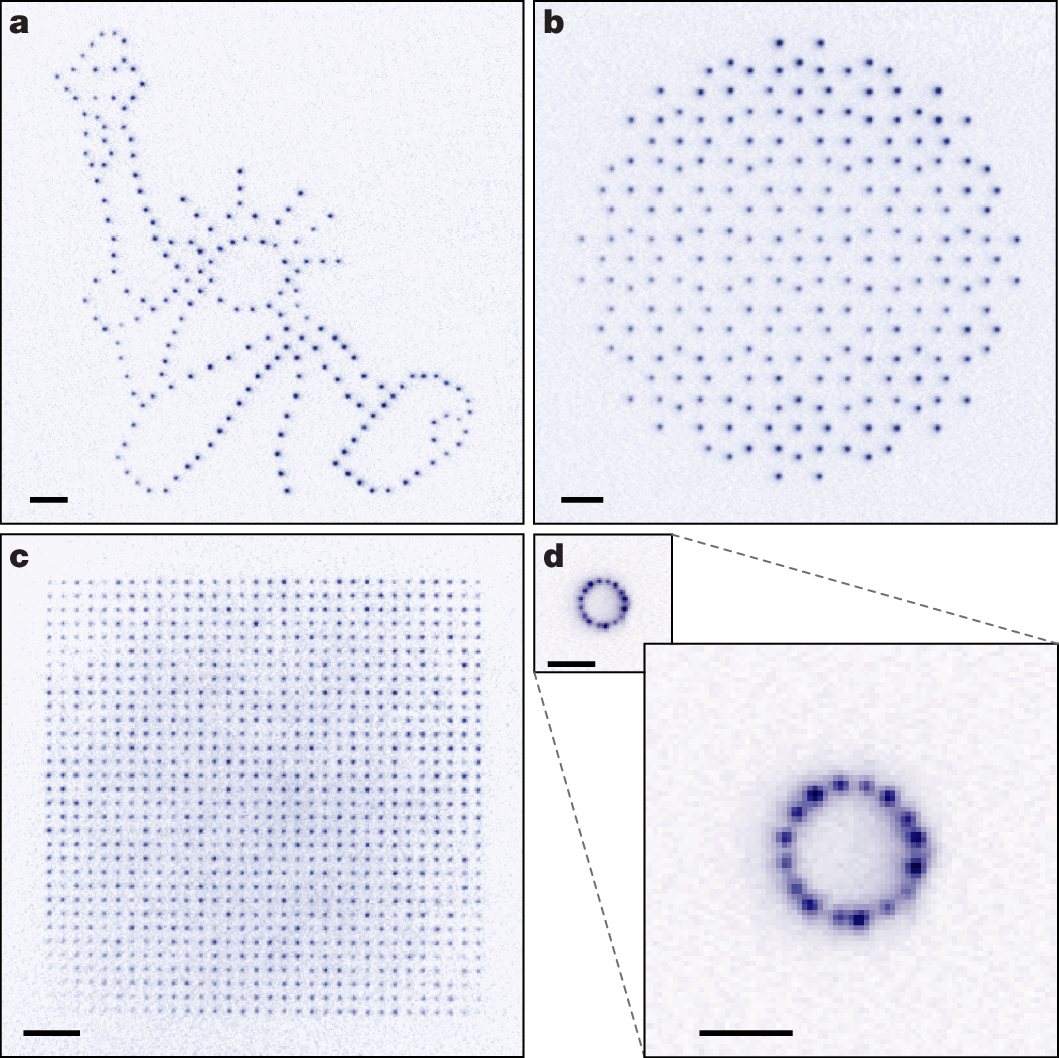
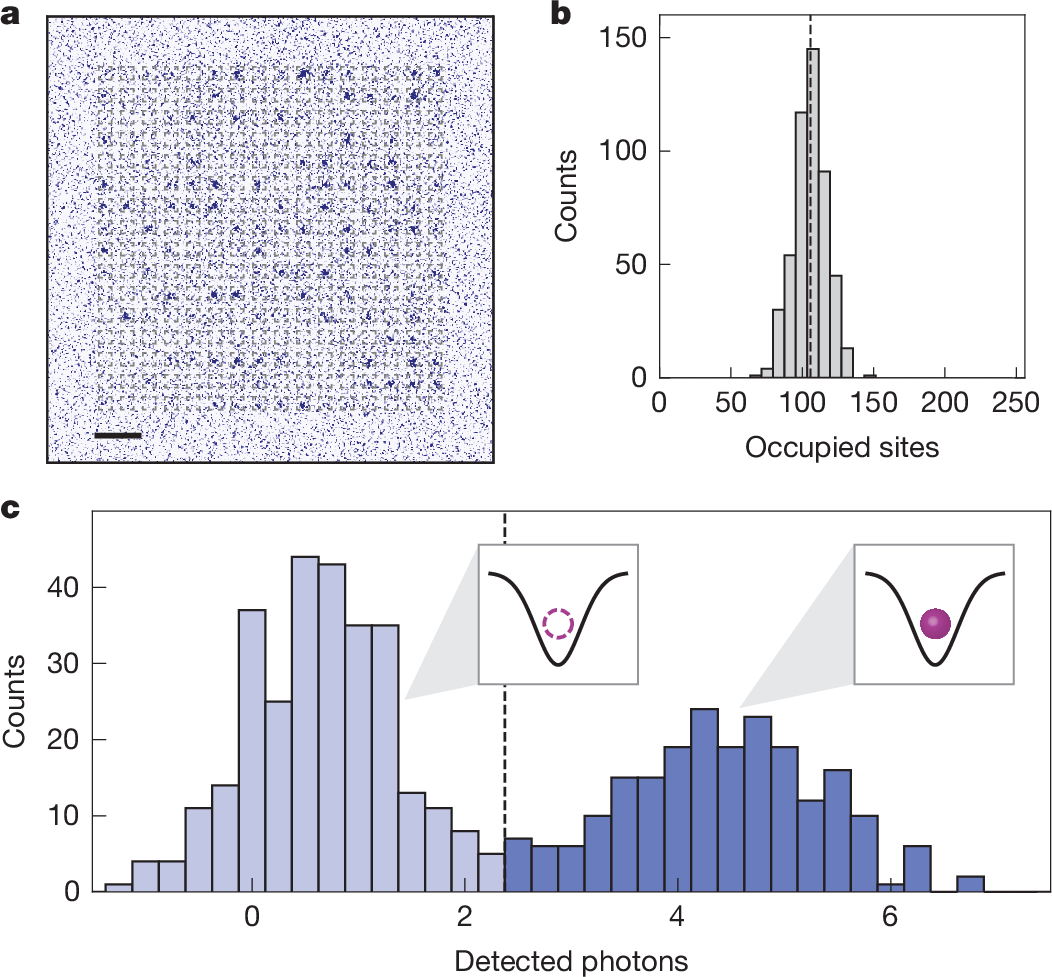
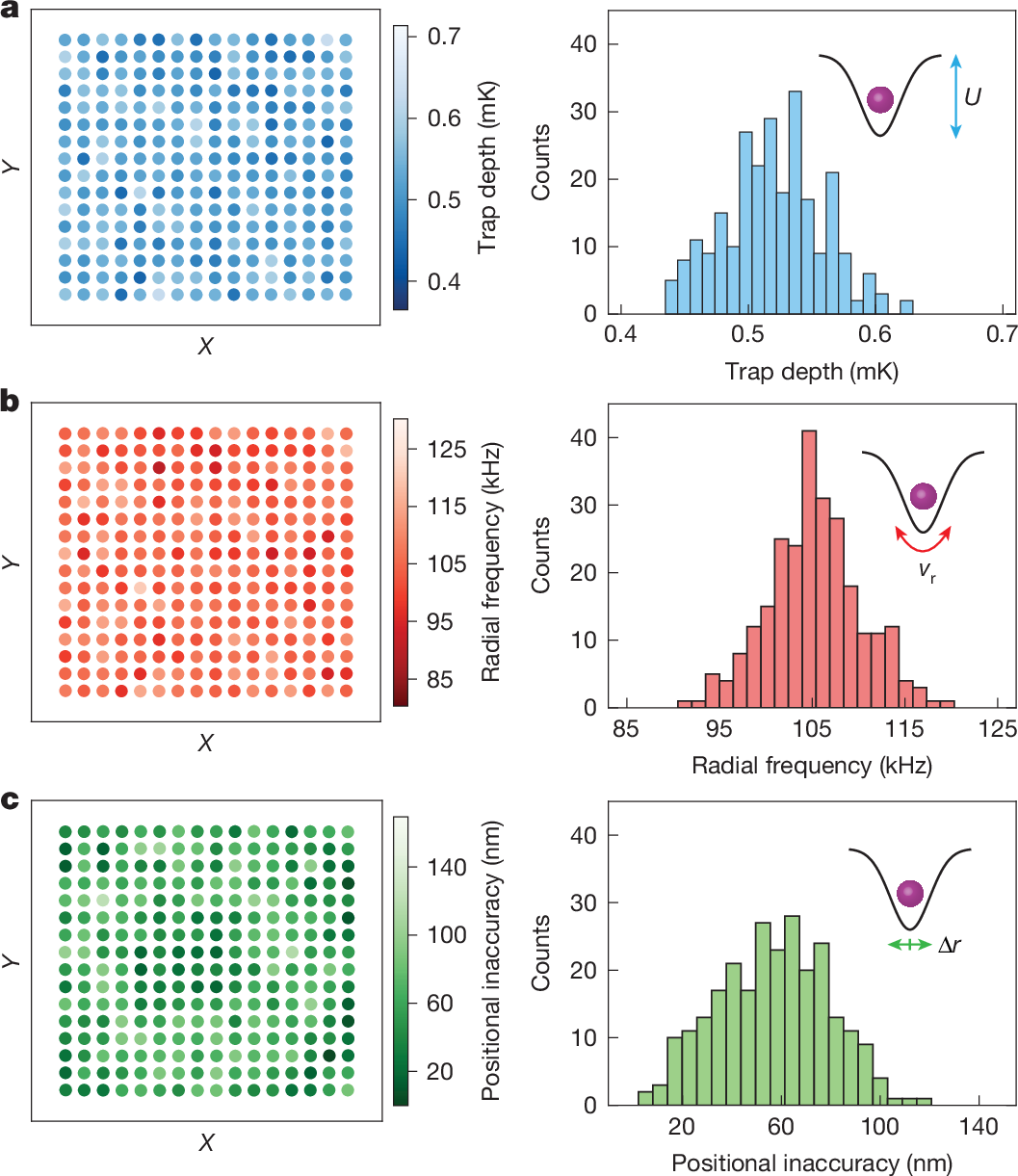
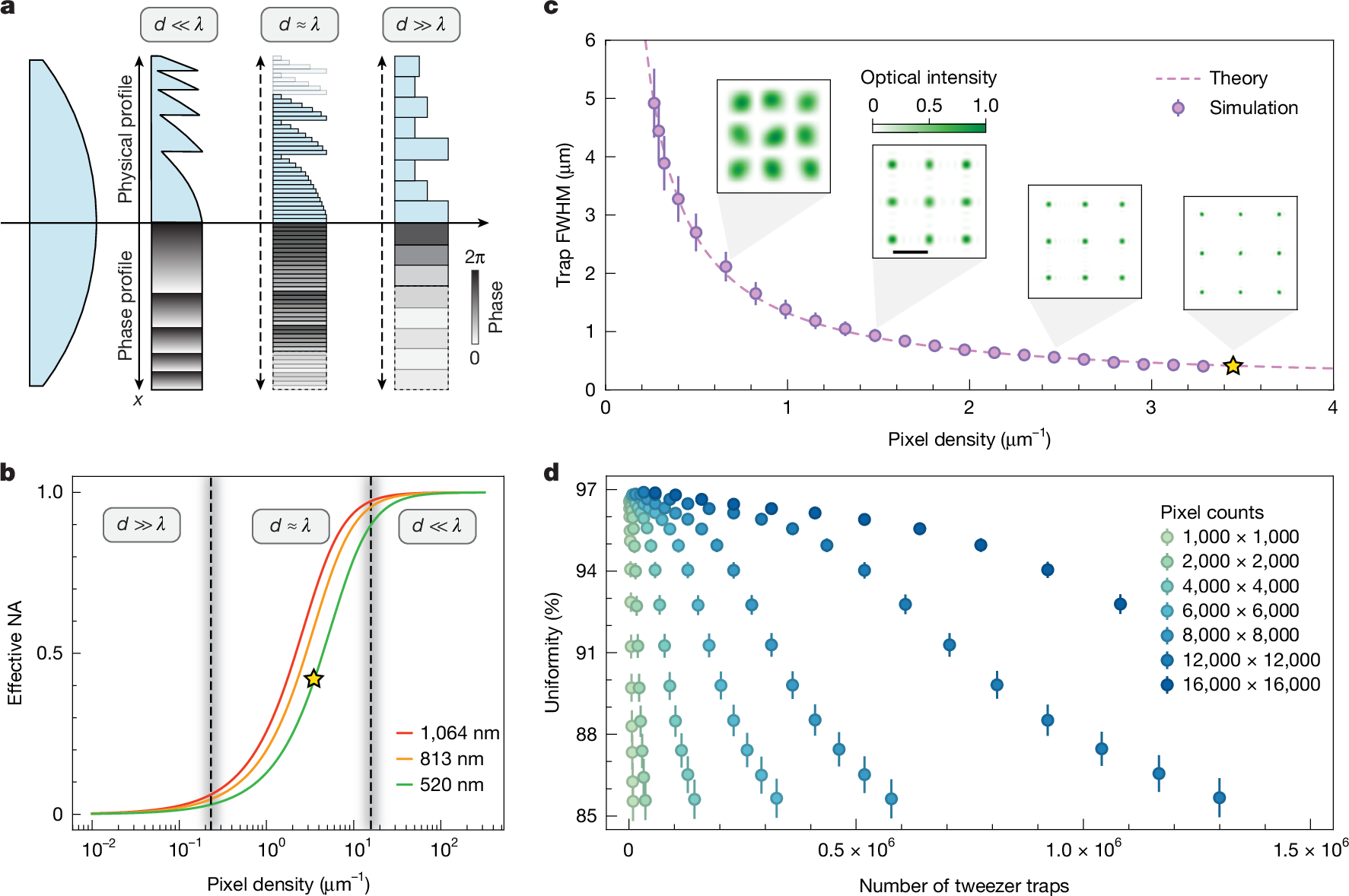
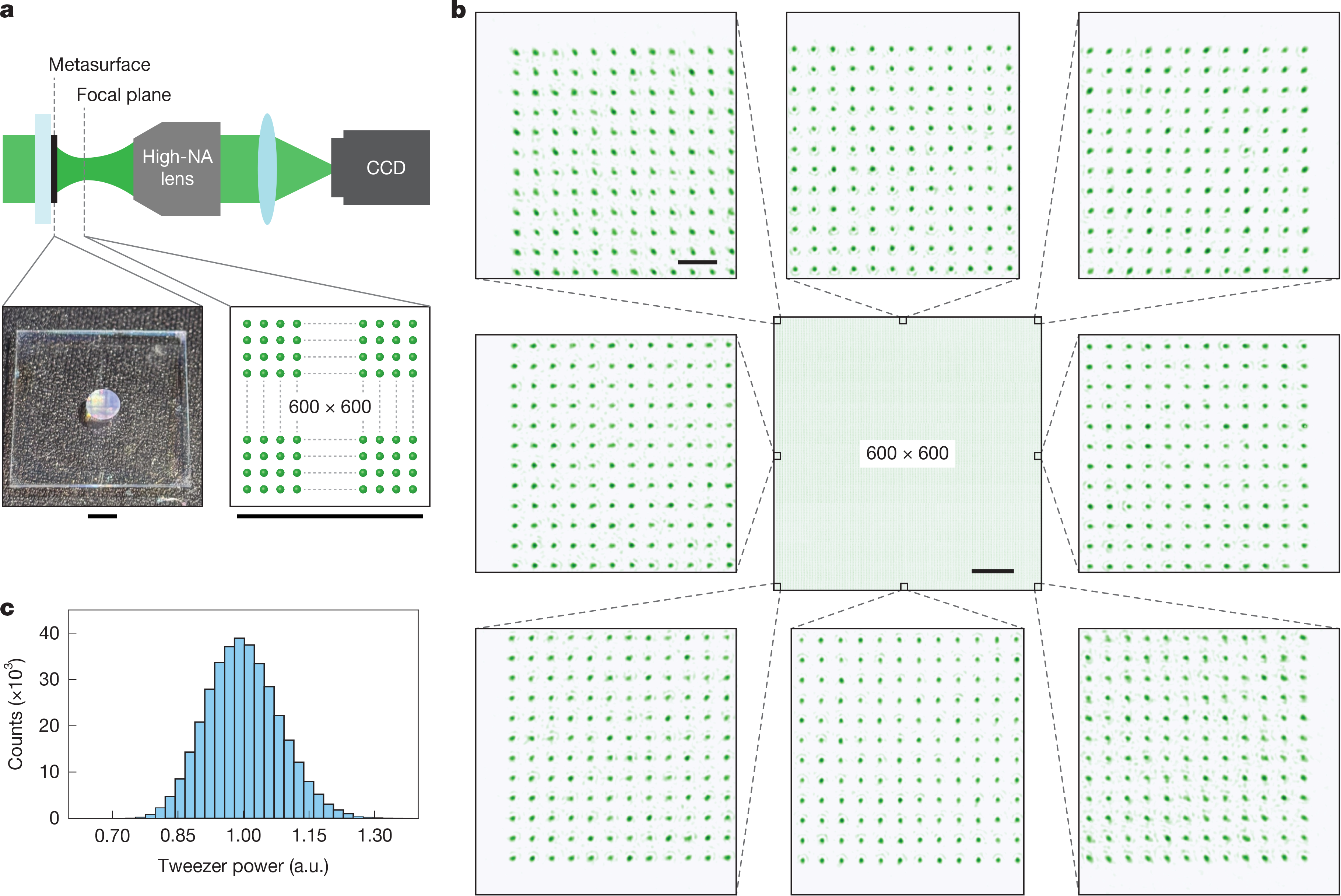
Optical tweezer arrays have emerged as a key experimental platform1,2 for quantum computation3,4, quantum simulation5,6 and quantum metrology7,8, enabling unprecedented levels of control over single atoms and molecules. The ability to scale such arrays has become a defining challenge. Typically, optical tweezer arrays are generated using acousto-optic deflectors or liquid-crystal spatial light modulators. Fundamental limitations in optical resolution have constrained array sizes to about 10,000 traps9. Metasurfaces10,11, planar photonic devices comprising millions of subwavelength pixels, provide an intriguing alternative for the generation of optical tweezer arrays12. Here we demonstrate the trapping of single strontium atoms in optical tweezer arrays generated via holographic metasurfaces. We realize two-dimensional arrays with more than 100 single atoms, arranged in arbitrary geometries with trap spacings as small as 1.5 μm. The arrays have a high uniformity in terms of trap depth, trap frequency and positional accuracy, rivalling or surpassing existing approaches. This is enabled by highly efficient holographic metasurfaces fabricated from high-refractive-index materials, silicon-rich silicon nitride and titanium dioxide. Through analytical and numerical methods, we find that the subwavelength pixel sizes of these metasurfaces allow scaling of tweezer arrays far beyond current capabilities. As a demonstration, we realize an optical tweezer array with 360,000 traps. These advances overcome a critical barrier to realizing scalable neutral-atom quantum technologies.
Access Nature and 54 other Nature Portfolio journals
Get Nature+, our best-value online-access subscription
$32.99 / 30 days
cancel any time
Subscribe to this journal
Receive 51 print issues and online access
$199.00 per year
only $3.90 per issue
Buy this article
- Purchase on SpringerLink
- Instant access to the full article PDF.
USD 39.95
Prices may be subject to local taxes which are calculated during checkout
Data availability
The experimental data that supports the findings of this study are available from the corresponding authors upon reasonable request. Source data are provided with this paper.
Code availability
All relevant codes are available from the corresponding authors upon reasonable request.
References
Kaufman, A. M. & Ni, K.-K. Quantum science with optical tweezer arrays of ultracold atoms and molecules. Nat. Phys. 17, 1324–1333 (2021).
Browaeys, A. & Lahaye, T. Many-body physics with individually controlled Rydberg atoms. Nat. Phys. 16, 132–142 (2020).
Graham, T. M. et al. Multi-qubit entanglement and algorithms on a neutral-atom quantum computer. Nature 604, 457–462 (2022).
Bluvstein, D. et al. Logical quantum processor based on reconfigurable atom arrays. Nature 626, 58–65 (2024).
Scholl, P. et al. Quantum simulation of 2D antiferromagnets with hundreds of Rydberg atoms. Nature 595, 233–238 (2021).
Semeghini, G. et al. Probing topological spin liquids on a programmable quantum simulator. Science 374, 1242–1247 (2021).
Madjarov, I. S. et al. An atomic-array optical clock with single-atom readout. Phys. Rev. X 9, 041052 (2019).