Climate change shifts the North Pacific storm track polewards
TL;DR
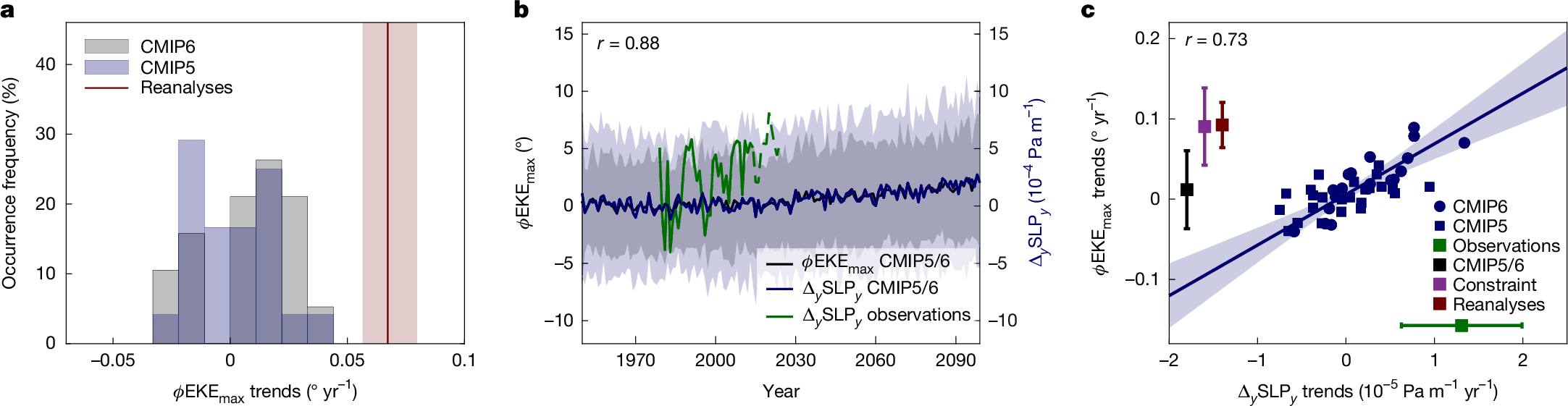
The winter North Pacific storm track has shifted polewards due to climate change, emerging from natural variability. This shift impacts heat and moisture transport, affecting precipitation and temperature in western North America, with models underestimating the change.
Key Takeaways
- •The winter North Pacific storm track has shifted polewards in recent decades, a change attributed to climate change rather than natural variability.
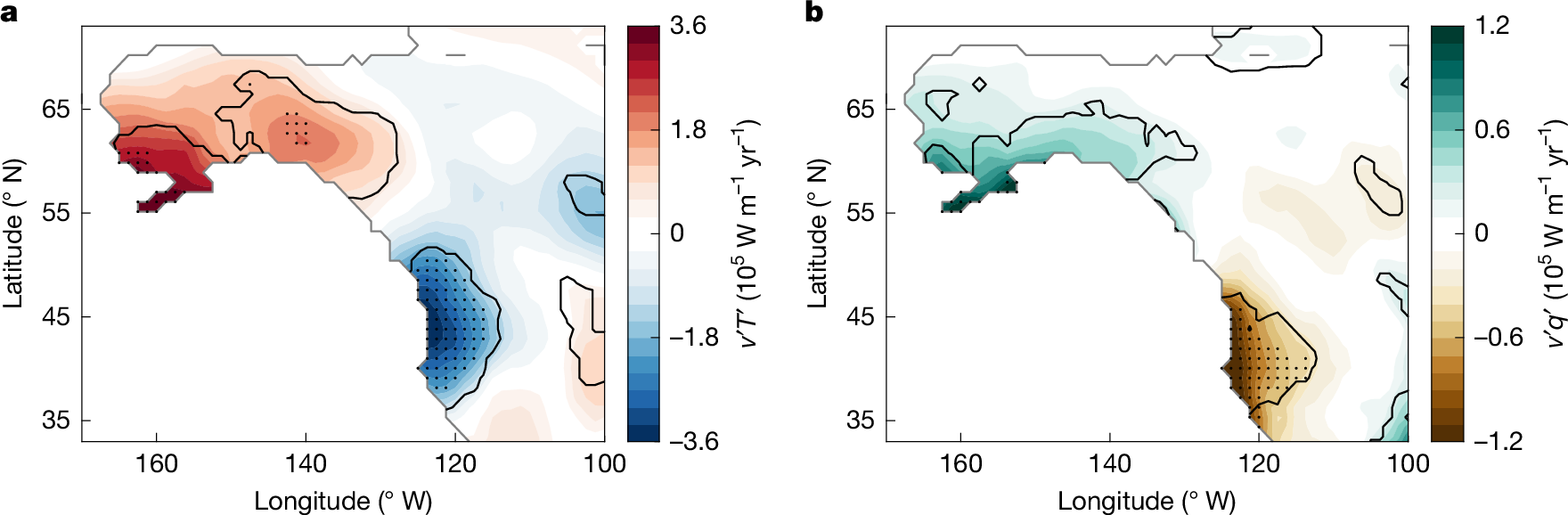
- •This polewards shift influences heat and moisture transport, leading to regional impacts on precipitation and temperature patterns in western North America.
- •Climate models currently underestimate the observed polewards shift, suggesting future human-induced impacts on ecosystems and water availability may be larger than predicted.
Tags
Abstract
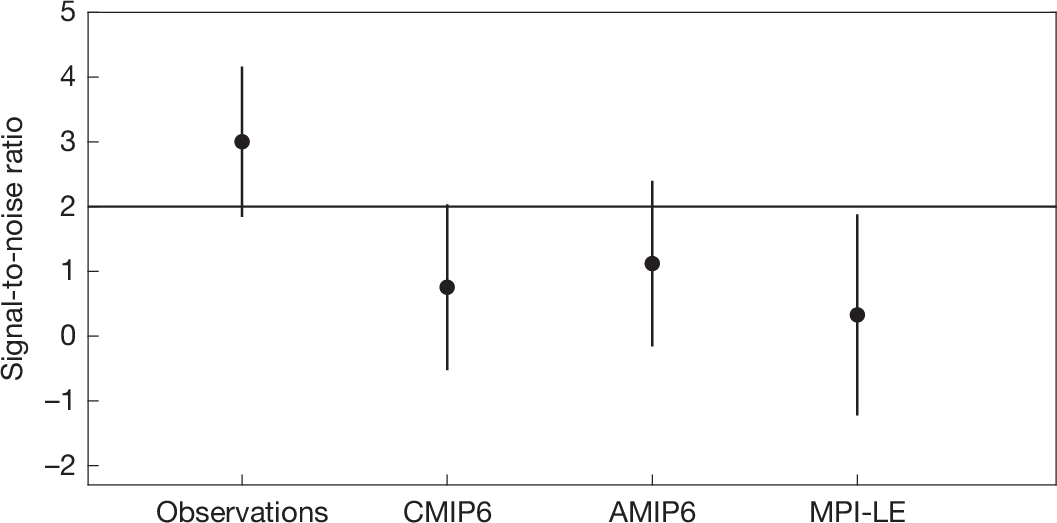
Across the North Pacific Ocean, the mid-latitude storm track accounts for most of the heat and moisture transport into the Arctic and western North America, considerably influencing regional precipitation and temperature patterns1,2. By the end of this century, the winter North Pacific storm track is projected to shift polewards3,4,5,6, with substantial implications for oceanic ecosystems and land-based water availability1,7. Although atmospheric reanalyses suggest a polewards shift of the storm track7,8,9,10,11,12, the lack of an observed wind record has left it uncertain whether the storm-track shift has occurred in recent decades, and what role climate change plays in determining the storm-track position. Here we derive an observational constraint for mid-latitude storm tracks and show that the winter North Pacific storm track has shifted substantially polewards, emerging from natural variability. A polewards shift of storm track-induced heat and moisture flux is also evident over western North America, implying regional impacts on precipitation and temperature patterns. Our analysis further reveals that climate models underestimate the polewards shift of the storm track in recent decades, suggesting that the future human-induced impacts on both the North Pacific ecosystem and western North America might be larger than in current predictions.
Access Nature and 54 other Nature Portfolio journals
Get Nature+, our best-value online-access subscription
$32.99 / 30 days
cancel any time
Subscribe to this journal
Receive 51 print issues and online access
$199.00 per year
only $3.90 per issue
Buy this article
- Purchase on SpringerLink
- Instant access to the full article PDF.
USD 39.95
Prices may be subject to local taxes which are calculated during checkout
Subtropical warming enhances North Pacific midlatitude winter storm track activity in recent decades
Persistent austral winter storm track weakening beyond doubling of CO2 concentrations

The future poleward shift of Southern Hemisphere summer mid-latitude storm tracks stems from ocean coupling
Data availability
The data used in the paper are publicly available for CMIP6 (https://esgf-node.llnl.gov/projects/cmip6/), CMIP5 (https://esgf-node.llnl.gov/projects/cmip5/), ICOADS (provided by the NOAA/OAR/ESRL PSD, http://www.esrl.noaa.gov/psd/), ERA5 (https://cds.climate.copernicus.eu/), JRA3Q and CFSv2 (https://rda.ucar.edu/), NCEP2 (https://psl.noaa.gov/data/gridded/data.ncep.reanalysis2.html), and MERRA2 (https://disc.gsfc.nasa.gov/datasets?project=MERRA-2). The border lines in the figures are based on Matlab’s ‘bwboundaries’ function and the ‘topo’ dataset.
Code availability
The code used to calculate the sea-level pressure meridional gradient is available at ref. 61 (https://doi.org/10.5281/zenodo.17476128).
References
Salathe, E. P. Influences of a shift in North Pacific storm tracks on western North American precipitation under global warming. Geophys. Res. Lett. 33, L19820 (2006).
Wise, E. K. & Dannenberg, M. P. Reconstructed storm tracks reveal three centuries of changing moisture delivery to North America. Sci. Adv. 3, e1602263 (2017).