Radiation-tolerant atomic-layer-scale RF system for spaceborne communication
TL;DR
Researchers developed a radiation-tolerant RF communication system using atomic-layer 2D MoS2 transistors for space applications. After 9 months in low Earth orbit, it maintained a bit error rate below 10^-8, with a predicted lifespan of 271 years in harsher environments. This demonstrates the potential of 2D electronics for durable spaceborne technology.
Key Takeaways
- •Atomic-layer 2D MoS2 materials show minimal radiation damage, enabling radiation-tolerant RF systems for space communication.
- •The system maintained a bit error rate below 10^-8 after 9 months in orbit, proving long-term stability and radiation resistance.
- •Predicted lifespan of 271 years in geosynchronous orbit highlights the durability of 2D electronics in harsh radiation environments.
- •This work advances spaceborne applications by leveraging wafer-scale 2D processes for compact, lightweight communication circuits.
Tags
Abstract
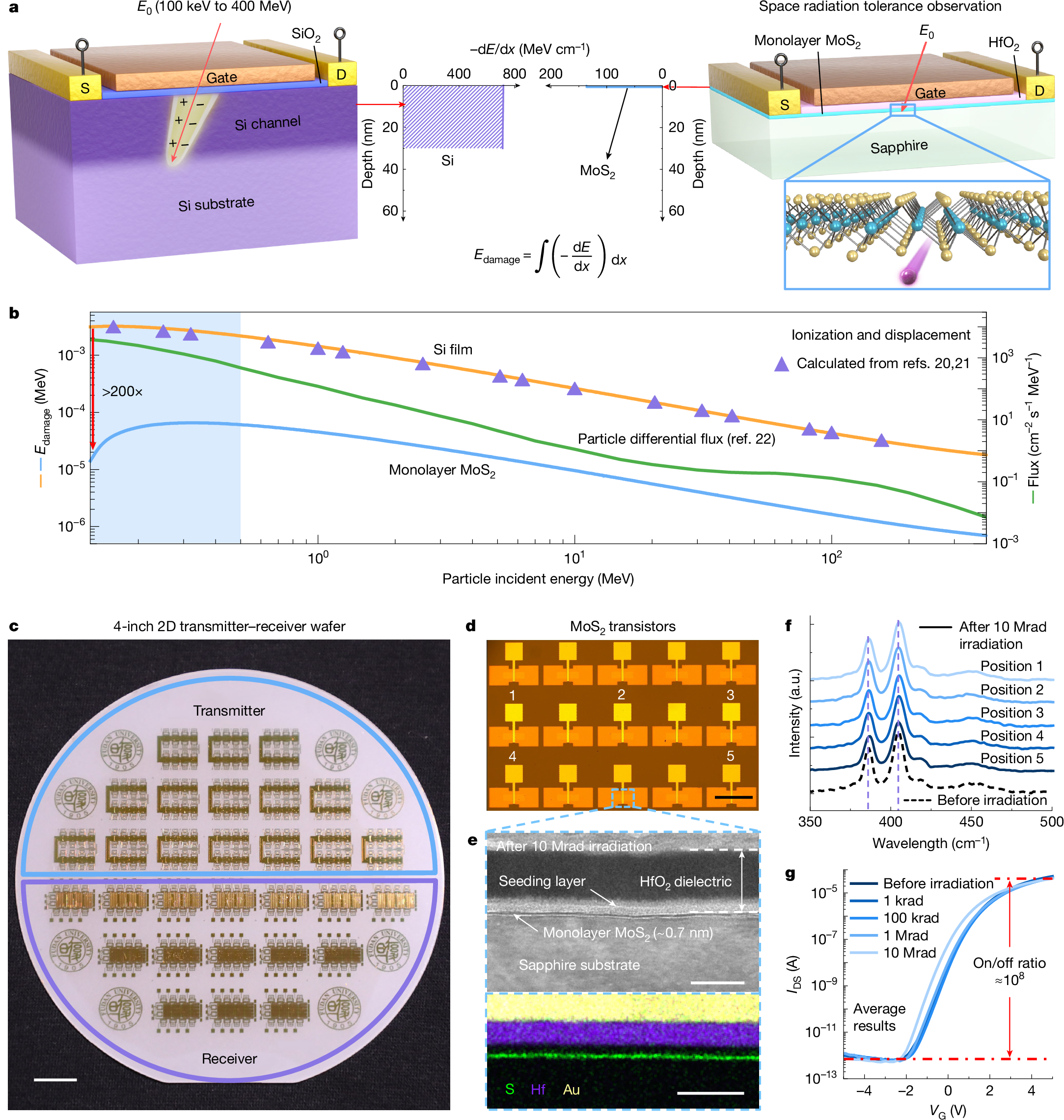
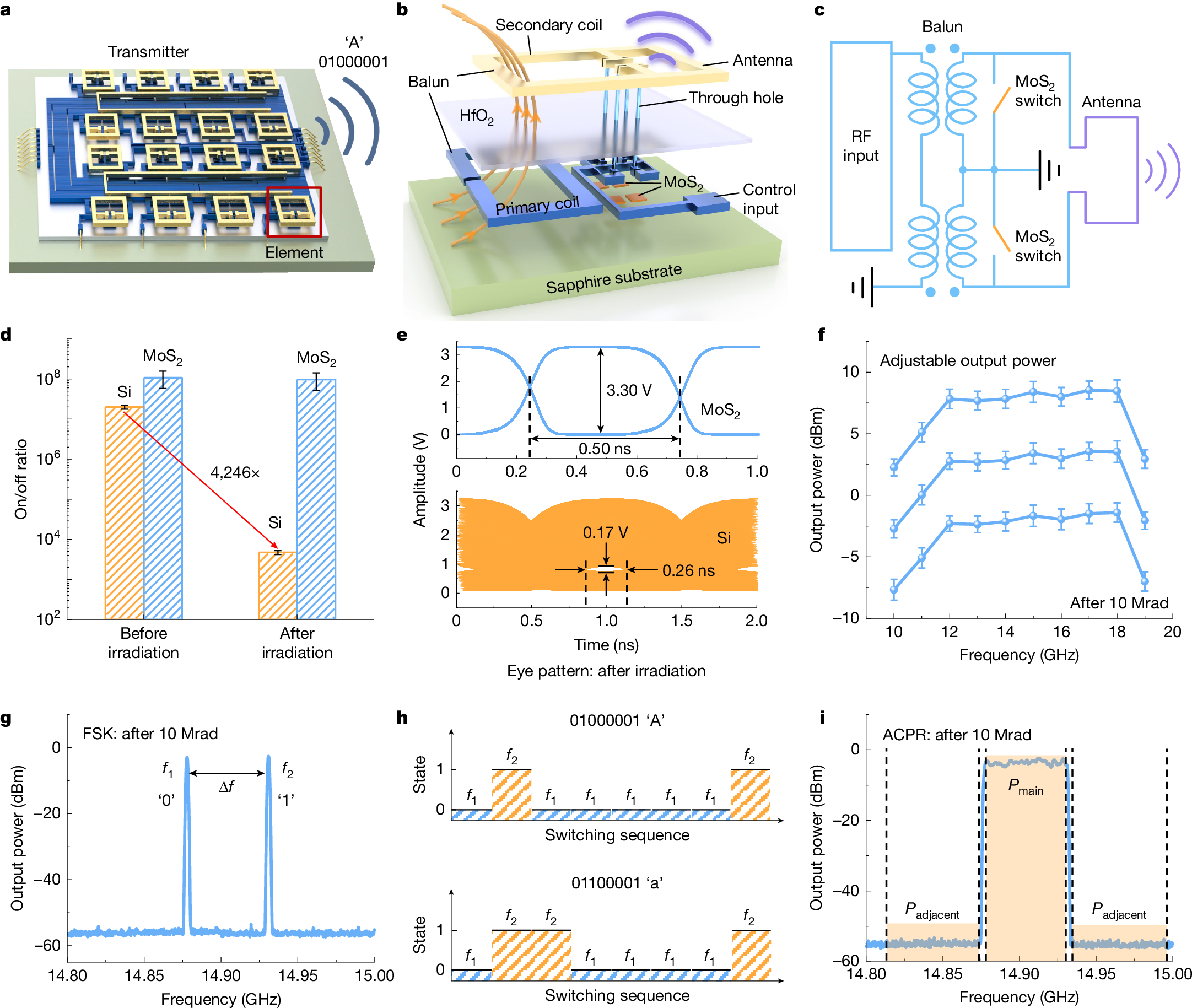
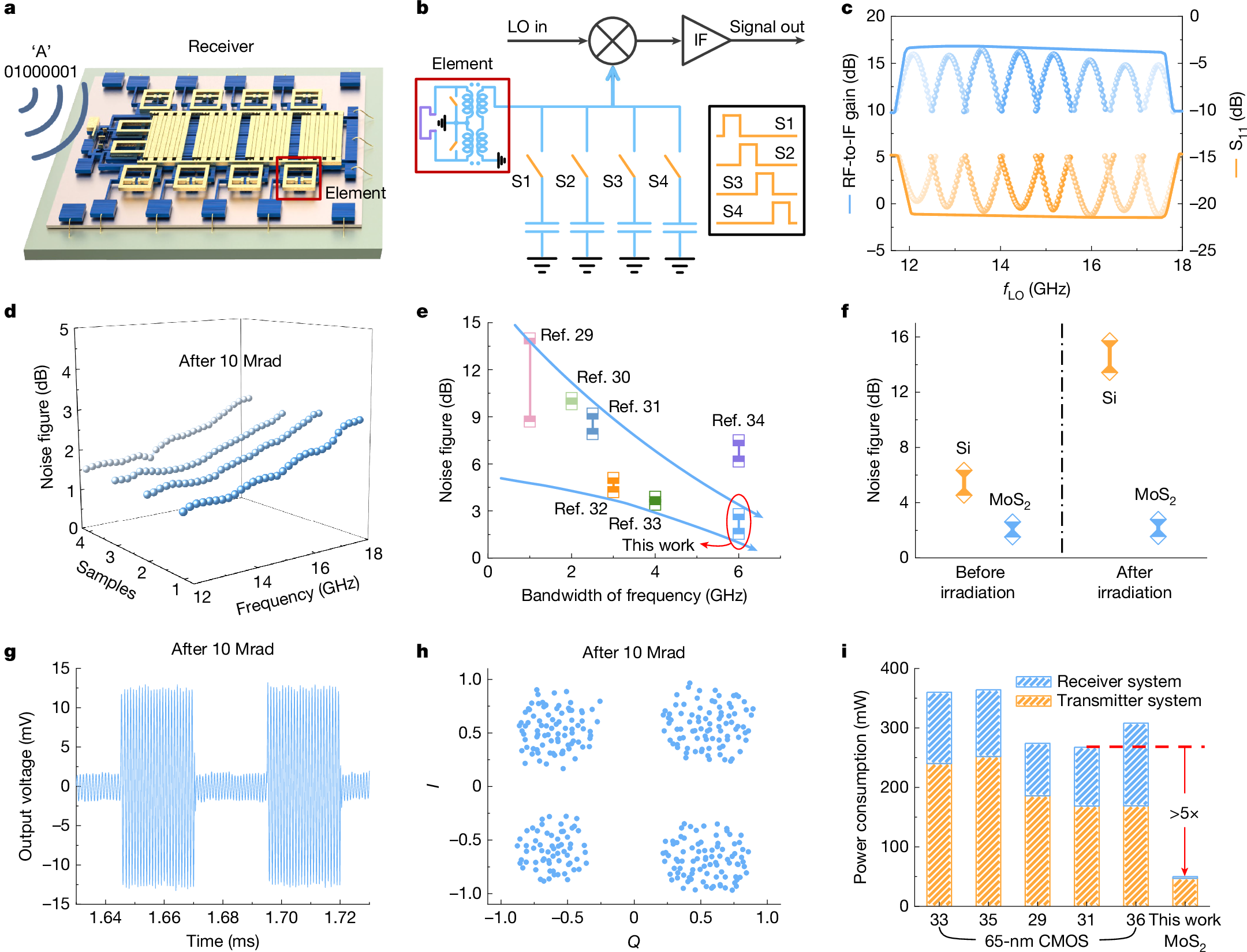
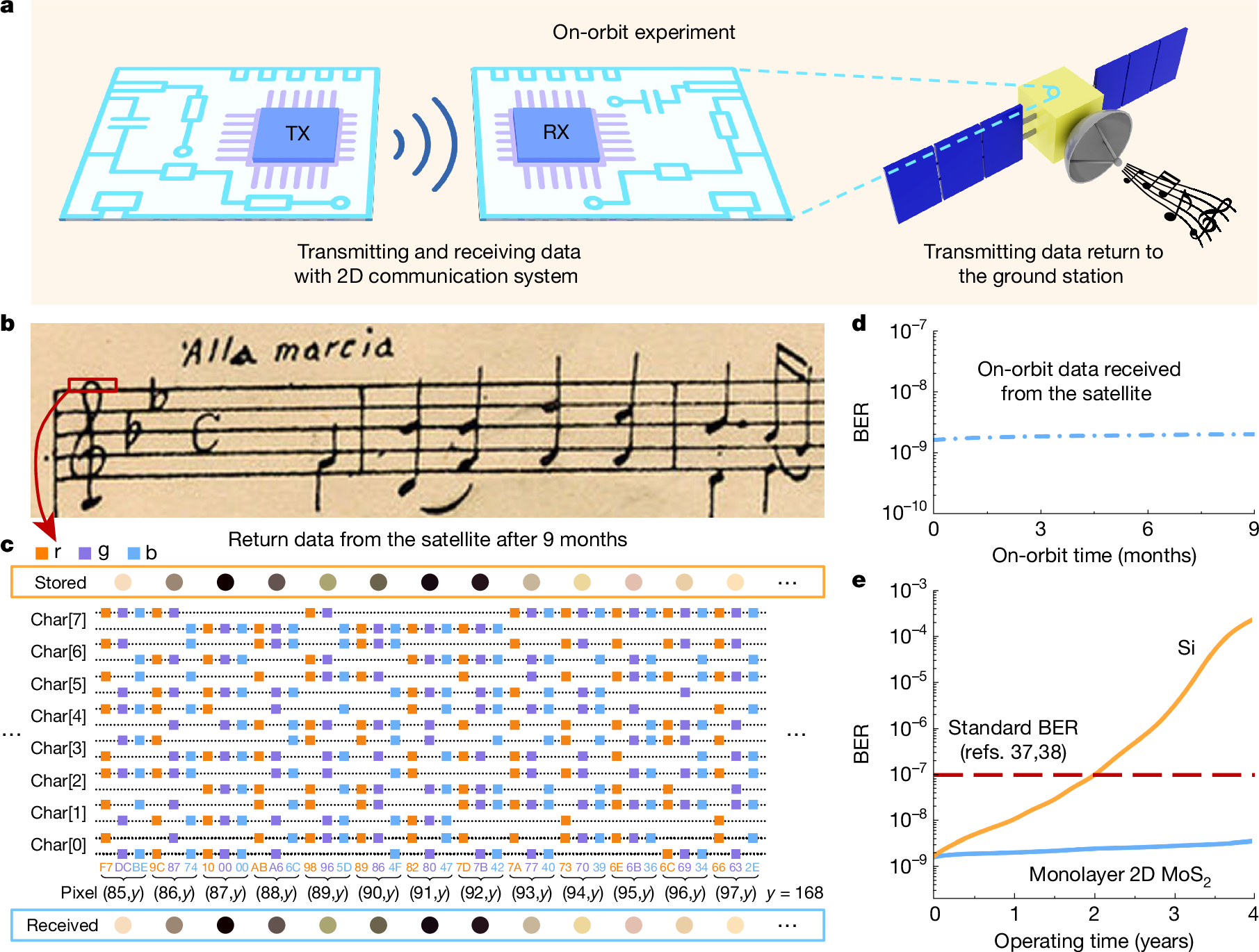
Integrated circuits for communications play an enabling role when it comes to outer-space exploration thanks to their small footprint and low weight1,2,3. However, owing to the severe irradiation effects of space energetic particles, the implementation of radiation-tolerant electronic circuits remains a challenge4,5,6. Here we report the observation of the space radiation effect on a satellite-based device and find that atomically thin materials are expected to accumulate minimal radiation-induced damage in principle. Accordingly, on the basis of a 4-inch wafer-scale monolayer 2D MoS2 process, we implement an atomic-layer transistor-based radiation-tolerant radio frequency (RF, 12–18 GHz) system with both transmitters and receivers for spaceborne communication. For on-orbit experiments, the 2D communication system was successfully launched to the approximately 517 km low Earth orbit. Notably, the system maintains a bit error rate (BER) of less than 10−8 in the transmitted data after 9 months of on-orbit operation, indicating substantial radiation tolerance and long stability. The lifespan of the 2D communication system is predicted to be about 271 years even on the geosynchronous orbit with a much harsher radiation environment. This work showcases the unique prospects of 2D electronics for spaceborne applications.
Access Nature and 54 other Nature Portfolio journals
Get Nature+, our best-value online-access subscription
$32.99 / 30 days
cancel any time
Subscribe to this journal
Receive 51 print issues and online access
$199.00 per year
only $3.90 per issue
Buy this article
- Purchase on SpringerLink
- Instant access to the full article PDF.
USD 39.95
Prices may be subject to local taxes which are calculated during checkout
Space radiation measurements during the Artemis I lunar mission
Towards sustainable human space exploration—priorities for radiation research to quantify and mitigate radiation risks
Space temperature traceability based on near-site transfer of miniature fixed points
Data availability
Source data are provided with the paper. All other data that support the findings of this study are available from the corresponding authors on request.
References
Chen, Y. A. et al. An integrated space-to-ground quantum communication network over 4,600 kilometres. Nature 589, 214–219 (2021).
Mao, D. et al. Space-qualifying silicon photonic modulators and circuits. Sci. Adv. 10, eadi9171 (2024).
Prinzie, J., Simanjuntak, F. M., Leroux, P. & Prodromakis, T. Low-power electronic technologies for harsh radiation environments. Nat. Electron. 4, 243–253 (2021).
Fransson, C. et al. Emission lines due to ionizing radiation from a compact object in the remnant of Supernova 1987A. Science 383, 898–903 (2024).