Constraints on axion dark matter by distributed intercity quantum sensors
TL;DR
An experiment using a distributed network of hyperpolarized noble-gas sensors in two cities sets new constraints on axion dark matter by detecting potential spin rotations from topological defects. It achieves high sensitivity, exceeding astrophysical limits for certain axion masses, and could enable broader searches for beyond-Standard Model physics.
Key Takeaways
- •A distributed quantum sensor network monitors spin rotations to search for axion topological defect dark matter.
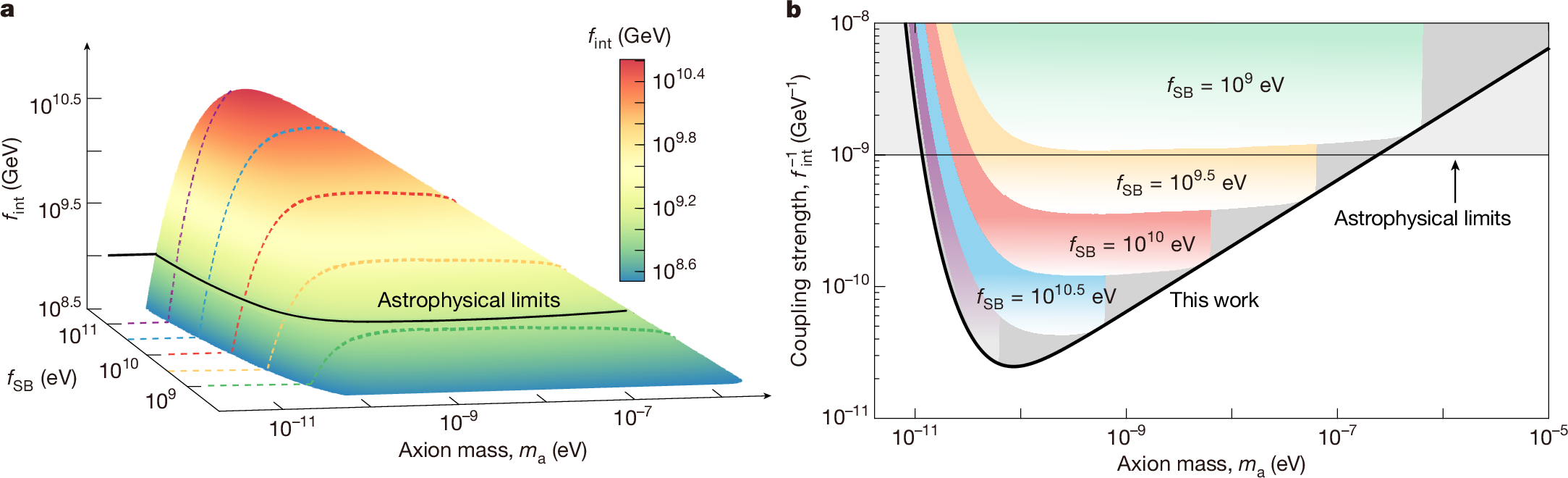
- •Hyperpolarized noble-gas spins enhance sensitivity to ~10^-6 rad, setting constraints on axion-nucleon coupling from 10 peV to 0.2 μeV.
- •The results exceed astrophysical observation constraints under different model assumptions, stimulating further beyond-Standard Model searches.
Tags
Abstract
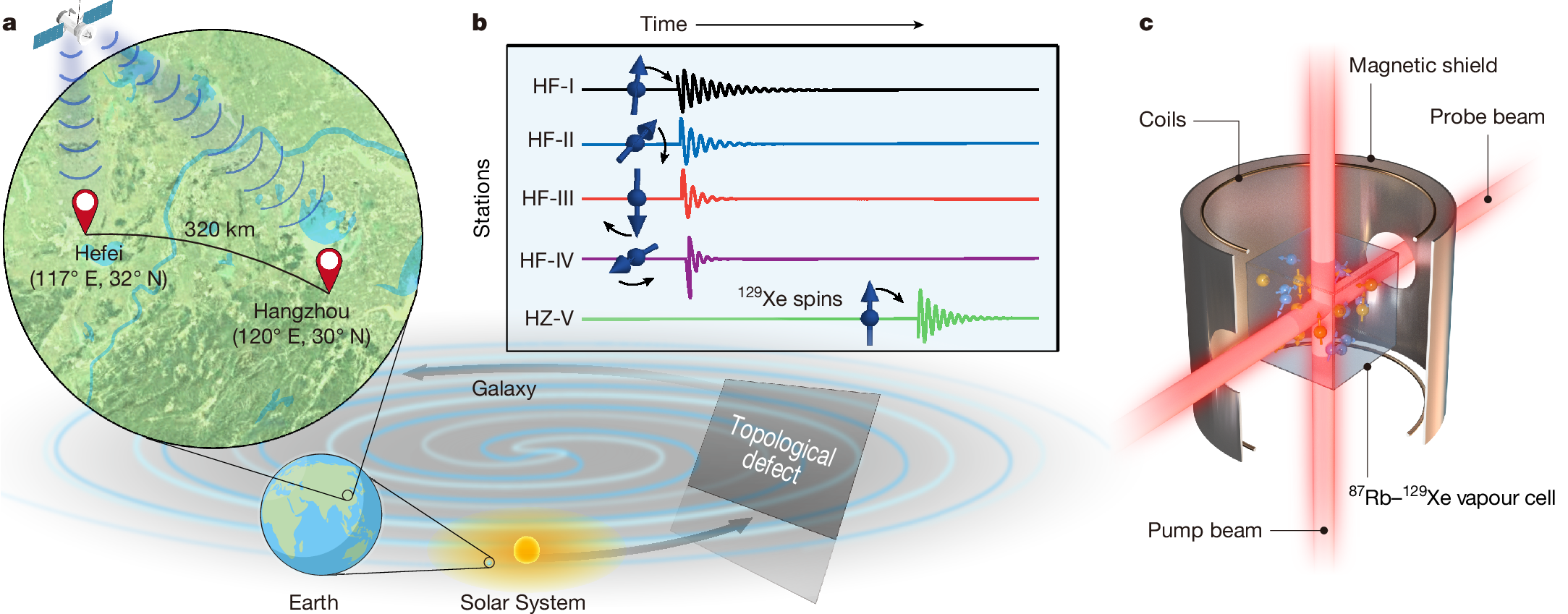
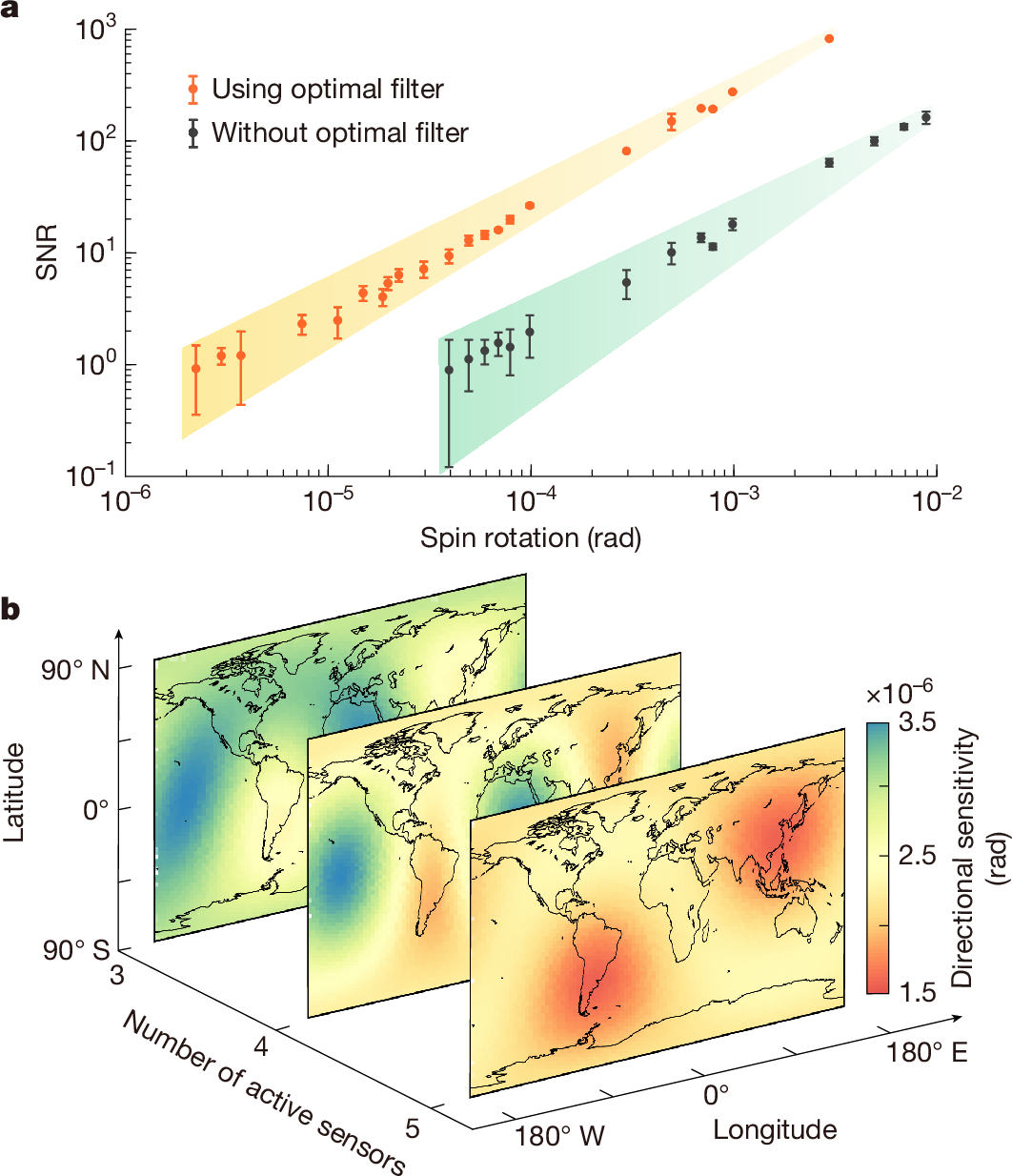
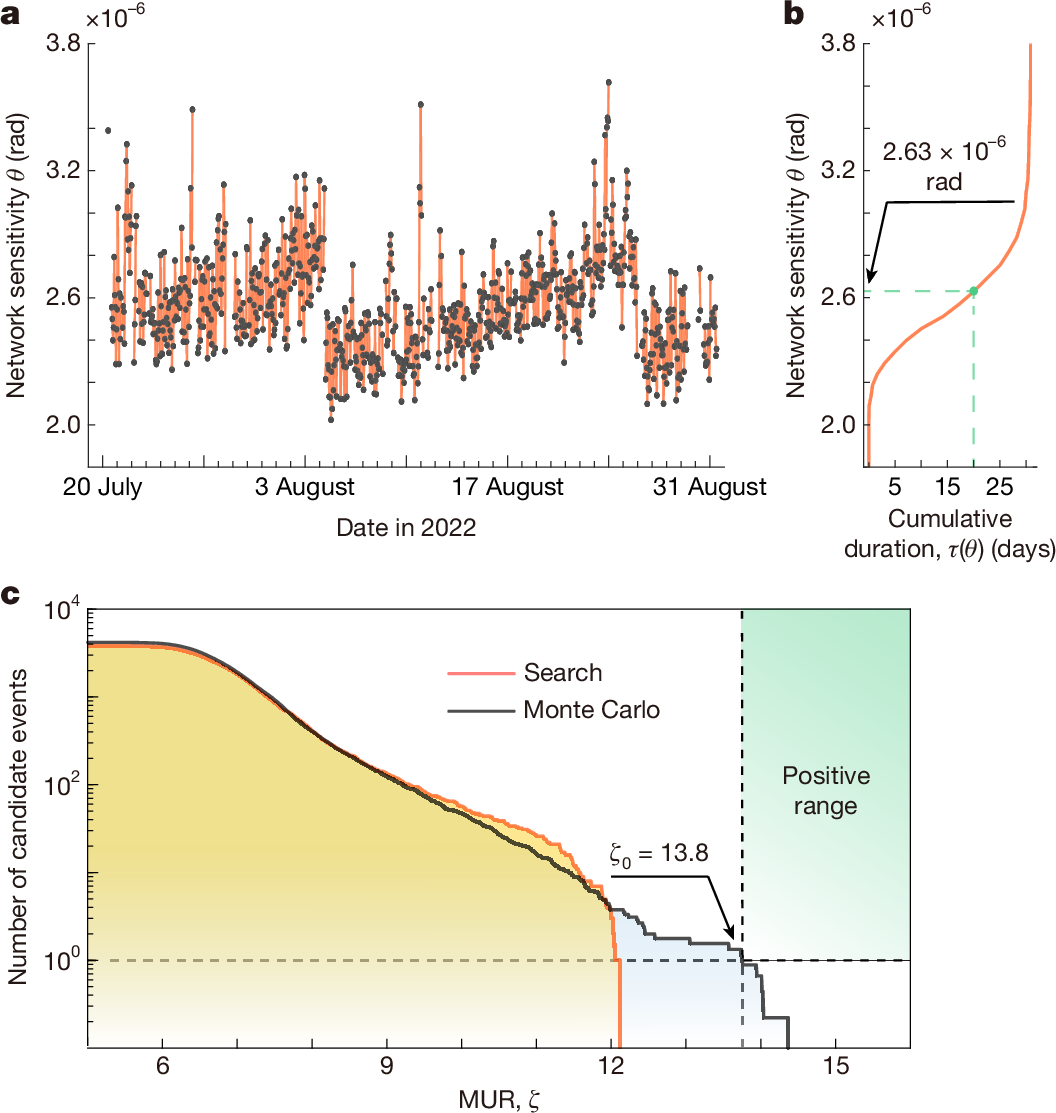
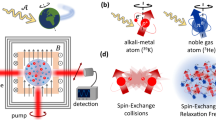
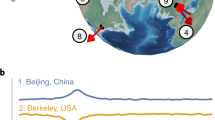
Ultralight axion particles are candidates for dark matter1, conjectured to form stable, macroscopic field configurations in three-dimensional space, resulting in the possible formation of topological defect dark matter2,3,4 (TDM). Exploring their possible existence through a realistic parameter space requires considering interactions that extend beyond the constraints imposed by astrophysical observations of stellar cooling processes5. Here we report the outcome of an experiment that monitors possible transient rotations of polarized spins, which could be induced by the interaction with topological defects, carried out by correlating five noble-gas laboratory set-ups located in two cities. Amplification and optimal noise filtering in hyperpolarized noble-gas spins greatly enhance the sensitivity to TDM-induced spin rotations, reaching approximately 10−6 rad. Through this, we set constraints on the axion–nucleon coupling across an axion mass range from 10 peV to 0.2 μeV, achieving 4.1 × 10¹⁰ GeV at 84 peV. These values exceed known constraints imposed by astrophysical observations, although these are obtained under different model assumptions. Our approach could further stimulate broad beyond-Standard Model physics searches, such as transient axion waves, axion stars, axion strings and Q-balls.
Access Nature and 54 other Nature Portfolio journals
Get Nature+, our best-value online-access subscription
$32.99 / 30 days
cancel any time
Subscribe to this journal
Receive 51 print issues and online access
$199.00 per year
only $3.90 per issue
Buy this article
- Purchase on SpringerLink
- Instant access to the full article PDF.
USD 39.95
Prices may be subject to local taxes which are calculated during checkout
Search for axion-like dark matter with spin-based amplifiers
Constraints on axion-like dark matter from a SERF comagnetometer
Search for topological defect dark matter with a global network of optical magnetometers
Data availability
Source data for the main figures are provided with this paper. Further data and code generated during the study are available from the corresponding authors on request.
References
Bertone, G. & Hooper, D. History of dark matter. Rev. Mod. Phys. 90, 045002 (2018).
Pospelov, M. et al. Detecting domain walls of axionlike models using terrestrial experiments. Phys. Rev. Lett. 110, 021803 (2013).
Afach, S. et al. Search for topological defect dark matter with a global network of optical magnetometers. Nat. Phys. 17, 1396–1401 (2021).
Derevianko, A. & Pospelov, M. Hunting for topological dark matter with atomic clocks. Nat. Phys. 10, 933–936 (2014).
Buschmann, M., Dessert, C., Foster, J. W., Long, A. J. & Safdi, B. R. Upper limit on the QCD axion mass from isolated neutron star cooling. Phys. Rev. Lett. 128, 091102 (2022).