Low-power integrated optical amplification through second-harmonic resonance
TL;DR
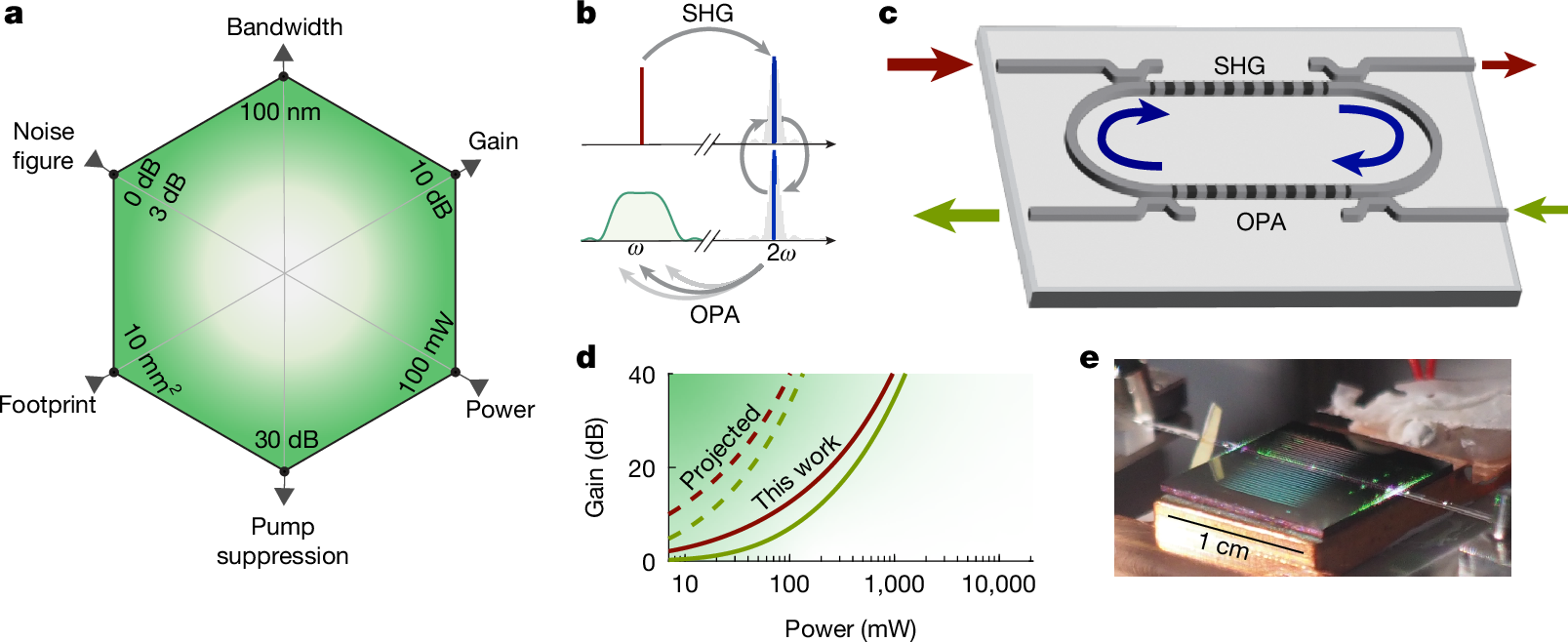
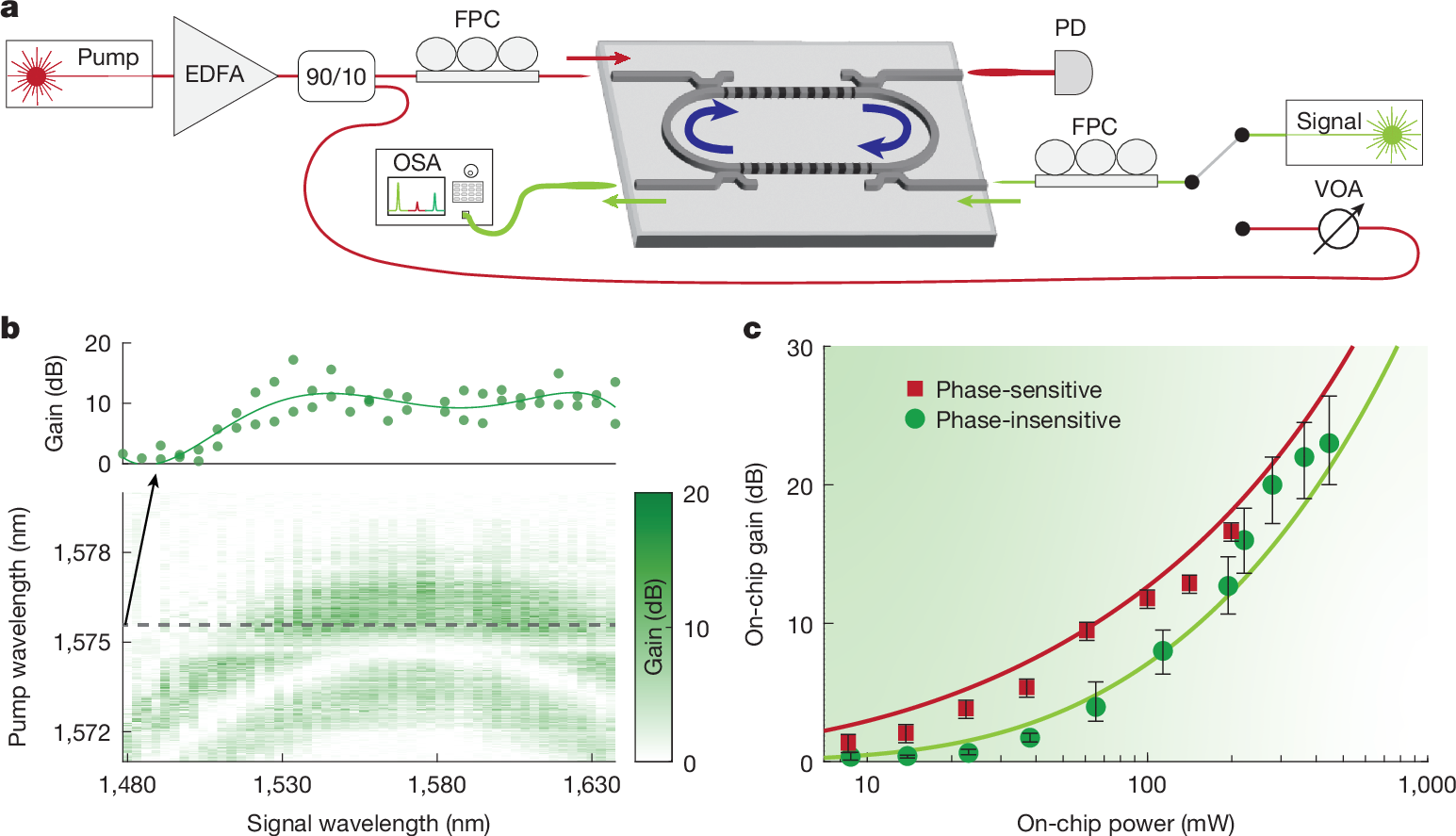
Researchers demonstrate an integrated optical parametric amplifier on thin-film lithium niobate with >17 dB gain using <200 mW input power, a tenfold improvement. The second-harmonic-resonant design enhances efficiency and enables near-quantum-limited noise over 110 nm, advancing on-chip photonics.
Key Takeaways
- •Achieved >17 dB gain with <200 mW input power, a tenfold improvement over previous optical parametric amplifiers.
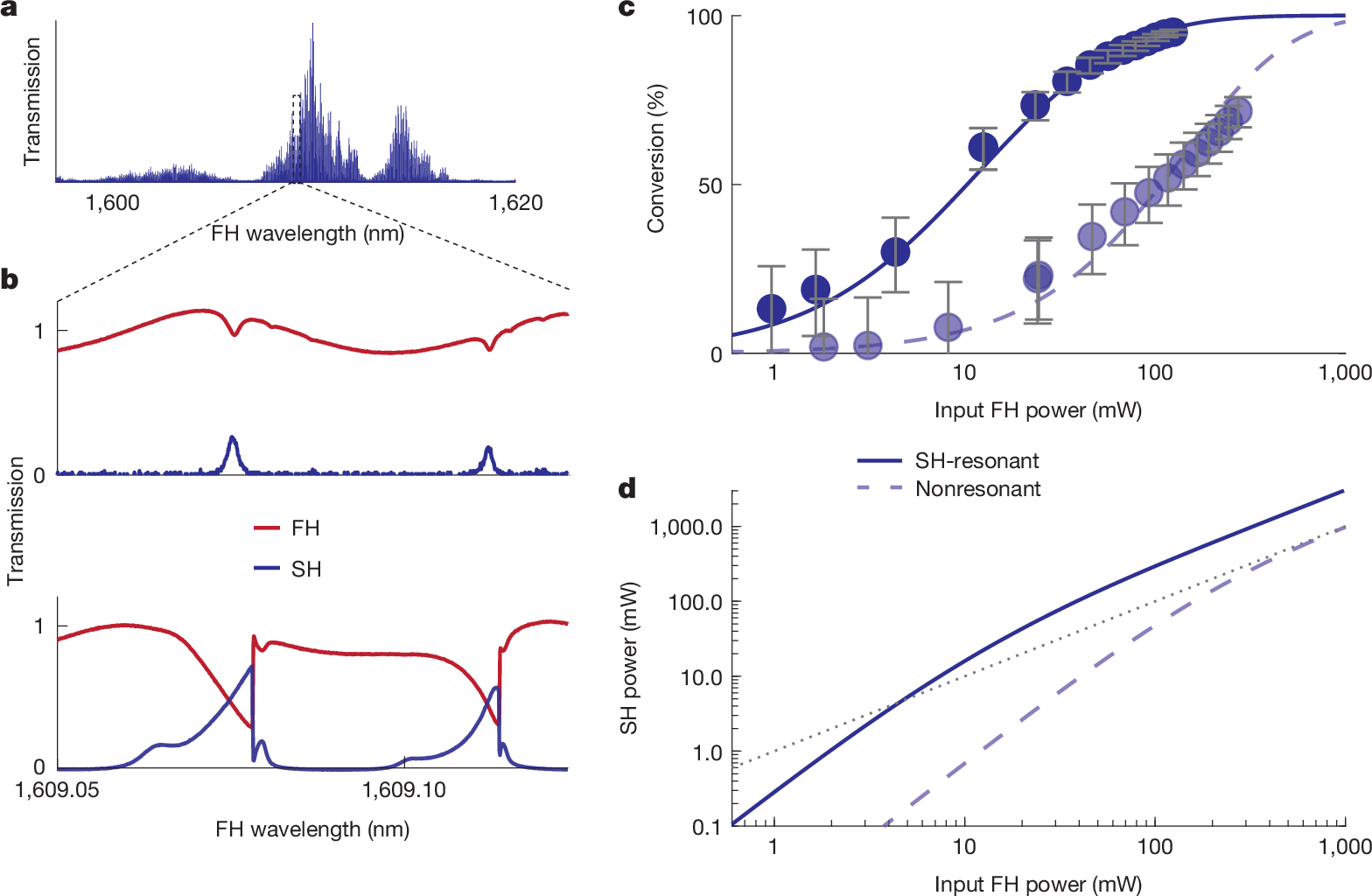
- •Second-harmonic-resonant design boosts pump generation efficiency to 95% and increases effective pump power through recirculation.
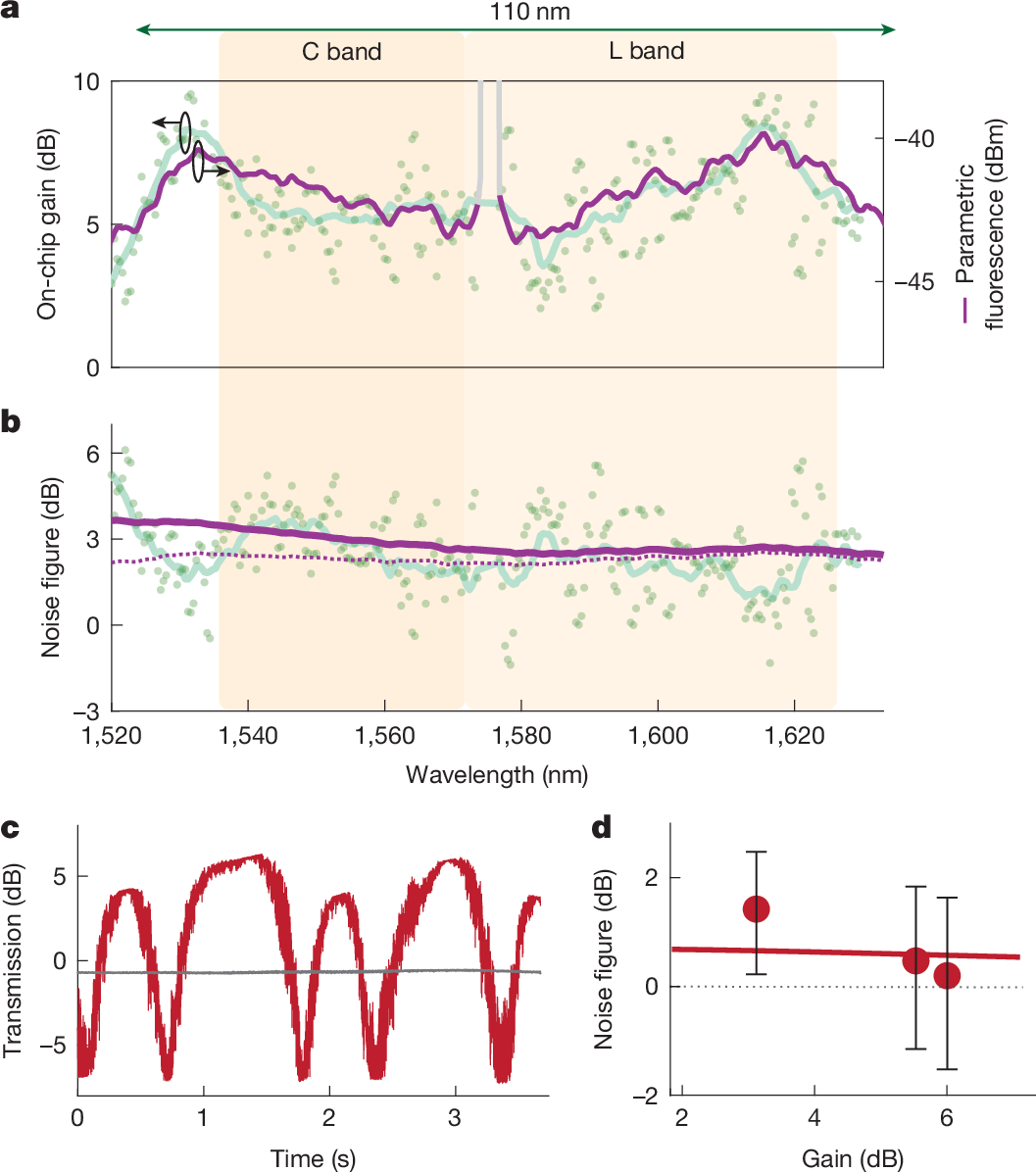
- •Demonstrated flat near-quantum-limited noise performance over a 110 nm bandwidth.
- •Enables practical on-chip optical parametric amplifiers for quantum and classical photonics applications.
Tags
Abstract
Optical amplifiers are fundamental to modern photonics, enabling long-distance communications1, precision sensing2,3 and quantum information processing4,5. Erbium-doped amplifiers dominate telecommunications but are restricted to specific wavelength bands1,6, whereas semiconductor amplifiers offer broader coverage but suffer from high noise and nonlinear distortions7. Optical parametric amplifiers (OPAs) promise broadband, quantum-limited amplification across arbitrary wavelengths8. However, their miniaturization and deployment have been hampered by watt-level power requirements. Here we demonstrate an integrated OPA on thin-film lithium niobate that achieves >17 dB gain with <200 mW input power—an order of magnitude improvement over previous demonstrations. Our second-harmonic-resonant design enhances both pump generation efficiency (95% conversion) and pump power utilization through recirculation, without sacrificing bandwidth. The resonant architecture increases the effective pump power by nearly an order of magnitude compared with conventional single-pass designs, while also multiplexing the signal and pump. We demonstrate flat near-quantum-limited noise performance over 110 nm. Our low-power architecture enables practical on-chip OPAs for next-generation quantum and classical photonics.
Access Nature and 54 other Nature Portfolio journals
Get Nature+, our best-value online-access subscription
$32.99 / 30 days
cancel any time
Subscribe to this journal
Receive 51 print issues and online access
$199.00 per year
only $3.90 per issue
Buy this article
- Purchase on SpringerLink
- Instant access to the full article PDF.
USD 39.95
Prices may be subject to local taxes which are calculated during checkout
Ultra-low-power second-order nonlinear optics on a chip
An ultra-broadband photonic-chip-based parametric amplifier
Data availability
The data that support the findings of this study are available from the corresponding authors upon reasonable request.
References
Desurvire, E. Erbium-Doped Fiber Amplifiers: Principles and Applications (Wiley, 1994).
Tse, M. et al. Quantum-enhanced advanced LIGO detectors in the era of gravitational-wave astronomy. Phys. Rev. Lett. 123, 231107 (2019).
Casacio, C. A. et al. Quantum-enhanced nonlinear microscopy. Nature 594, 201–206 (2021).
Madsen, L. S. et al. Quantum computational advantage with a programmable photonic processor. Nature 606, 75–81 (2022).
Kawasaki,