Bandwidth-tuned Mott transition and superconductivity in moiré WSe2
TL;DR
Researchers use twist-angle-tuned moiré WSe2 bilayers to study high-Tc superconductivity, observing a Mott transition and superconducting domes near the insulator. This tunable system provides insights into strong correlations and superconductivity mechanisms.
Key Takeaways
- •Moiré WSe2 bilayers, tunable via twist angle, serve as a controllable platform for studying high-Tc superconductivity and Mott transitions.
- •Superconductivity emerges adjacent to the Mott insulator at ν=1, with highest Tc occurring near the transition point, indicating strong correlation as key.
- •The system exhibits high-Tc phenomenology including antiferromagnetic insulators, superconducting domes, and strange metals, similar to cuprates.
- •Electrical gating and magneto-optical measurements map the phase diagram, revealing intricate competition between orders in the moderate correlation regime.
- •This work establishes moiré WSe2 as a quantum simulator for the Hubbard model, aiding in understanding and designing new high-Tc materials.
Tags
Abstract
The emergence of high-transition-temperature (Tc) superconductivity in strongly correlated materials remains the main unsolved problem in physics. High-Tc materials, such as cuprates, are generally complex and not easily tunable, making theoretical modelling difficult. Although the Hubbard model—a simple theoretical model of interacting electrons on a lattice—is believed to capture the essential physics of high-Tc materials1,2,3,4,5, obtaining accurate solutions of the model, especially in the relevant regime of moderate correlation, is challenging6. The recent demonstration of robust superconductivity in moiré WSe2 (refs. 7,8), in which low-energy electronic bands can be described by the Hubbard model and are highly tunable9,10,11, presents a new platform for studying the high-Tc problem. Here we tune moiré WSe2 bilayers to the moderate correlation regime through the twist angle and map the phase diagram around one hole per moiré unit cell (ν = 1) by electrostatic gating and electrical transport and magneto-optical measurements. We observe a range of high-Tc phenomenology, including an antiferromagnetic insulator at ν = 1, superconducting domes on electron and hole doping, and unusual metallic states such as strange metals12,13,14. Twist-angle dependence studies further show that the highest Tc always occurs adjacent to the Mott transition3,15. Our results indicate strong correlation as the key to superconductivity in moiré WSe2 and establish a new material system for studying high-Tc superconductivity in a controllable manner.
Superconductivity in twisted bilayer WSe2
A tunable bilayer Hubbard model in twisted WSe2
Correlated states controlled by a tunable van Hove singularity in moiré WSe2 bilayers
Main
The Hubbard model, describing electrons hopping on a lattice with a hopping amplitude t between neighbouring sites and an on-site electron–electron repulsion U, provides a simplified representation of high-temperature superconductors1,2,3,4,5. The electron hopping leads to a finite bandwidth W (=8t and 9t, respectively, for square and triangular lattices). In cuprates, W and U are comparable3,5, indicating that these materials are in the moderate correlation regime and are near a Mott transition from an insulator to a metal3,15. The idea of doping a Mott insulator for superconductivity has been extensively studied for decades1,2,3,4,5. Although the nature of the superconducting state itself has been qualitatively understood, a full understanding of the rich phase diagram remains unknown because accurately solving the Hubbard model in the moderate correlation regime, in which different orders intricately compete in the ground state, is difficult6. Studying high-transition-temperature (Tc) phenomenology in a tunable quantum system16,17 may, therefore, shed light on how superconductivity emerges and pave the way for designing new high-Tc materials.
Transition metal dichalcogenide (TMD) moiré heterobilayers, such as WSe2/WS2, are established quantum simulators of the two-dimensional (2D) triangular lattice Hubbard model18,19. For small twist angles, the moiré period (consequently U/W) is largely determined by the lattice mismatch in heterobilayers. Studies so far have focused on the strong correlation limit, and superconductivity has not yet been realized. The recent demonstration of robust superconductivity in twisted WSe2 (tWSe2) homobilayers7,8, for which U/W can be readily tuned by the twist angle20,21,22, provides the possibility of exploring the superconducting phase diagram in the moderate correlation regime23,24,25. Here, we report the phase diagram of tWSe2, focusing on twist angle around 4.6°, for which U and W are comparable. The transport characteristics, supplemented by magnetic susceptibility, reveal rich high-Tc phenomenology, including an antiferromagnetic (AF) insulator, superconducting domes and strange metals. The phase diagrams for both electron and hole doping of the AF insulator and their continuous evolution as the system undergoes a band-structure-tuned Mott transition can be obtained using a single dual-gated device (Fig. 1a).
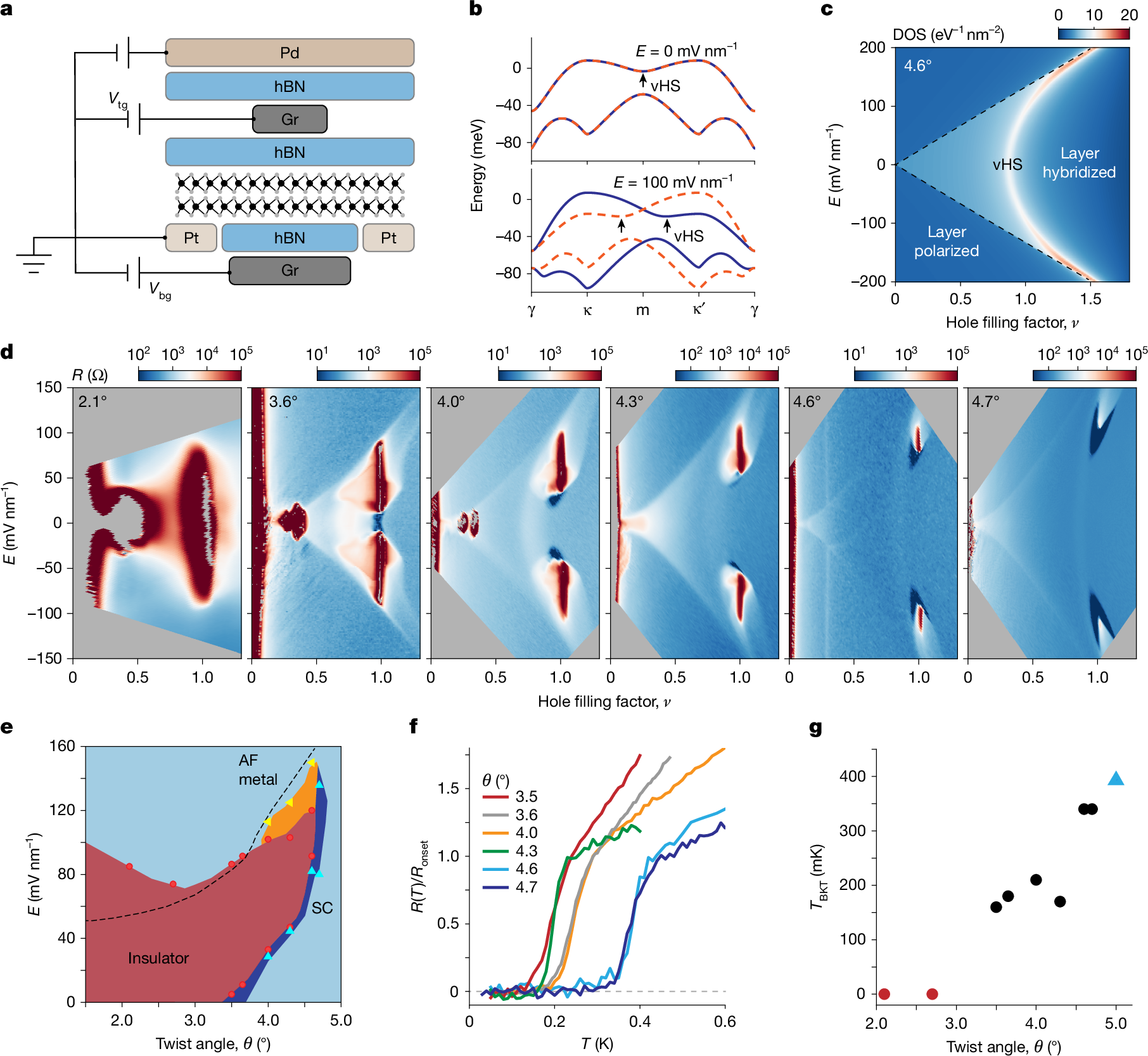
a, Schematic side view of dual-gated transport devices. The tWSe2 sample is contacted by platinum (Pt) electrodes and controlled by voltages Vtg and Vbg applied on the hBN/Gr gates. The Pd contact and split gates turn on the Pt contacts and turn off the parallel channels, respectively. b, Topmost moiré valence bands for the K-valley state (blue solid line) and K′-valley state (orange dashed line) at E = 0 mV nm−1 (top) and 100 mV nm−1 (bottom). Arrows mark the vHS. c, Electronic DOS as a function of ν and E. The vHS with high DOS shifts towards higher ν with increasing E. Results in b and c are from the continuum model calculations for 4.6° tWSe2. d, Resistance as a function of ν and E at 50 mK in tWSe2 with twist angle varying from 2.1° to 4.7°. e, θ–E phase diagram at ν = 1 constructed from experiment (symbols). Red, correlated insulator; dark blue, superconductor (SC); yellow, AF metal; light blue, metal. f, Superconducting transitions (for the highest Tc) for different twist angles. g, Highest TBKT (Berezinskii–Kosterlitz–Thouless transition temperature) versus θ. The blue triangule is from ref. 8. Dashed lines in c and e denote the boundary between the layer-hybridized and layer-polarized regions.
Twist angle effects
Monolayer WSe2 is a triangular lattice semiconductor with its valence band maxima located at the K and K′ points of the hexagonal Brillouin zone (BZ)19. A triangular moiré lattice with period \({a}_{{\rm{M}}}=\frac{a}{\sqrt{2(1-\cos \theta )}}\) is formed when two layers are stacked with a relative twist angle θ, where a = 0.33 nm is the monolayer lattice constant. Figure 1b,c shows, respectively, the band structure and density of states (DOS) as a function of hole filling factor (ν) and vertical electric field (E) for 4.6° tWSe2 from the continuum model calculations (Methods). The K-valley states of the top and bottom layers fold, respectively, onto the κ and κ′ valleys of the moiré BZ, which are swapped for the K′-valley states9,10,11,26,27. The bands from the two layers hybridize and generate a saddle point at which they intersect. The hybridized bands remain spin degenerate for small θ because of spin–valley locking in monolayer TMDs19 (Fig. 1b, top). Application of a finite E-field places the two layers at different potentials and lifts the spin degeneracy10 (Fig. 1b, bottom); it also shifts the van Hove singularity (vHS) with a diverging DOS continuously from ν < 1 to ν > 1 (Fig. 1c). Sufficiently large fields eventually polarize the holes to one of the layers. Theoretical studies showed that the topmost moiré valence band, if nontopological, can be described by the triangular lattice Hubbard model with an additional E-dependent spin–orbit coupling term9,10,11. This applies to samples with θ ≥ 4° (ref. 28).
Figure 1d shows resistance R as a function of E and ν at temperature T = 50 mK in a series of dual-gated tWSe2 devices with twist angle increasing from 2.1° to 4.7° (see Methods for details on the device fabrication and characterizations; see Extended Data Fig. 1 for a device image; see Extended Data Fig. 2 for the determination of the moiré density). The resistance maps qualitatively agree with the DOS map in Fig. 1c, including a layer-hybridized region centred at E = 0 and a vHS with enhanced resistance due to the large DOS. Not captured by the band theory are the insulating states at fractional fillings of the first moiré band, ν = 1, 1/3 and 1/4, which exhibit strong electron correlations. As the twist angle increases, the correlated insulators gradually melt and are indiscernible at 4.7°. This is expected because the correlation effects weaken as the moiré period decreases. The E-field dependence of the ν = 1 state is further enriched by the presence of the vHS, which enhances the correlation effects7,8,10,20,29 (see Methods for further discussions).
Superconductivity starts to emerge near θ = 3.5–3.6° and persists over a range of twist angle up to about 5° (beyond which superconductivity is expected to fade away together with the moiré effect). Rather than following the vHS, the most robust superconducting state always appears right next to the ‘melting point’ of the ν = 1 insulator on the low E-field end in the layer-hybridized region. The optimal Tc increases with θ (Fig. 1f,g). At ν = 1, superconductors occupy a narrow strip (dark blue) in the (θ–E) phase diagram (Fig. 1e). Both θ and E can induce an insulator-to-superconductor transition. Theoretical studies examined the phase diagram in the small and large twist angle limits (large and small U/W)30,31,32,33,34,35,36,37,38,39,40,41,42,43,44,45. The moderate U/