Bottom-Up Synthesis of Molecular Nanodiamond from Nanographene
Abstract
Nanodiamonds hosting colour centres are promising building blocks for quantum technologies, enabling advances in quantum computation1,2, nanoscale NMR spectroscopy3–6, single-spin magnetometry7,8, wide-field quantum imaging9 and single-photon sources10,11. However, the controlled bottom-up synthesis of ultrasmall and structurally uniform nanodiamonds has remained a major challenge, with existing methods producing heterogeneous materials that vary in size, morphology, impurity content and defect quality. Here we show that well-defined, hydrogen-terminated molecular nanographenes serve as chemically confined precursors for high-pressure, high-temperature synthesis of ultrasmall (3–4 nm), monodisperse and highly crystalline molecular nanodiamonds (m-NDs) with only a single sp² surface reconstruction and produced on a milligram scale. The same bottom-up platform also enables a two-component strategy for incorporating silicon- and germanium-based colour centres during synthesis, yielding SiV⁻ and GeV⁻ emitters without ion implantation, irradiation or post-treatment. Because the nanographene precursor defines both the confined carbon framework and the hydrogen content, this approach provides intrinsic, precursor-level control over nanodiamond size and composition, particularly in the low-nanometre regime relevant for biological and quantum sensing. Molecular nanographenes, ultralarge polycyclic aromatic hydrocarbons, therefore establish a scalable and modular route to high-quality molecular and fluorescent nanodiamonds and offer a general design principle for tailored quantum materials and nanoscale devices.
Access Nature and 54 other Nature Portfolio journals
Get Nature+, our best-value online-access subscription
$32.99 / 30 days
cancel any time
Subscribe to this journal
Receive 52 print issues and online access
$199.00 per year
only $3.83 per issue
Prices may be subject to local taxes which are calculated during checkout
Molecular geometry specific Monte Carlo simulation of the efficacy of diamond crystal formation from diamondoids

Plastic deformation in nanodiamonds
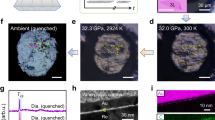
Experimental demonstration and transformation mechanism of quenchable two-dimensional diamond
Author information
These authors contributed equally: Jiaxu Liang, Christopher P. Ender
Authors and Affiliations
Max Planck Institute for Polymer Research, Ackermannweg 10, Mainz, Germany
Jiaxu Liang, Christopher P. Ender, Nancy C. Forero-Martinez, Jingyi Liu, Xin Yang, Yizhi Liu, Tobias Eklund, Kilian Lee Gallo, Rüdiger Berger, Katrin Amann-Winkel, Manfred Wagner, Klaus Müllen, Gábor Csányi, Robinson Cortes-Huerto, Yingke Wu & Tanja Weil
Institute of Geosciences, Goethe University Frankfurt, Altenhöferallee 1, Frankfurt, Germany
Jiaxu Liang
Institut für Physik, Johannes Gutenberg-Universität Mainz, Mainz, Germany
Nancy C. Forero-Martinez, Tobias Eklund & Katrin Amann-Winkel
Engineering Laboratory, University of Cambridge, Trumpington St, Cambridge, UK
Ilyes Batatia & Gábor Csányi
Institute for Quantum Optics and Center for Integrated Quantum Science and Technology (IQST), Ulm University, Albert-Einstein-Allee 11, Ulm, Germany
Raul Gonzalez Brouwer, Lev Kazak, Rémi Blinder, Fabian Rohmann, Andreas Tangemann, Alexander Kubanek & Fedor Jelezko
Department of Colloid Chemistry, Max Planck Institute of Colloids and Interfaces, Research Campus Golm, Am Mühlenberg 1, Potsdam, Germany
Leonardo Cancellara
INM-Leibniz Institute for New Materials, Campus D2 2, Saarbrücken, Germany
Nadezda V. Tarakina
Department of Materials Science and Engineering, Saarland University, Saarbrücken, Germany
Nadezda V. Tarakina
Institute for X-Ray Physics, University of Göttingen, Friedrich-Hund-Platz 1, Göttingen, Germany
Mangalika Sinha & Sarah Köster
Deutsches Elektronen Synchrotron (DESY), Notkestraße 85, Hamburg, Germany
Shrikant Bhat & Robert Farla
- Jiaxu Liang
Search author on:PubMed Google Scholar
- Christopher P. Ender
Search author on:PubMed Google Scholar
- Nancy C. Forero-Martinez
Search author on:PubMed Google Scholar
- Ilyes Batatia
Search author on:PubMed Google Scholar
- Jingyi Liu
Search author on:PubMed Google Scholar
- Xin Yang
Search author on:PubMed Google Scholar
- Raul Gonzalez Brouwer
Search author on:PubMed Google Scholar
- Lev Kazak
Search author on:PubMed Google Scholar
- Rémi Blinder